


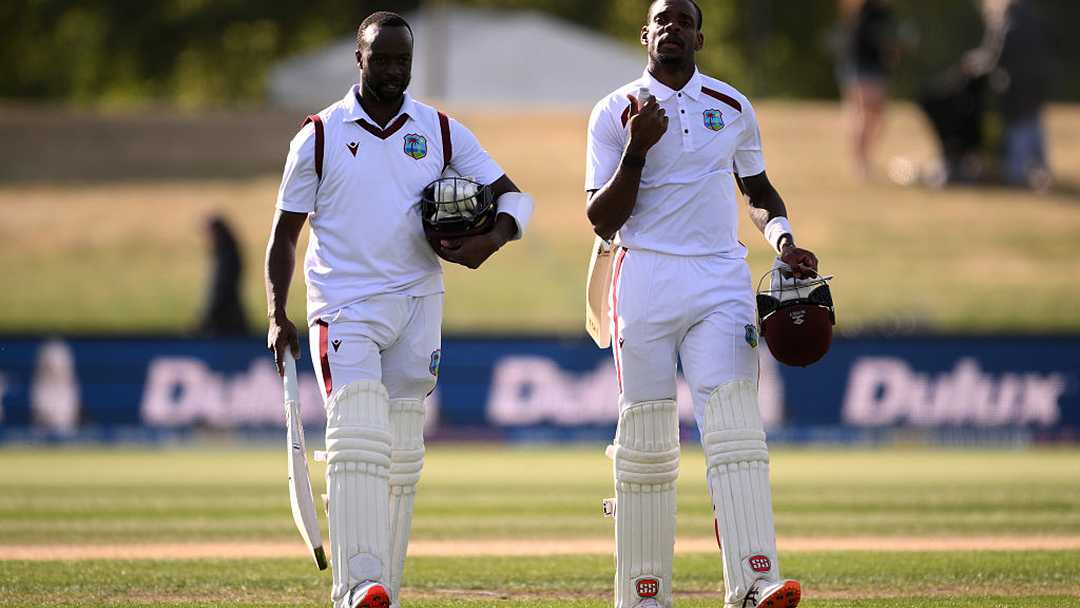
Justin Greaves 202* leads West Indies to improbable draw in Christchurch
There is a particular kind of Test match that starts ordinary, meanders into the desperate, and ends somewhere between the miraculous and the bloody-minded. This was one of those. Justin Greaves made an incredible 202* on the final day of the Christchurch Test, an innings that began as rescue and ended as refusal, and West Indies – who had been 100 for 2 and then 167 all out in the first innings, who were asked to make 530 or survive two days – drew a Test match that by all logic and recent history should have been lost much earlier.
The numbers tell you what happened. Greaves and No.8 Kemar Roach battled undefeated for 409 balls, a 180-run stand of pure defiance, a record for the seventh wicket surpassing the efforts of Sachin Tendulkar and Manoj Prabhakar from 35 years ago. At 163.3 overs, this was the longest fourth innings for the West Indies since 1930. Their total of 457 for 6 is the highest fourth-innings total ever in a time-bound total. Greaves batted 388 balls, 201 of those in a stand of 196 with Shai Hope, who himself got a hundred while battling an eye infection.
But numbers can't quite capture the texture of the way this game unfolded on the final day, the way improbability gave way to possibility and then, briefly, to something wilder. At 398 for 6, needing 132 from 33 overs with four wickets standing, there was a moment when the outlandish seemed almost reasonable. Chase it down? Why not? But Greaves and Roach chose sense over theatre, hunkered down, and batted New Zealand into exhaustion.
By this stage, New Zealand were cooked. Two days of toil will do that. Two frontline seamers – Matt Henry, Nathan Smith – gone to injury will do that. All three reviews burned before the final session will definitely do that. They were left to appeal and hope, appeal and watch the umpire's head shake, appeal again because what else was there to do?
On another day, with a review or two in hand, one of the two chances Michael Bracewell created in the final session – an LBW and a caught behind against Roach – results in a dismissal and opens up the tail and this becomes a very different story. But this day belonged to fortune meeting guts. Both sides had the latter – Bracewell bowled 55 overs of off-spin on a fifth day track offering little, while the two standing seamers, Zakary Foulkes and Jacob Duffy, sent down 76 second-innings overs between them and still had something left in the tank when the third new ball was available with four overs remaining. West Indies just had more of the former.
It didn't seem that way at the start of the final day, when 90 overs stretched out like an eternity even against a depleted attack. But Hope and Greaves, overnight centurion and overnight partner, saw off the first hour without incident and added 55 runs for good measure. The kind of batting that makes you think, well, maybe. Then came the third over after drinks, and the maybe disappeared. Duffy's short-ball ploy finally found reward. After 239 balls of concentration, Hope's pull shot hung in the air just long enough for Tom Latham to dive and pouch it behind the stumps.
From the other end, Foulkes trapped Tevin Imlach LBW shortly after with a nip-backer and suddenly West Indies were staring at seven overs until Lunch plus two full sessions with victory 253 runs away and four wickets standing. The immediate concern, though, was that Greaves sat on 97, three short of a second Test century. He got there in the first over after Lunch, whipping Bracewell past square leg for a single. It was momentary relief, but then he was back on his rescue mission.
What followed was New Zealand trying everything and nothing quite working. They burned a review on Roach, an LBW appeal off Bracewell where the ball pitched fractionally outside leg. They also dropped Roach on 30, then again on 47, both times off Bracewell, both times costly. The partnership grew and 29 overs between Lunch and Tea, 104 runs added, and by the time the final session began, New Zealand's body language told you everything. Fielders threw sloppily. Shoulders sagged. The kind of weariness that comes from knowing you've done everything right except the one thing that matters.
The final session should have been theirs. Roach, on 53 after his maiden Test fifty in a 16-year career, was beaten by Bracewell's turn while stretching forward. Umpire Alex Wharf gave it not out. New Zealand would have won the review. They didn't have one. Same score, Roach feathered an edge to the keeper. Not given. No reviews left.
Roach stayed on 53 for 72 balls, deadbatting everything, while New Zealand fed Greaves the single early in overs, trying to isolate the tail-ender. But Roach wasn't playing like a tail-ender. He was playing like an 85-Test veteran who understood what this meant. Greaves began cramping in the final ten overs, all that effort, all that tension finally manifesting. With a West Indian win out of the question, New Zealand crowded the bat, attacked with close-in fielders, threw everything they had left. On another day, it works. On this day, the opposition refused to budge.
Brief scores: New Zealand 231 & 466/8 decl vs West Indies 167 & 457/6 (Justin Greaves 202*, Shai Hope 140, Kemar Roach 58*; Jacob Duffy 3-122) Match Drawn
Related Posts
 Islamabad United vs Peshawar Zalmi,7th Match,Pakistan Super League 2026,2026-03-31 15:00 GMT
Punjab Kings vs Gujarat Titans,4th Match,Indian Premier League 2026,2026-03-31 15:00 GMT
Islamabad United vs Peshawar Zalmi,7th Match,Pakistan Super League 2026,2026-03-31 15:00 GMT
Punjab Kings vs Gujarat Titans,4th Match,Indian Premier League 2026,2026-03-31 15:00 GMT
 Redback-to-back: With Shield glory, South Australia become pride of state, again