


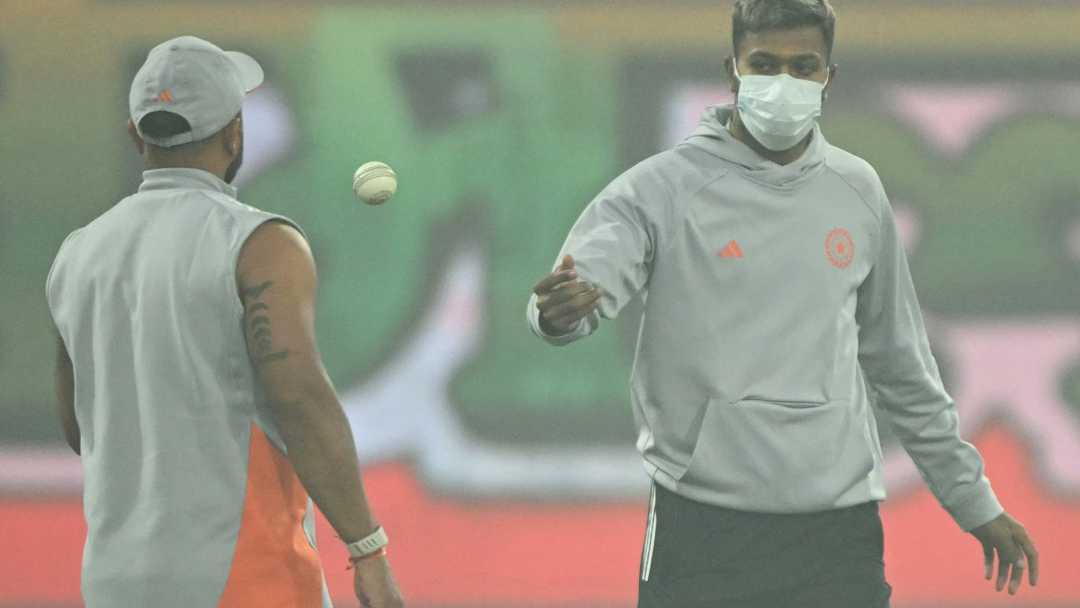
Fans lost in Lucknow's haze
As Lucknow's disappointed fanbase left the Ekana Cricket Stadium following the abandonment of the T20I between India and South Africa, a man in his late 30s looked more vexed than most. Boarding a shared auto-rickshaw, he poured out his reason for being stressed.
"Aaj ghar jaakar bahut daant padni hai biwi aur bachchon se. Do hazaar rupaye barbaad ho gaye (My wife and kids are going to scold me. I wasted two thousand rupees on this match ticket)," he said.
As his fellow riders tried to calm him down, explaining that the money would be refunded since not a single delivery was bowled, the man countered, "I had to buy this ticket in black from a stranger. There were no tickets available. I won't get a penny in return."
It wasn't just the money. He had skipped a day at work and travelled nearly 700 kms (one way) from Machi Talab in Munger, Bihar to watch the match.
Was it a crime of love, circumstances or personal choices that an Indian cricket fan bought a match ticket from the black market at INR 2000, travelled more than 1300 km to sit in the stands for four hours breathing 'hazardous' air, and did not get to watch a single ball?
On Wednesday evening, as a dense cloud of fog settled around the stadium, it was obvious that a cricket match was unlikely to happen. To provide some entertainment to the half-full stadium, the DJ played the popular Bollywood song 'London Thumakda'. The line 'dikhta hai sab kuch clear maahiya tere saamne (everything seems clear in front of you)' seemed ironic.
Soon enough, India's players ended their warm-up routines and left the field. Silent visuals of Hardik Pandya wearing a mask to counter the air quality index (AQI) of 490 offered the required explanation.
The conditions were clearly unfeasible. Yet when the last inspection took place around 9.25pm and the match was called off, more than half the stadium was still full. After all, international men's cricket had come to Lucknow for the first time in more than two years.
That the match was abandoned due to 'excessive fog' came as no surprise. For nearly a decade now, domestic matches in north India have been impacted by fog, especially in late December and early January.
The most logical question then is: why were three out of the five matches in the series scheduled in north India, when it has been clear for a decade that air quality is problematic in the region at this time of year?
The most honest answer, in some ways, came through an exchange between BCCI vice-president Rajiv Shukla and fellow Congressman Shashi Tharoor outside parliament: rotation policy. It's a part of the unofficial agreement between the board and the state associations.
In a tropical country like India, which hosts a massive volume of cricket, venue allotment is a complex process. Monsoons hamper the south western regions from June to September. December and January become challenging for north India, and the summer months are reserved for IPL.
The BCCI also has to factor in cultural events, logistical limitations, and ensuring pitches remain fresh for high-profile matches.
Cricket has not been played in front of crowds at Bengaluru's M Chinnaswamy Stadium following a stampede earlier this year, while Chennai's Chepauk is undergoing renovation. Mumbai's DY Patil is set to host the Women's Premier League early next year, while Baroda's BCA stadium will host WPL games as well as an ODI.
Rajkot, Nagpur, Guwahati, Visakhapatnam, Thiruvananthapuram, Raipur and Indore are all scheduled to host international men's cricket next month. Delhi, Kolkata and Mumbai's Wankhede Stadium are scheduled to host men's T20 World Cup games.
If the 'rotation policy' is to be followed, where else could the games against South Africa have gone if not north India?
The BCCI employs a manual process to allot games. To be fair, the board does a reasonable job to ensure the functioning of over 2000 domestic games every season. The vast land mass requires state associations to step in with their inputs on local factors. In some ways, it's a reminder that three associations in north India were convinced they could pull off an international match under lights. Two of them could.
For the common fan, watching Indian cricket from the stadium has been an exercise in endurance for a while. Several international stadiums are outside city limits. Ticket prices are steep, and getting affordable tickets is often out of bounds. Once inside, access to water, reasonably-priced food, clean seats and washrooms is a challenge.
Problems are plenty. The administrative ingenuity has worked to keep the vast network of Indian cricket functional, even if chaotic. Unfortunately, it has often come at the cost of fan comfort. But for many, the long travel, expensive ticket, and high AQI don't matter. This passion has often driven people beyond their means, ensuring demand for tickets far outweighs supply.
It would be unwise for the BCCI to take this for granted. Any business that treats its customers like second-class citizens can expect troubles once that customer base wakes up to the reality.
Hopefully, the abandoned match in Lucknow has offered the BCCI a reminder, unearthing uncomfortable truths often suppressed by the glamour of the sport.
The next five months of cricketing action—WPL, a T20 World Cup and IPL—has enough power to make Lucknow's abandonment a distant memory. But hopefully, there will be some fixes that show the BCCI is paying attention and wants to treat its fans more respectfully.
The words of assurance came from Shukla in response to Tharoor's argument about the fog-abandoned game: "Aage se dhyaan rakhenge (We will ensure this doesn't repeat in the future)."
Related Posts
 Redback-to-back: With Shield glory, South Australia become pride of state, again
 Shubman Gill and the art of control
 Green to play as pure batter for short period after minor back complaint