


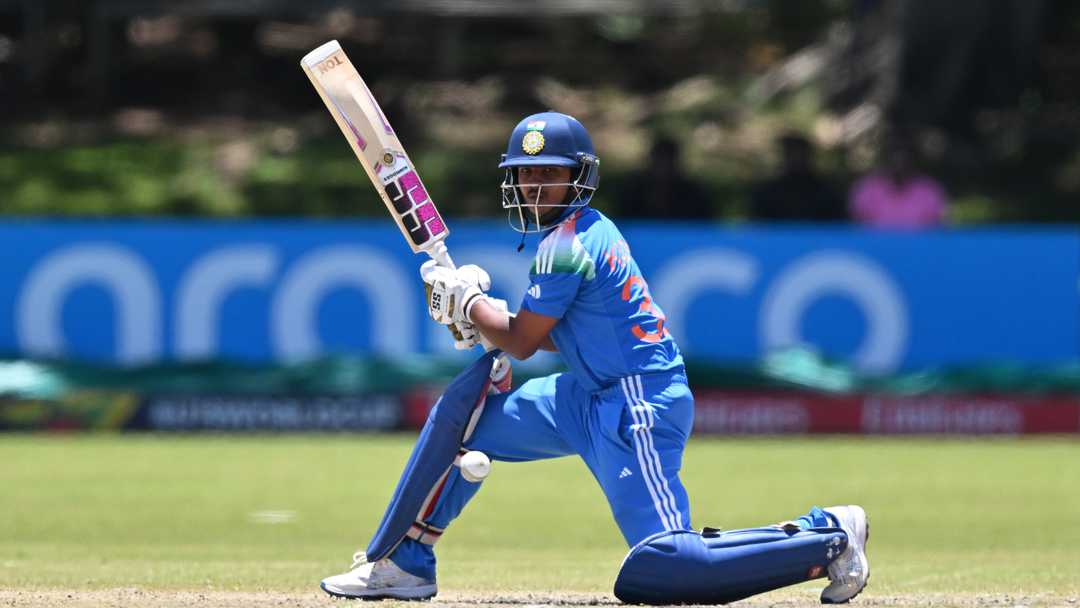
In a city shaped by textbooks, Abhigyan Kundu chose the bat
When Chetan Jadhav, the cricket coach in Navi Mumbai, first saw a five-year-old Abhigyan Kundu take a swipe with a plastic bat, he announced: "Tu mera India player banega."
This optimistic proclamation was not a commentary on the youngster's cricketing skills; he could barely lay the bat on the ball. The proclamation was Jadhav's desperation to find and convince a boy from Navi Mumbai to take his cricketing ambitions seriously. Given his experiences as a coach in the city, Jadhav was convinced that Kundu, a son of two engineering graduates, would leave the sport after a while to focus on academics.
Jadhav had previously hoped that another promising cricketer, Sourabh Patil, would make it to Mumbai's Ranji team. But Patil left his cricket training mid-way to pursue his academic ambitions. Patil became a doctor, and Jadhav a disappointed coach who was unable to come to terms with the limited cricketing ambitions in Navi Mumbai.
Jadhav had trained under Ramakant Achrekar as a wicketkeeper in an intensely-competitive environment in the 1990s, seeing several of his batchmates – including Amol Muzumdar and Sameer Dighe – go on to play at higher levels with great distinction. Such aspirations appeared to be missing in Navi Mumbai, a satellite city of Mumbai.
Planned by Charles Correa in the 1970s to decongest Mumbai, Navi Mumbai may have been a grand project but it failed in one of its primary intents – to unburden Mumbai and shift businesses outside of it. It ended up becoming a dormitory city, where people lived at lower rentals and travelled to Mumbai for work and education. The new city lacked the cricketing culture and history of Mumbai; with limited dreams, it was shaped by middle-class aspirations that put academics before sports to achieve a more comfortable and secure life.
That social pattern didn't sit well with Jadhav, who was on the lookout for serious cricketers. "Mujhe player banana tha (I wanted to train a cricketer), but I only ended up becoming a babysitter coach ever since I moved to Navi Mumbai," recalls Jadhav. "Navi Mumbai is not for khel-kood. Parents would send their kids to me who didn't take their cricket seriously. I had become desperate to find someone because I had given up my job to become a cricket coach. The few kids I found were poor. How could I help them?
"When Sourabh brought Abhigyan to me, I asked him, will he play or will he also end up becoming a doctor or an engineer, like him? Because I had become a babysitter coach to Sourabh, I didn't want to become a babysitter for Abhigyan too. He was after all a son of two engineering graduates, just like Sourabh was a son of two doctors. I was not sure if a family that is into padha-likhai (education), with no background in cricket, would let their child train long hours with me."
Jadhav's scepticism wasn't out of place. For more than half a century since its formation, Navi Mumbai has yet to see the emergence of any cricketer of note. Even for Kundu, when his cricketing potential was witnessing merit, he was swiftly moved from Kopar Khairne's St Mary's School to Anjumal-I-Islam in south Mumbai, which had one of the best teams in Mumbai's school-cricket circuit.
"It's a credit to his parents that they let him spend time with me at the ground. Once I got that liberty, after the age of eight, I made him play long hours and he enjoyed it. I made him wear weights while playing, got him to bat 5000 balls every day. At times his wrists and back would hurt, but he would continue training. I tried to instill the lessons I had learnt from Achrekar sir – he didn't have the modern setup like we have today, but he insisted that we should train with honesty and work hard."
Much like Jadhav, Kundu took to wicketkeeping. But his career flourished as a batter. By the age of 14, Jadhav claims, Kundu had hit nine double centuries, two triple centuries and two quadruple centuries. He shows printouts of the scorecards for proof. So elated was Jadhav with Kundu's batting success that he shared a video of him going and touching the feet of his ward, in what he calls Kundu's 100th club century.
Jadhav's office in Vashi's Sector 26 has a massive collection of trophies and files with scorecards and printed records of every big knock by Kundu, and nearly 6 TB of his batting footage.
It was at the age of 14 that Jadhav realised that Kundu was not just an excellent batter, but someone who was extraordinary for the age-group level, one who could stand up against the best in the country. At 14, Kundu was selected to represent Mumbai in Under-16, and his career sky-rocketed on the back of prolific scores.
In May 2025, Kundu was named captain of India's touring Under-19 team to England. In September, he stroked 158 runs in two youth ODI matches in Brisbane, at a strike rate of 114.49. In November, he was adjudged Player of the Series in the Under-19 Challengers Trophy. In the Youth Asia Cup, he became the first Indian to smash a double century in Youth ODIs.
"Abhigyan was brought up in a comfortable environment, so I wanted him to get used to uncomfortable conditions," says Jadhav. "I made him bat in the rain. But he too owned the academy ground like his own space. As he grew up, he started rolling the pitches, cleaning the washroom.
"Once he started earning through cricket, he started giving back. Now, you can see players from far lesser-privileged backgrounds are coming to my academy to play from far distances – Bihar, Odisha, Gorakhpur, Bengal, Tamil Nadu, Goa, Sawantwadi, Gujarat. He has seen the challenges of other kids and bought 2500 cricket balls, sponsored kits, clothes and bicycles, and donates a lakh every year to the club. He even gifted me a scooter."
Jadhav has seen several kids, including his peers who trained under Achrekar, who had promising talent at the age-group level fade into obscurity at the senior level. But he finds one difference.
"Of all the players I have seen, not one among them practised facing even 1000 balls a day. Abhigyan faces 5000 deliveries every day. Just see the list of his scores. How do you stop someone who has such an appetite towards practising and scoring runs? He has not come up through some age-fudging or godfather or vote-bank politics. He is different," Jadhav said, recalling an incident where 11-year-old Kundu skipped visiting the hospital to play in an Under-14 tournament despite a massive drop in his blood platelets count due to malaria. He ended up scoring two centuries in two days.
"You might think I'm making up these stories – that's why I've maintained all the records and the medical reports for reference," he says, sharing the files. "Flip whichever page you wish."
Abhigyan has a unique training method, where he swipes at thousands of deliveries bowled under-arm from short distances. As unconvincing as it may sound, Jadhav feels that repetition of movement is enough practice to take on the fastest bowlers in the world, in all kinds of conditions.
Kundu's success has convinced Jadhav that he can produce another promising cricketer if he has full access. He now wishes to turn his focus on his own nine-year-old son, and also has a new ward in his academy, Kundu's eight-year-old sister, Avika, who is closely following her brother's exploits at the ongoing Under-19 World Cup.
But for Abhigyan, Jadhav states, the bigger worry is not the upcoming matches. "He is more worried about his upcoming 12th board exams."
Related Posts
 West Indies Women vs Australia Women,2nd ODI,Australia Women tour of West Indies, 2026,2026-03-29 19:00 GMT
 IPL Pulse: Salt flies, Duffy lands
 ‘Kept putting him back on strike’: Kohli hails Padikkal’s ‘phenomenal’ knock