


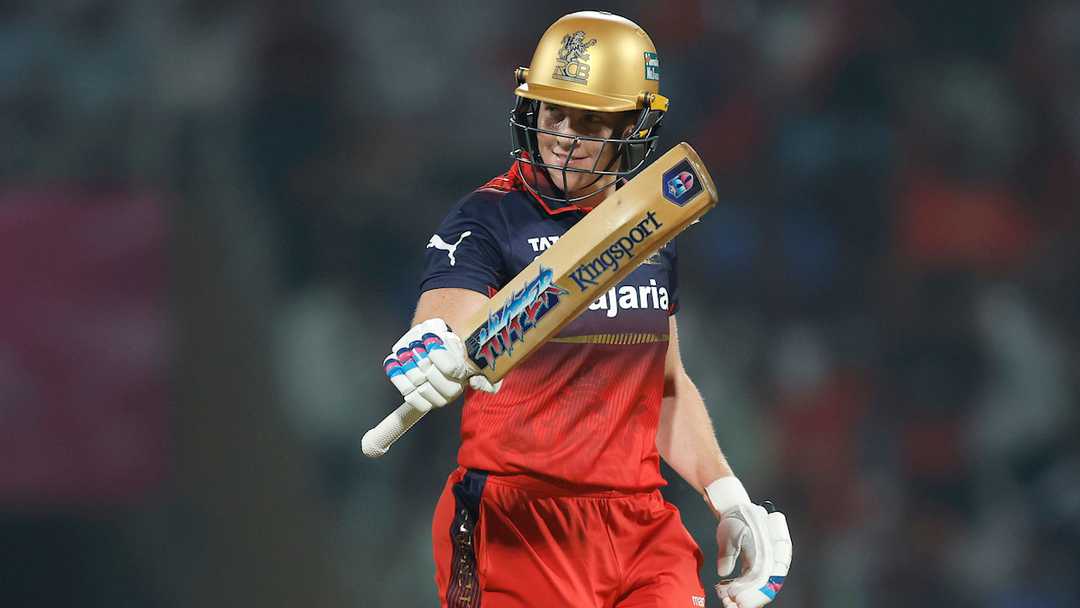
'Go for the cheese': The clarity that unlocked Grace Harris at RCB
During a routine training session with Royal Challengers Bengaluru, Grace Harris received a straightforward offer from stand-in head coach Malolan Rangarajan ahead of WPL 2026: she would open the batting. Though flexible, this pre-season clarity was exactly what Harris needed.
"I don't have to bat in a particular spot; I just simply need to be given a role," Harris responded. She began facing the new ball in the nets, shifting from her usual finishing role.
The directive was clear: "Grace, go for the cheese, not the cat. Take the extra risk, not be afraid of getting out." This simple messaging has made Harris the most aggressive PowerPlay batter of WPL 2026. Among batters facing at least 30 balls in the first six overs, she leads in runs (172), run-rate (10.32), strike-rate (172), and boundary percentage (35).
Her approach is calculated, not reckless. "You've only got two fielders out [in the PowerPlay]. You'll face a swinging or seaming delivery more than changes of pace. So, it's [about] being able to kind of calculate the risk. Essentially, a 40 metre hit or a 30 metre hit will get you more runs sometimes than trying to hit it 78 metres.
"If it comes off, it comes off. But if it doesn't, at least try and make it a good ball to get you out, not a rubbish, hacky kind of shot."
This high-risk role has its pitfalls. Between two big fifties against UP Warriorz, Harris managed only 43 runs across other innings and has been dismissed six times in eight PowerPlay appearances. She acknowledges the volatility.
"T20 cricket's so fickle and also the role that I play is so inconsistent that you can't keep hanging on the last innings because you can't strike it at 200 consistently," she says. "You're not going to hit a fifty every time. And if they want me to be more consistent, I'd definitely have to drop that strike-rate and drop that impact."
Harris maintains objectivity in her self-review: "If I pick the right shot to the right ball, that's a tick. But if I didn't execute it, then I'd just say unlucky or, you know, be better. If I've definitely played the wrong shot, then I go and I say to the coaches, no, we need to work on this."
Adapting to different venues has been key. The flat pitches at DY Patil Stadium in Navi Mumbai allowed her to "stand and deliver," while conditions in Vadodara required more adjustment. "Sometimes scoring tough runs is the impact," Harris notes. "Sometimes it's just taking the shine off the ball and then letting someone else come in and bolt it at the backend. So, you just try and take your ego out and just plan for what's in front of you."
At the other end, she has formed a potent partnership with captain Smriti Mandhana, describing them as "polar opposites." The pair already has two century stands this season. "She's such a quiet-natured person – probably the opposite of myself," Harris says. "Sometimes opposites work, sometimes they go horrifically bad. I'm glad that it's worked out this time."
Communication between them is minimal but effective. "Most of the time it's just good vibes and a good time."
Before the final, RCB took a team trip to Goa for a mental reset. "Finals come with higher expectations and pressure. Or, perceived pressure," Harris reflects. "Sometimes mental clarity is more significant or more important than how many hours you train… Getting that balance right is huge."
When asked about a potential opening role for Australia, given a vacancy at the top of their T20I order, Harris remains pragmatic: "I'll leave that up to that group. There's plenty of top-order batters going around [in the Australian setup]."
For now, at RCB, her role comes with the freedom to attack, fail, and adapt, making her the team's X-factor at the top.
Related Posts
 Multan Sultans vs Islamabad United,4th Match,Pakistan Super League 2026,2026-03-28 14:00 GMT
Royal Challengers Bengaluru vs Sunrisers Hyderabad,1st Match,Indian Premier League 2026,2026-03-28 14:00 GMT
Eswatini vs Ghana,12th Match,ICC Men’s T20 World Cup Africa Sub Regional Qualifier B, 2026,2026-03-28 13:50 GMT
Multan Sultans vs Islamabad United,4th Match,Pakistan Super League 2026,2026-03-28 14:00 GMT
Royal Challengers Bengaluru vs Sunrisers Hyderabad,1st Match,Indian Premier League 2026,2026-03-28 14:00 GMT
Eswatini vs Ghana,12th Match,ICC Men’s T20 World Cup Africa Sub Regional Qualifier B, 2026,2026-03-28 13:50 GMT