


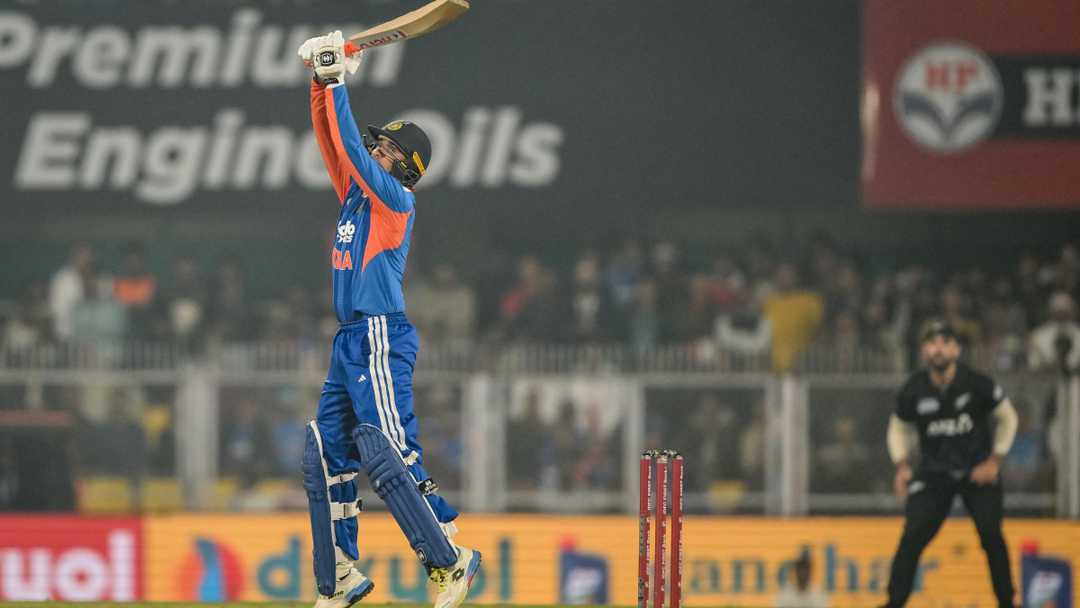
Built for the future: How Abhishek Sharma is re-engineering T20 batting benchmarks
Capturing and decoding the disbelief
When it comes to summarising what makes Abhishek Sharma so unusual, few cut to the heart of the puzzle as succinctly as Tabraiz Shamsi. "Every time I've watched him," Shamsi tweeted, "he has managed to smash sixes with ease against all different types of bowlers and bat at a high strike rate. Generally, batters who bat like that fail a lot more."
Shamsi's statement reminds us that T20 cricket has trained bowlers to expect excess aggression to be self-correcting. Yet Abhishek operates where that assumption breaks down. The surprise is not that he attacks relentlessly, but that he does so without failing "a lot more."
The raw data makes the disbelief understandable:
- Strike Rate: 194.74
- Average: 37.05
- Boundary every: 3.2 balls
- Six every: 7.6 balls
His strike rate and boundary percentage are unmatched in T20I history. His balls-per-six figure is second only to Andre Russell. These are not cameo numbers; they have been produced across 38 matches.
Only six batters in T20Is have 1000+ runs at a 35+ average and 160+ strike rate. It halves to three when considering only Full Member teams. Abhishek comfortably leads on strike rate whilst matching their average.
Batters with 35+ avg & 160+ SR in T20Is (1000+ runs)
| Player | Team | Inngs | Runs | Avg | SR |
|---|---|---|---|---|---|
| Abhishek Sharma | India | 37 | 1297 | 37.05 | 194.74 |
| Karanbir Singh | Austria | 40 | 1721 | 47.80 | 169.22 |
| Tim David | Aus/Singapore | 58 | 1596 | 36.27 | 168.88 |
| Phil Salt | England | 48 | 1587 | 37.78 | 166.52 |
| Suryakumar Yadav | India | 98 | 3030 | 36.95 | 165.48 |
| Bilal Zalmai | Austria | 48 | 1485 | 35.35 | 161.23 |
The closest thing to a prototype T20 batter
If one were to design an ideal T20 batter in a laboratory, Abhishek Sharma would be disturbingly close. His returns against both pace and spin are comfortably above format norms. He resists categorization—there is no obvious bowling technique, line, length, or angle that reliably suppresses him.
He scores all around the wicket, across lengths, and against movement in either direction, making defensive fields largely cosmetic.
Breaking the fundamental T20 trade-off
Conventionally, strike rate and balls per dismissal share an inverse relationship: score faster, get out sooner. Plotting this for batters with at least 1000 T20I runs confirms this relationship almost universally.
Abhishek Sharma sits conspicuously away from the trendline. He does make the classic trade-off but stretches the scoring ceiling so dramatically that the cost of dismissal becomes secondary. The risk profile shifts because reward overwhelms it.
This structural shift mirrors influential batters across eras. Virat Kohli ruled the 2010s with volume and control. Suryakumar Yadav expanded possibility through innovation in the early 2020s. Abhishek has gone a step further, compressing risk, time and margin into a single, relentlessly aggressive method.
Abhishek's philosophy is brutally simple: every ball is a potential boundary. Of his 37 innings, his first shot was a six in nine of them, with five coming off the very first ball he faced.
Innings Progression (Strike Rate)
- Balls 1-10: 183.38 (Highest among batters with 25+ T20I innings)
- Balls 11-20: 205
- Balls 21-30: 175
- Balls 31-40: 230
- Balls 40+: 267
A batter without negative matchups
Most elite batters have a chink in their armour. If there's one in Abhishek's, he has not revealed it yet.
- vs Spin: Average 33.91, Strike Rate 211
- vs Pace: Average 42, Strike Rate 188
He strikes at 170+ against all five major bowling styles and averages 35+ against four of them.
Abhishek vs Bowling Techniques
| Technique | Inns | Runs | Dis | Avg | SR |
|---|---|---|---|---|---|
| Right-Arm Pace | 34 | 759 | 19 | 39.94 | 191.66 |
| Leg Break | 9 | 152 | 6 | 25.33 | 245.16 |
| Off Break | 16 | 151 | 4 | 37.75 | 173.56 |
| Left-Arm Pace | 17 | 131 | 2 | 65.50 | 170.12 |
| Left-Arm Orthodox | 10 | 104 | 2 | 52.00 | 236.36 |
Only eight batters from Full Member nations strike at 150+ against both pace and spin (min. 30 overs each). Only two—Abhishek and Tim David—combine that with a 30+ average against both. Abhishek outstrips David on strike rate against both and averages 10 more runs per dismissal against pace.
Dominance in the Powerplay
Abhishek's Powerplay strike rate of 192 is the highest among openers from Full Member sides (min. 20 innings). Travis Head, his Sunrisers Hyderabad partner, sits second at 174.
Abhishek in Powerplay (as opener)
| Where | Inngs | Runs | Avg | SR |
|---|---|---|---|---|
| Home | 17 | 387 | 38.70 | 201.56 |
| Away | 18 | 460 | 51.11 | 184.00 |
Unlike most Powerplay aggressors, he accelerates after the field spreads. His strike rate rises from 192 in the Powerplay to 209 post-Powerplay.
India's load-bearer in the fastest era
Since January 2025, Abhishek has top-scored for India in three of five series. In 26 innings since then:
- Runs: 1041
- Average: 43
- Strike Rate: 201
For context, his opening partners Shubman Gill and Sanju Samson combined for 425 runs at an average of 18 and strike rate of 137 in the same period. Since January 2025, Abhishek has scored 24.21% of India's runs, the highest share by any batter from a Full Member nation (min. 20 innings).
The Indian side is amongst the fastest-scoring in T20I history, yet Abhishek still outpaces them. In innings where he bats, the team strikes at 148.44 compared to his 194.74—a difference of 46.3, the largest among batters from Full Member nations.
A comparison with the best peaks
Comparing Abhishek's entire T20I career (37 innings) with the top 25 37-innings scoring streaks among Full Member batters:
- His aggregate of 1297 runs is the 10th best.
- His strike rate is more than 20 points ahead of the next batter at their peak.
Pakistan's Mohammad Rizwan represents the opposite end, averaging 70.26 but striking at under 134. Rizwan was once the perfect case study for Shamsi's logic that risk has an inverse relationship with sustainability. Abhishek has spent his first two years in international cricket rewriting that rule entirely.
Related Posts
 Mumbai Indians vs Kolkata Knight Riders,2nd Match,Indian Premier League 2026,2026-03-29 15:00 GMT
Saint Helena vs Malawi,15th Match,ICC Men’s T20 World Cup Africa Sub Regional Qualifier B, 2026,2026-03-29 14:50 GMT
Ghana vs Tanzania,14th Match,ICC Men’s T20 World Cup Africa Sub Regional Qualifier B, 2026,2026-03-29 14:50 GMT
Mumbai Indians vs Kolkata Knight Riders,2nd Match,Indian Premier League 2026,2026-03-29 15:00 GMT
Saint Helena vs Malawi,15th Match,ICC Men’s T20 World Cup Africa Sub Regional Qualifier B, 2026,2026-03-29 14:50 GMT
Ghana vs Tanzania,14th Match,ICC Men’s T20 World Cup Africa Sub Regional Qualifier B, 2026,2026-03-29 14:50 GMT