


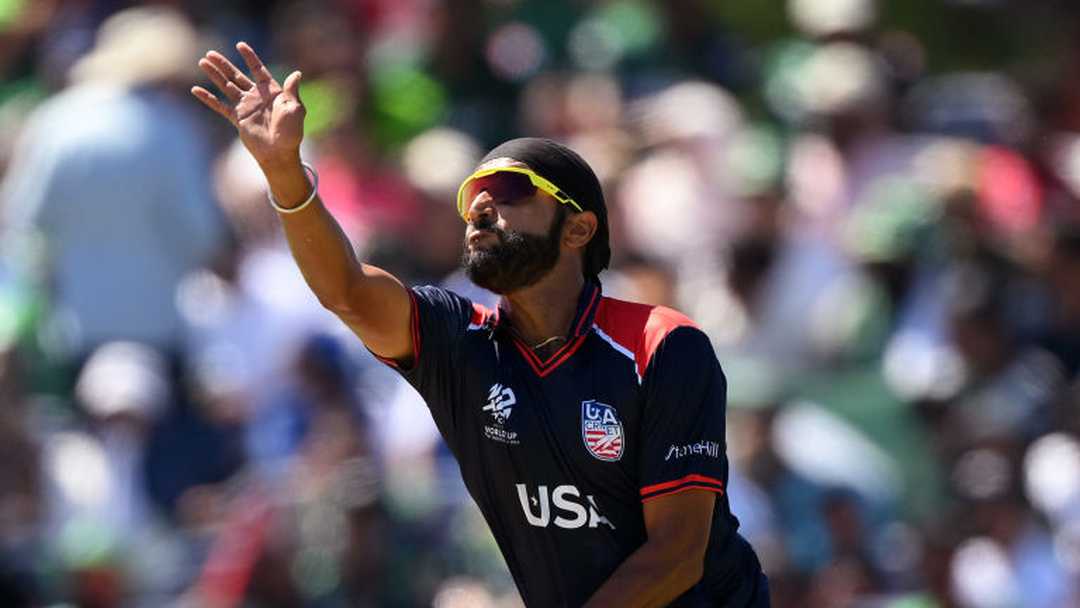
Harmeet Singh's Long Way Home
For Harmeet Singh, Mumbai has always been both the city that raised him and the city he had to leave to become himself.
His last visit to Wankhede Stadium as a Mumbai cricketer in 2015 ended humiliatingly. During a net session, then-coach Chandrakant Pandit sent him home for not wearing the prescribed team shorts. He left immediately, holding back tears, beginning the same tedious two-hour local train journey back to Borivali he had just endured to reach the ground.
"Bombay is a very big city," Harmeet says. "Coming to Wankhede itself is an effort. The travel on local trains can be physically taxing. Only after you clear that first hurdle does the question of effort on the cricket field even begin. I don't remember being angry often, but that episode was frustrating."
Soon after, his Mumbai career was effectively over. He was 23. A prodigy whom Ian Chappell had described in late 2012 as the world's second-best spinner behind Graeme Swann played his last first-class match for Mumbai barely three years later. Astonishingly, it was only in 2015—three full seasons after Chappell's remark—that he was finally given a look into Mumbai's first-class setup, featuring in just four matches before his falling-out with Pandit. For a cricketer who had made his Ranji Trophy debut at 16, was a U19 World Cup winner, and whose languid left-arm action had once compelled Dilip Sardesai to note him as a natural successor to Bishan Singh Bedi, the reversal was stark.
"I wanted a full first-class season, something I was never given," says Harmeet, who played just nine first-class matches for Mumbai across six years. "I never really even got the opportunity to fail. I always believed I was one season away from making it big. But that season never came in Mumbai."
Nearly a decade later, Harmeet returns to Wankhede on his own terms. This time, it is to the flashbulbs of a World Cup. He comes back as an international cricketer, his place earned through performance, and as one of American cricket's most traveled figures on the global T20 circuit.
Harmeet views this return less as vindication and more as closure. "I don't hold hate," he says. "God has given me back things in ways one can't imagine. He has brought me back to Wankhede in a dramatic way."
The moment carries deeper meaning for those no longer there to witness it. Harmeet has often spoken of how painful it was for his parents to watch his premature exit from Mumbai's Ranji setup, followed by the media trial around the 2013 IPL fixing saga—an episode that tarnished his image despite him being cleared by the BCCI.
His mother, his greatest cheerleader, accompanied him to almost every game at Wankhede through his formative years. That she will not be there now on the biggest night of his career, in his hometown, adds a poignant stillness to the occasion.
"It was a journey we lived together," says Harmeet. "My parents loved the Mumbai cricket setup, its importance, and its history. So my exit wasn't something they could easily digest. The media trial around the IPL fixing controversy affected them deeply. My name was eventually cleared, but by then the damage was done. I was only 20. People don't realise how frightening that period was."
That phase may have distanced him from Mumbai geographically, but it never separated him from the cricketing values the city drilled into him. The refusal to concede, the insistence on winning games from impossible positions, the street-hardened edge of Mumbai maidaans—all of it has traveled with him. It showed most vividly on his T20I debut, when he walked in during a desperate situation against Bangladesh and produced a breathtaking 13-ball 33 to script USA's first-ever win over a Full Member. The familiar Mumbai instinct of "kahi se bhi match nikal lena hai" (win the match from anywhere) took over.
Harmeet has also had a cultural impact on the American team. Along with captain Monank Patel, he has been central to USA shedding that associate team energy to play an enterprising brand of cricket. That shift was evident from his debut series win over Bangladesh, followed by a historic World Cup run where his late-order heroics nearly carried USA past South Africa.
"I wasn't able to relate back then, but when you move out of Mumbai and see the cricketing culture elsewhere, it's very different," Harmeet says. "In Mumbai, even our club games are treated as a matter of life and death. Whatever tournament it is, the word would be that it is prestigious and there is no option but to win it. That thought is perennially drilled in your head."
His bowling action today is unrecognizable from the fluid motion that once impressed pundits. It has been remolded for T20 cricket. So has his persona. He has mellowed. Recently, he visited his school coach Dinesh Lad and gifted him a cheque for 10 lakhs for his foundation, which trains needy youngsters for free.
By giving back to the city in whatever little way he can, he has already played his part. What remains, perhaps, is for Mumbai to respond by turning up and celebrating one of their own.
Related Posts
 Quetta Gladiators vs Hyderabad Kingsmen,5th Match,Pakistan Super League 2026,2026-03-29 10:30 GMT
Seychelles vs Eswatini,13th Match,ICC Men’s T20 World Cup Africa Sub Regional Qualifier B, 2026,2026-03-29 10:30 GMT
Lions vs Titans,Final,CSA Provincial One-Day Challenge Division One 2026,2026-03-29 09:00 GMT
Quetta Gladiators vs Hyderabad Kingsmen,5th Match,Pakistan Super League 2026,2026-03-29 10:30 GMT
Seychelles vs Eswatini,13th Match,ICC Men’s T20 World Cup Africa Sub Regional Qualifier B, 2026,2026-03-29 10:30 GMT
Lions vs Titans,Final,CSA Provincial One-Day Challenge Division One 2026,2026-03-29 09:00 GMT