


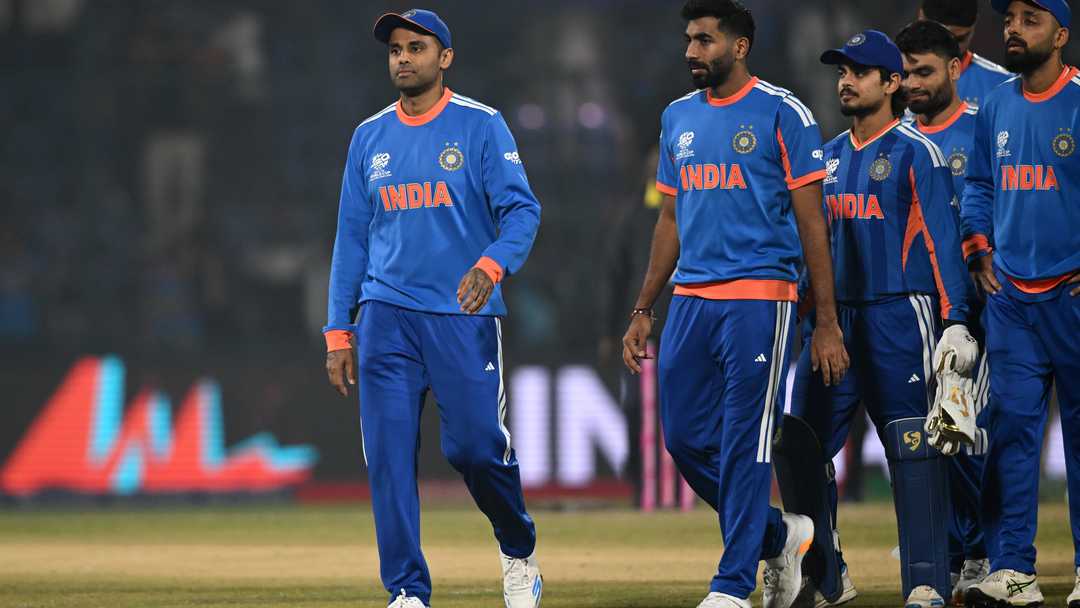
Old lessons for India's new test across the Palk Strait
After India's game against Namibia, Hardik Pandya said they would love to play on "more flatter wickets." Ishan Kishan later admitted the surfaces India faced in the T20 World Cup were "a bit different from what we expected." On the eve of the match against Pakistan in Colombo, Suryakumar Yadav called the pitches against the USA and Namibia "not proper T20 wickets."
This is unusual for a side that entered a home World Cup as overwhelming favourites, prepared on flat decks against New Zealand, and boasts a batting order known for overwhelming attacks. Yet, two games in, India have had to work harder than expected. Against the USA in Mumbai, early wickets threatened an upset before Suryakumar played a nuanced innings. Against Namibia, on another tricky surface, they stumbled but registered their biggest T20 World Cup win, extending their winning streak to 10—all without hitting top gear.
Suryakumar acknowledged the scratchiness. "I feel we had a little scratchy start, yes," he said in Colombo. "You can't run away from the fact that it was not a proper T20 wicket. But there is no excuse. Batters should be brave in taking their own calls on a tricky T20 wicket. In the second game, we were really good. We came back very strong. That's the beauty of T20 cricket. One or two batters taking responsibility, being brave, showing character makes us cross the line."
"Brave" is central to India's campaign so far. It hasn't been about carefree hitting but recalibration and courage to not play just for reputation.
Colombo's R. Premadasa Stadium will demand more recalibration. It's a big ground, often sticky and rarely indulgent. What Pandya wants is unlikely here. Sri Lanka is subcontinental but not a replica. "It's definitely challenging when you come to Sri Lanka," Suryakumar said. "Pitches are a little different, not too different from India. And when spinners bowl really well… you have to challenge yourself, find a solution and come out good."
India can take comfort from recent memory. In the UAE at the Asia Cup in September, on gripping surfaces requiring patience, they moved away from trying to hit every ball for six. They adjusted their combination, playing only one front-line pacer and leaving out Rinku Singh to include both Varun Chakaravarthy and Kuldeep Yadav. This template, born of patience, brought them the title, capped by a win over Pakistan in the final.
Suryakumar hinted at a similar combination. "When we played in the Asia Cup, there was a similar type of wicket, big ground. This is also a similar big ground, but the wicket will be a little better. So I feel similar type of combinations will be used here. But it is a very difficult call. It is a good headache to give a break to a fast bowler or a good spinner and play an extra batsman."
This could mean a return for Kuldeep Yadav, who has had success against Pakistan in white-ball cricket, with his wrist spin becoming a central subplot in Colombo. It may also mean tough calls on seamers, a reminder that in tournaments, reputation sometimes yields to match-ups.
"Flexibility is very important in this format," the India captain said. "I have already said that about batting order but flexibility is also very important in bowling. If someone's match-up is good against a bowler in a game, you should play him. This is not a bilateral tournament or franchise cricket. Here, you don't get time for a comeback, so you have to take that tough call on the day."
Suryakumar, as captain, has never stuck to rehearsed scripts. He has shuffled batting orders, used fast bowlers in unusual fielding positions, and given the ball to part-timers in key phases. Against Namibia, Chakaravarthy looked threatening but bowled only two overs. His use of Jasprit Bumrah exemplifies this: sometimes bowling three overs in the PowerPlay, other times held back for the middle and death overs.
"I want to be different on every given day," he said. "I don't want to go with a set plan. I want to have my plans different on each different day, different games. What comes in your mind at that time is more important than thinking about what has worked before."
India must do what their captain tries in every match: play it by ear. They have the evidence of September, having adapted and prevailed against Pakistan on similar surfaces. In this T20 World Cup, two imperfect victories showed they can absorb discomfort and still cross the line. Now, they need to carry that template across the Palk Strait, to a ground that rewards nuance over noise, and prove that even when not at their fluent best, they remain a side that finds solutions before excuses.
Related Posts
 India vs Pakistan,27th Match, Group A,ICC Men’s T20 World Cup 2026,2026-02-15 13:30 GMT
 Lockie Ferguson granted paternal leave, to miss Canada match
 Markram hails ‘comfortable’ cruise to win