


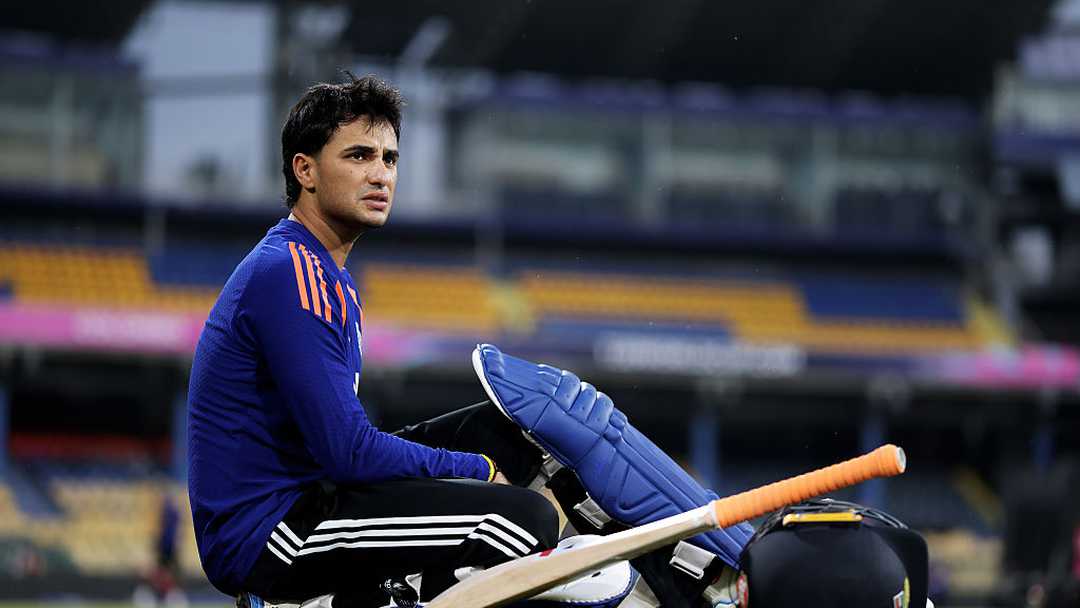
Round arm reckoning
In the week leading into India versus Pakistan, one arm has travelled further than the ball it releases. Usman Tariq has become both a talking point and a tactical problem, his round arm action debated, defended, copied in nets and dissected in press rooms.
Pakistan's bowlers have imitated it. India's have too. During a rain-curtailed session under lights on Saturday, Suryakumar Yadav paused midway in his delivery stride and slung the ball wide of the crease to exaggerate the angle to Ishan Kishan. Rinku Singh did that in the adjoining net. Other net bowlers followed without the theatre but with the same purpose: get used to the release, get used to the trajectory that begins in your peripheral vision and in the end, keeps moving away.
India are left-hand heavy. Six of their top eight in a first-choice XI bat left-handed. An offspinner going round the arm naturally takes the ball away from their swing arc. On a large R. Premadasa Stadium ground, with one side shorter because the pitch is not central, the angle and the release becomes significant. Hit against the spin and you risk the bigger boundary.
"Sometimes there is a question in the exam which is out of syllabus," Suryakumar described the Usman Tariq challenge with a smile. "So we can't leave that question. To tackle that, you have to adopt your own way. Yes, he is a different character when he comes to bowl but at the same time, we can't just surrender. We practice with similar type of bowlers and similar actions. And we will try to execute what we are practicing in the night sessions."
If one round-arm has shaped the tactical conversation, another kind has been needed quietly around Abhishek Sharma, telling him that falling sick at the wrong time does not undo months of certainty. That there's still time to make up. And in the current circumstances, there's perhaps no bigger stage than against Pakistan in Colombo to do that.
He arrived at this tournament in a run of form that made big scores feel inevitable. The weeks before it had been loud and prolific. Then came a stomach infection at precisely the wrong time, leaving him short of rhythm in the first match and on the bench in the next. He's looked frail since, needing hospitalization and IV drips to get back on his feet.
Abhishek is key to India's left-handed core, particularly with an offspinner taking the ball away and the early overs likely to set the tone. On Saturday, he batted in two separate stints, longer than anyone else before the drizzle trimmed the session to ninety minutes. He faced the round arm trajectory repeatedly. Behind him stood head coach Gautam Gambhir, speaking often, gesturing about shape and direction.
In Mumbai, Abhishek had been caught at deep cover against pace. Here in Colombo, the challenge is subtler. It's less about speed, more about the angle.
On the other side, Tariq has needed assurance of his own. Questions about his action, and the legality of it, have followed him despite being cleared twice by the ICC. Pakistan captain Salman Agha defended him firmly. "The guy has been cleared twice and he has done what the ICC said. Don't know why people are saying so many things about him. Usman doesn't care about what people are saying, he's mature enough to deal with all this."
The symmetry in all this is hard to miss. One arm redraws angles and invites doubt, another settles around a young opener who needs patience more than pressure.
When India meet Pakistan on February 15 in Colombo, Usman Tariq will sling it from wide of the crease, testing geometry and patience. Abhishek Sharma will take guard, trying to reclaim the rhythm illness briefly stole. Round arm has shaped the build up, it now waits to shape the contest.
Related Posts
 India vs Pakistan,27th Match, Group A,ICC Men’s T20 World Cup 2026,2026-02-15 13:30 GMT
 Lockie Ferguson granted paternal leave, to miss Canada match