


Abhishek's hat-trick of ducks: India's unexpected hiccup highlights a deeper pattern
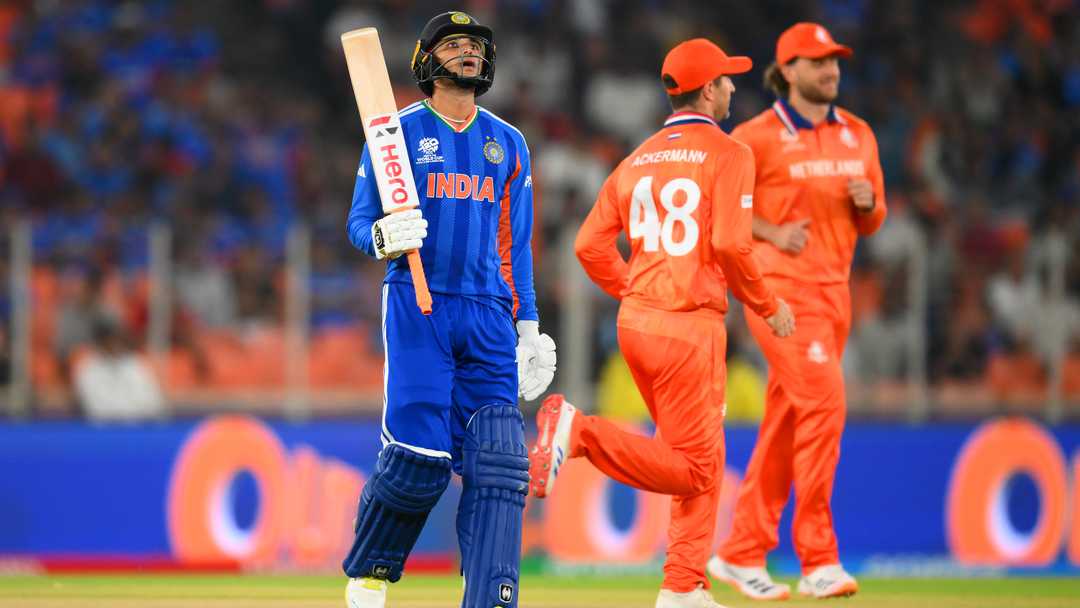
Predicting that Abhishek Sharma's form would be India's biggest worry heading into the Super Eights would have been the cricketing equivalent of crying wolf. Except, the wolf showed up.
India have secured four wins in as many games of the ongoing T20 World Cup and yet, not a run was needed off the bat of the No. 1 batter in the format. Three consecutive ducks later, Abhishek has ensured that even the most destructive batting line-up in the competition isn't at its flawless best.
India's assistant coach, Ryan ten Doeschate, has brushed it aside for the time being. "He batted really well last night in the nets, he spent 90 minutes batting," ten Doeschate said after India's win over Netherlands. "You also have to give him a bit of space. He came into the group phase not feeling too well… It's been a very disappointing tournament for him so far. But I saw some really good signs with his ball striking last night. So no worries about him."
It's understandable why Abhishek's inability to buy a run isn't alarming. He entered the tournament after a prolific year and a half, powering him to the top of the rankings. Secondly, there is no specific pattern to his dismissals.
He well-timed a loft to deep cover, mistimed a pull to mid on, and missed a pull to get cleaned up. No pattern really.
Given that the rest of the batters have chipped in, Abhishek's struggles haven't bothered the team yet. Ishan Kishan's rampage against Pakistan ensured that Abhishek's early dismissal wasn't a concern. Earlier, in similar rare early dismissals, Sanju Samson stroked centuries when Abhishek didn't click.
India's dominant run in T20Is has come from early control seized by the openers. On the surface, all players who have occupied the opening slots since the last World Cup have fared reasonably well.
But lift the rug slightly, and there's a lot more swept under it. The individual brilliance of the openers—Abhishek, Sanju Samson, Shubman Gill, Ishan Kishan and Yashasvi Jaiswal—has overshadowed the reality that India haven't been getting good opening stands in this period of dominance, where they have won nearly 80 percent of their games. Much pressure for that control has fallen on the No. 3s.
In these 45 innings, only three times have the openers managed to stay on till the end of the seventh over. The high percentage of at least one opener getting dismissed early is understandable. Theoretically, given India's all-out attack approach, the openers are bound to find themselves in such a position more often. They are expected to be on the offensive to take advantage of the powerplay, with the least access to conditions.
But the short time spent in the middle aside, the runs too haven't been healthy, with Indian openers crossing 35 runs for their partnership only 12 times.
Ten Doeschate confirms that while it remains a point to be noted, there are way too many players who are chipping in at different times. "The team's record speaks for itself. There's always this one guy who gets us out of the powerplay even if we are two or three down. We still manage to come out of the powerplay pretty strong," Doeschate said.
So far, Abhishek's lack of runs haven't hurt the team. As Suryakumar Yadav suggested, in T20 cricket, you don't need all your batters to fire every day. A good day for two or three batters does the work. If it's an all-out attack approach, many are bound to fail. The dependency is on those few who stand up under pressure. It's a consciously chosen path.
For as easily as the rewards of this method have been witnessed, it is no secret that it is fraught with risks. But it's a danger the team management has made peace with. "If Ishan and Abhi fire, it's a dream… But a part of the strategy is that we will be playing this high level, we have to accept that you are going to lose wickets as well. The guys deserve a lot of credit for how we have managed to bounce back," ten Doeschate said.
Abhishek's lack of runs may not be a concern for the team as yet, but against tougher oppositions in the more crucial stage, his contribution could be the differentiator.
The absence of his contribution has been observed in small measures already. Despite winning all the games, India's batting is yet to come close to its peak standards in this competition. Would an Abhishek Sharma show have made a difference?
He is going to be tested further. Given India's left-handed heavy line-up, it's natural for teams to turn towards their offspin options—including part-timers. And in most cases, they would be operating right from the first over. With the team's trust to repay, the task will be on Abhishek to figure a way out of this unexpected wolf fight.
Related Posts
 Portugal vs France,4th Match,Portugal T20I Tri-Series, 2026,2026-04-06 14:00 GMT
Portugal vs Norway,3rd Match,Portugal T20I Tri-Series, 2026,2026-04-06 10:00 GMT
Multan Sultans vs Rawalpindiz,14th Match,Pakistan Super League 2026,2026-04-06 15:00 GMT
Portugal vs France,4th Match,Portugal T20I Tri-Series, 2026,2026-04-06 14:00 GMT
Portugal vs Norway,3rd Match,Portugal T20I Tri-Series, 2026,2026-04-06 10:00 GMT
Multan Sultans vs Rawalpindiz,14th Match,Pakistan Super League 2026,2026-04-06 15:00 GMT