


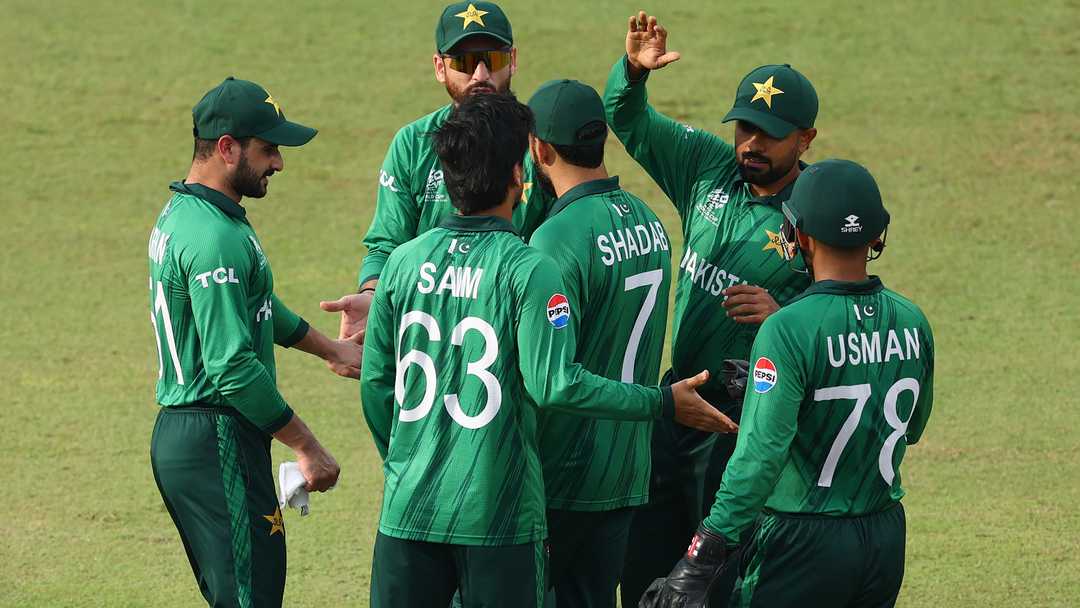
Old and new at the SSC, just like Pakistan
At the outdoor nets of the Sinhalese Sports Club, a laminated notice greets parents of young, aspiring cricketers.
"Please do not remain in this area and watch the children at practice, since both the children & coaches find it difficult to concentrate on their task when parents are watching!"
Dated January 7, 2025, the notice asks parents to move to the upper deck of the main pavilion instead. It is a small detail, but it says something about the SSC.
This is one of cricket's most old-fashioned venues, tucked away in a quiet, leafy part of Colombo, where wooden staircases creak and grassbanks frame the outfield. But even here, change has found its way in. The advisory at the nets is one such sign.
The six state-of-the-art floodlight towers tell the same story. Installed only recently, they enabled the venue's first day-night fixture just days ago. They signal change. The SSC has not abandoned what it is; it has simply made room for what the present demands.
At this very venue, under those same lights, Pakistan found their own balance between the old and the new.
Coming off a heavy defeat to India, this was a must-win fixture against Namibia. The response was emphatic: a 102-run victory, their biggest margin in T20 World Cups, achieved through recalibration.
Pakistan have been difficult to recognise at first glance in recent months. Since July 2024, they have bowled more than 51% of their overs through spin, the third most among Full Member nations. Against India, they bowled five of the six PowerPlay overs with spin. For a team historically defined by fast bowling, it felt like a sharp pivot.
But against Namibia, there was adjustment without overcorrection. Pakistan went back to opening the bowling with pace from both ends, a quiet nod to their past. They did not abandon spin but leaned into it gradually. The reward was eight wickets for the spinners, the joint-most for Pakistan in a T20 World Cup, but it was the early strike from pace in the PowerPlay that set it up.
Finding that balance required uncomfortable decisions. Shaheen Afridi, who had struggled for rhythm against India, was left out. The new ball instead went to Salman Mirza, a fellow left-arm pacer who justified the call with an early strike.
Pakistan were equally deliberate with the bat. When Salman Agha fell in the 13th over, it was not Babar Azam who walked out. It was Khawaja Nafay. And when Nafay fell, it was Shadab Khan.
The batting order was not accidental. Since returning to the T20I side after missing the Asia Cup, Babar has struck at 101.70 against spin. Each of his five dismissals in 2026 have come against it. Namibia had at least three bowlers who turn the ball away from him.
"As a professional, you should not mind such things," Shadab Khan said after the match. "The environment in the team is very good. The messaging is quite clear. Every player is trying to help the team win. There were clear messages given to every batter. Everyone has been told what their entry point is going to be. I think Babar has also been given a clear message about his entry point. The combinations will keep on changing as per the conditions."
Flexibility showed up in the combination as well. Pakistan went in with an extra batter in Nafay at the cost of Abrar Ahmad, a specialist spinner, trusting that Salman Agha's overs would provide cover. They still had six bowling options, four of them spinners, but the shape of the side felt less rigid.
"I think we have the luxury of spinners," Pakistan captain Salman Agha said. "We have all-rounders who can bat and bowl and then we have a proper match winner [Usman Tariq] when it comes to spin bowling. So if you have that much spin bowling in Sri Lanka, you don't really need to bowl a fast bowler in the middle."
One constant from the older order was Sahibzada Farhan. With Babar waiting out his turn, Farhan tightened his grip at the top, producing his maiden T20I hundred. It was also his fifth T20 century since 2025.
At 30 off 27 balls, it was hardly a fluent beginning. Farhan battled sweaty gloves and cramps before shifting gears. He needed just 31 more deliveries to bring up his hundred. It was an innings built on patience before power.
Perhaps, it was fitting that it happened here at the SSC. Where parents are not banished but simply asked to step back, and where LED floodlights rise above chandelier-lit dressing rooms. Here, the old and the new have learnt to coexist, and Pakistan found a similar equilibrium against Namibia. They didn't abandon spin, didn't stubbornly cling to pace and didn't let reputation dictate selection or batting order. Under those lights, Pakistan rediscovered how to win without losing themselves.
Related Posts
 Abhishek’s hat-trick of ducks: India’s unexpected hiccup highlights a deeper pattern
 Dube’s death-overs batting fuels India’s fourth win on the bounce