


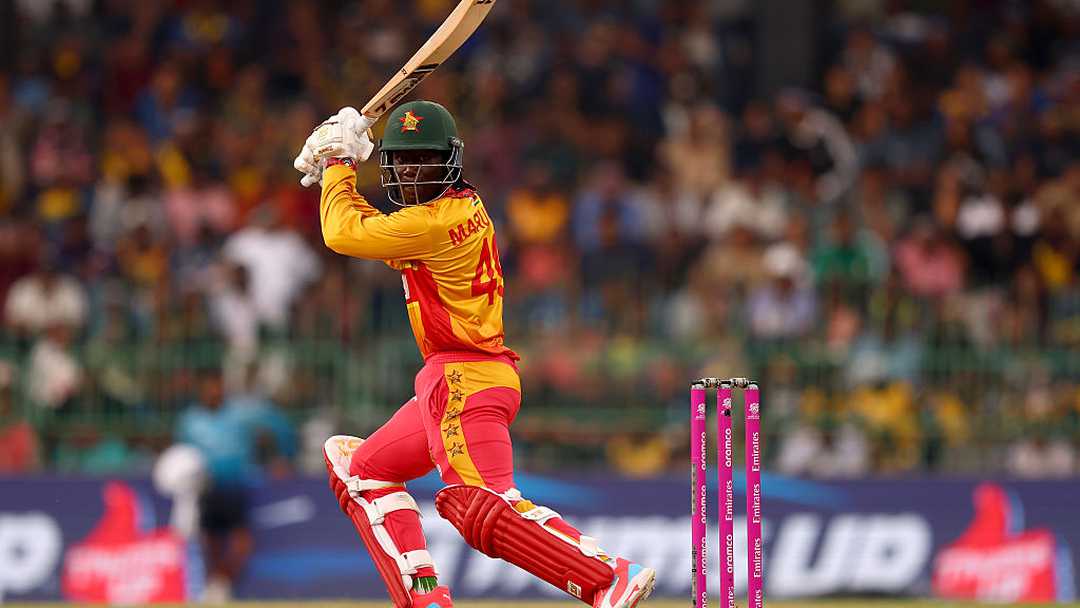
Zimbabwe learn to live with the noise
Long before the first ball is bowled at the R. Premadasa Stadium, trumpets and drums fill the upper tiers. People dance near the stairways, often to multiple bands playing over each other. The sound builds regardless.
It is very different from watching cricket in India. Here, the music often leads the game, closer to a wedding than a cricket match.
In that setting, Tadiwanashe Marumani discovered even basic communication required planning.
"My batting partner and I couldn't hear each other," he said. "Sometimes we were taking a bit of time off and meeting each other in the middle of the pitch. Sometimes, just a few signs to communicate. It was really loud out there."
It was his first time batting in such an environment. "It was really exciting but, to be honest, it was also a bit nerve-racking. I told myself to stay in the moment." If this was loud, he added, India would be "2x."
That might be the more useful way to see this match for Zimbabwe—less as a dead rubber and more as exposure to volume, to expectation.
A few nights earlier, they had beaten Australia with a performance that bordered on complete. Sri Lanka's start suggested the noise would once again belong to the hosts. They raced to 61 for 1 in the PowerPlay, with Pathum Nissanka sweeping assuredly.
But the game shifted. Overs 7 to 15 brought only 61 runs and three boundaries. While the drums did not slow, the innings did.
Zimbabwe's spin shaped that shift. Thirteen overs, nine through the middle, held Sri Lanka to 6.77 an over in that phase. Sikandar Raza sensed early that wrist-spin was finding more purchase.
"Because I bowled one of the last overs at the death, I told the boys that finger spinners weren't finding much, but wrist spinners were getting a bit of turn," Raza said. "They had two or three finger spinners and one wrist spinner, so I felt we could put them under pressure."
Ryan Burl's first ball drifted in, dipped, drew Kusal Mendis forward and spun past his bat. Marumani kept his composure to complete the stumping. Nissanka followed in the same passage, undone by an unforced error.
Zimbabwe, in response, scored 79 for 2 between overs 7 and 15. Raza's 23 off 13 in that stretch shifted the tempo and his eventual 45 anchored the chase.
"I think today's target was very good," Kusal Mendis said. "Since we didn't take a wicket in the middle overs while bowling, we felt that this target wasn't enough. Zimbabwe batted better than we expected."
The margin was six wickets, but the route was not straightforward. Assistant coach Dion Ebrahim called it what it was. "Today was quite a scrappy game," he said, retracing the swings.
It was not close to the near-flawless execution against Australia, but that was precisely the gain. "The benefit of going through this game today in front of a fervous crowd here in Sri Lanka was great for our boys to experience," Ebrahim said, "but also then to get over the line in a little bit of a scrappy fighting way."
Two years ago, Zimbabwe failed to qualify after losing to Uganda. Ebrahim has spoken about incremental improvement. "Whilst the results in terms of wins haven't quite been there, we've seen the incremental improvements over a long period of time."
Now the wins are stacking. Zimbabwe have topped a group featuring former champions Australia and Sri Lanka.
It is not just the results that feel different; it is the language around them too. Raza spoke at the toss about habits, about putting themselves in winning positions and closing games.
For the Super 8s, Zimbabwe now move to India. The setting will be grander, the attention heavier. "It will be the big challenge of us making sure that we are not overwhelmed by the occasion and not overwhelmed by the crowds, the atmosphere," Ebrahim said, "especially when India take momentum, because they will."
Colombo did not quieten for Zimbabwe. They settled inside the noise, took the game back when it drifted and finished it. Australia was not a spike. It was a sign. And if the volume rises from here, it will not be unfamiliar territory.
Related Posts
 West Indies Women vs Sri Lanka Women,1st ODI,Sri Lanka Women tour of West Indies 2026,2026-02-20 13:30 GMT
 Emotional Trott signs off from a journey that began by chance