


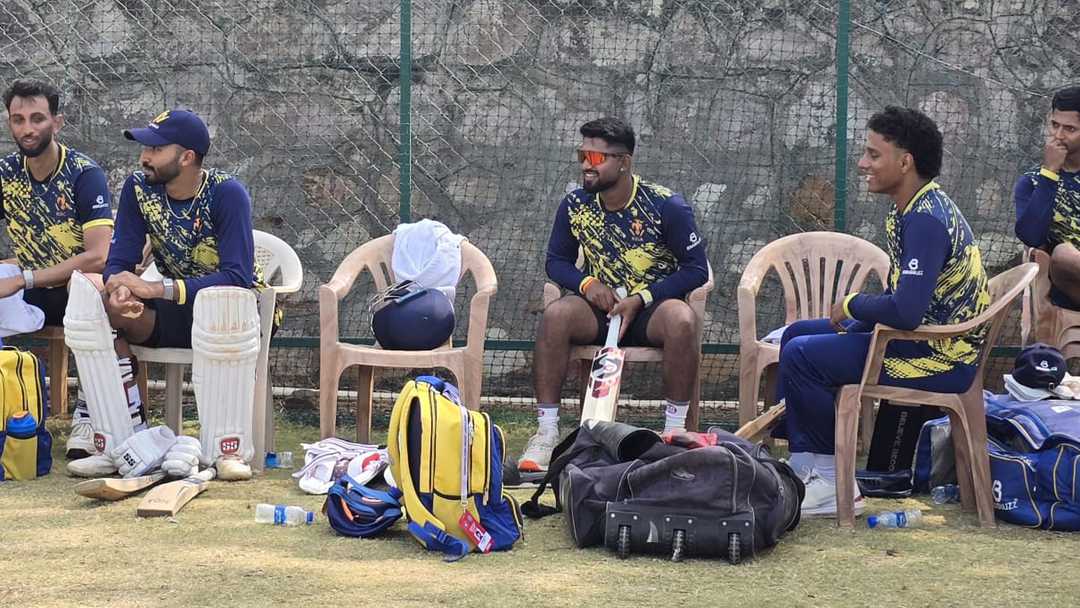
History vs stature – A clash of unequal burdens in the Ranji Trophy final
The photographers had received their memo. They waited through a nearly 10-minute press conference before the Ranji Trophy 2025-26 final. Right after the final question, one sprang to task. "Captains ka handshake karao."
Paras Dogra and Devdutt Padikkal, sitting behind a desk, awkwardly placed their hands just above it, ready for the click.
Doga has been around the circuit for nearly 25 years. He has seen the evolution of Indian domestic cricket from various extremes—playing the zonal format, at neutral venues, in the plate division. Over these years, he has learned to adapt to all sorts of conditions: green tracks, dust bowls, dead pitches. What he hasn't learnt is to pose ahead of a tournament final in a press room surrounded by nearly 40 people holding cameras and recorders. Mid-way into his third decade as a domestic cricketer, it's still a fresh experience.
As silence stretched, someone had to say it. This was the Ranji Trophy final—the grandest stage of India's domestic calendar—unfolding in Hubballi. And yet, here were two captains, stuck in an ungainly handshake.
Padikkal, just as new to the experience, stood up and turned to his right, uncomfortably staring into the eyes of Dogra, unsure how long to hold the pose. The act of shaking hands, repeated after every cricket match they ever played, suddenly seemed to require training. Padikkal muttered an awkward 'Best of luck.'
In the 10 minutes preceding that, it seemed neither captain would ever be called to cut a promo for a boxing match. The talk ranged from nervousness to subtle confidence. Even the odd display of chest-thumping, when Dogra mentioned the team's knockout victories—against Madhya Pradesh in Indore and Bengal in Kalyani—was spelt out softly, with hesitation.
Could they beat Karnataka in Karnataka to win a title they have never won?
"Obviously it's a very big moment for us," Dogra admitted. "We are just trying to stay calm and composed. We will stick to our basics, let's see how it goes."
The restraint was understandable. For a team playing its first final, up against statistically the second-most successful side in the tournament's history, the odds are stacked against them. But Jammu & Kashmir would know this is no accident. They have been building toward this moment for two seasons.
Recent history offers encouragement. In the past decade, whenever a legacy heavyweight has met a never-been-champion in the title clash, the outsider has prevailed. Gujarat and Madhya Pradesh over Mumbai, Vidarbha over Delhi, Saurashtra over Bengal. Pedigree has not always dictated destiny.
What could a Ranji Trophy win mean to the players of Jammu & Kashmir?
There couldn't have been more contrasting men seated next to each other. Dogra has outlasted selectors and teammates, only to find himself one game away from a trophy that never seemed in reach, even as he piled up runs season after season for Himachal Pradesh, Puducherry, and now Jammu & Kashmir.
Padikkal, who took over captaincy midway through the campaign, has scored nearly as many runs as Dogra this season (in fewer innings). He is already on the fringes of the national team, and a title win might nudge the selectors into considering him once more. The hope for such optimism features all around him—KL Rahul, Mayank Agarwal, Karun Nair, and Prasidh Krishna. Dogra has barely witnessed that across teams, across decades.
Can an Auqib Nabi, with 55 wickets this season, aspire with the same confidence to play for India later this year? Has the climb to this moment already come to matter more than the summit still unseen?
The limelight may not have been on Dogra in the press room, with questions largely fielded by home-boy Padikkal, tasked with bringing the cup back for the ninth time. That's not to say where the limelight of the contest, outside the room, really is. Jammu & Kashmir have entered their maiden final, and the magnitude of the moment isn't lost on anyone. Former cricketers, politicians—including the chief minister—have all joined the discussion.
Some have joined to take potshots. Samiullah Beigh, the former J&K pacer, wrote, "A quick glance at the journey of two Ranji Trophy 2026 finalists reveals that it is going to be a direct contest between Karnataka's batting vs J&K's bowling. Going by the defensive mindset shown by Karnataka in the Semis, I am certain KSCA would do everything to provide the flattest deck possible to negate J&K bowlers and then bank on its batting to win on first innings-lead."
Beigh's assessment could come true, not necessarily due to 'smart gamesmanship,' but because Karnataka have mustered 500-plus inning totals in each of their last three games at the venue.
This passion is understandable from someone who spent decades preparing in trying conditions, the J&K jersey on his back, sometimes with nothing more than a tennis ball bowled inside his house compound for practice.
This aggressive involvement contrasts with the silence from Karnataka's cricketing establishment. Reaching the final may not be a point of success for the eight-time champions, but it's a stage they have long waited to return to—more than a decade since they won back-to-back titles, with their status as the second-most dominant team somewhat on the wane.
That moment to regain lost pride has arrived. The venue, conditions, opposition, and history—all scales tilt in their favour. One team is playing to make history; the other is playing to uphold its stature. It is not always clear which is the heavier burden to carry to a final. But one thing is certain: whoever lifts the trophy by the end of this week will pull out a more confident pose for the cameras.
Related Posts
 Ruthless West Indies set to unleash spin force on reeling India
 West Indies put on six-fest to floor Zimbabwe
 India’s identity crisis