


India's identity crisis
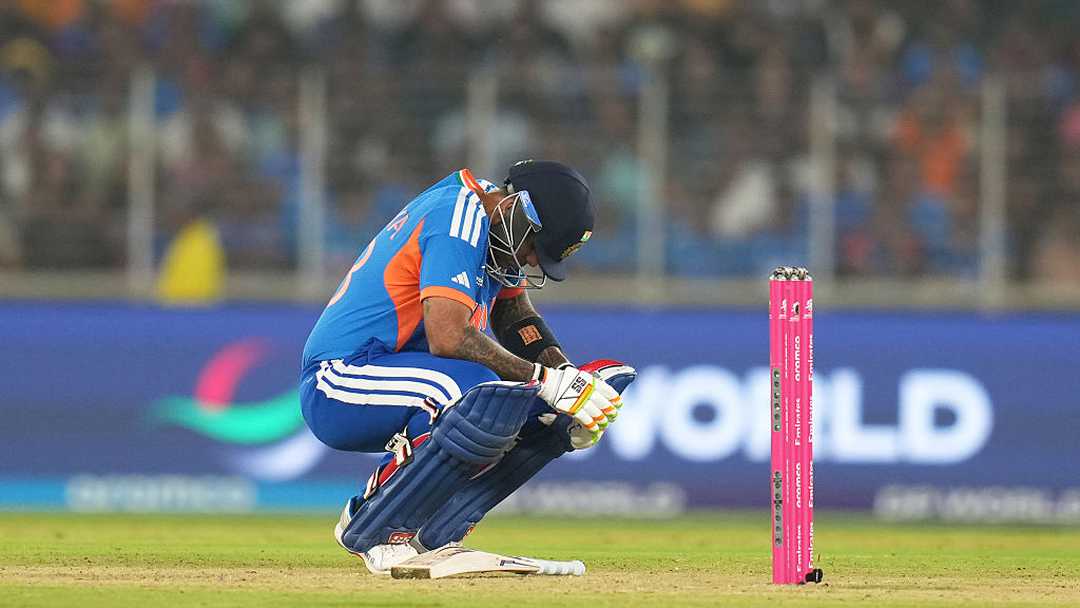
The hollow feeling of losing a big World Cup match at the Narendra Modi Stadium in Ahmedabad is not new for Suryakumar Yadav. He endured it on one of the most harrowing nights in Indian cricket nearly two and a half years ago. He was at the centre of another such deflating experience on Sunday, leading the team this time.
At the end of it, he said: "Sometimes you've got to think, if you're chasing 180-185, you can't win the game in the Powerplay, but you might lose the game in the Powerplay."
An inference like that was unthinkable until three weeks ago, when India strutted into the World Cup as the most feared batting unit, playing with a sense of arrogance and setting benchmarks. The defining motif of this team's success in this World Cup cycle began with unyielding Powerplay intentions. They've scored at close to 10 runs an over in that phase.
Run-rates across phases in this World Cup cycle (Teams in India's Super Eights Group)
| Teams | Powerplay (0-6) | Middle-overs (7-15) | Death overs (16-20) |
|---|---|---|---|
| India | 9.87 | 9.59 | 10.42 |
| South Africa | 7.79 | 8.91 | 9.08 |
| Zimbabwe | 8.36 | 7.82 | 9.75 |
| West Indies | 7.91 | 8.24 | 9.91 |
But this tinge of conservatism in Suryakumar's ideas is not sudden. It's been the World Cup's narrative: India's batters have been tripped up early by sticky surfaces across venues. Before the Namibia fixture, assistant coach Ryan ten Doeschate reckoned India needed to consider a batting plan B after what went down against USA. There, India were down to 46/4 in the Powerplay and needed timely rescuing from their captain.
The win papered over the cracks, and against Namibia they slipped back into their usual groove with 86/1 in six overs. Yet, Ishan Kishan, who smashed 61 off 24, pointed out that the pitch was sticky early on. Hardik Pandya went a step further, claiming that both pitches India had played on until then weren't conducive to batting.
That preference does a disservice to the batting talent at India's disposal. True surfaces in all four home series during this World Cup cycle allowed them to fly at the start. When conditions have denied them that first act, they've been made to look distinctly one-dimensional.
Against USA in the group stage and South Africa in the Super Eights, they've had their wings clipped early. Their quality rose above the surface against the Associate side, but the 2024 finalists buried them after knocking them back in the first six overs (31/3).
"I've sort of banged the drum about it. I think the biggest challenge for us is finding a way to play on wickets that are not typical to what we're playing on," ten Doeschate said in Ahmedabad.
This is another reiteration that India need to rewire some of their habits to account for pitches where the ball will hold up. It's perhaps easier in theory to suggest a shift than to implement it for players who've built their batting approach over the last two years in docile conditions at home.
The question for India is whether recalibration is truly possible at this juncture for batters wired to hit it big from the first ball. Now that the conditions have thrown a curveball at them and left them on thin ice with a terrible Net Run Rate (-3.800), their title defence rests on how the batters improvise over the next one week against Zimbabwe and West Indies.
Related Posts
 Ruthless West Indies set to unleash spin force on reeling India
 West Indies put on six-fest to floor Zimbabwe