


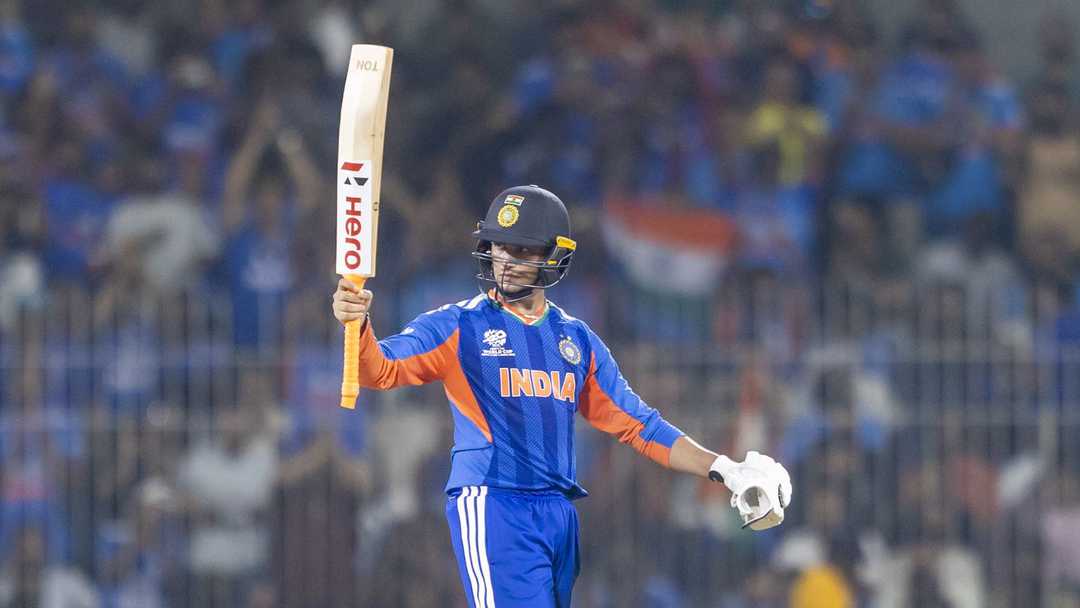
No bait, mostly straight: Abhishek Sharma's Chepauk reset
A big part of the theatre of Abhishek Sharma's T20 batting lies in the anticipation of what he will do with the first ball he faces. For those asking in the last couple of years, he's put it out plainly: trying to hit the ball hard remains the only real plan in this format.
Zimbabwe were aware. When Sanju Samson turned over the strike to Abhishek in the second over, it prompted an immediate field change. Sikandar Raza moved his mid-wicket across, packing the off-side ring with a deep cover also in place. On the leg side, Raza was the only fielder in front of square. Blessing Muzarabani then ran in and delivered to plan: a length ball outside off-stump.
There's been a pattern to how oppositions have tried to get inside Abhishek's head. Against USA, Ali Khan lured him into finding deep extra cover on the first ball. In Colombo, off-spinner Salman Agha took him out first ball off a miscue. Three days later in Ahmedabad, Netherlands' Aryan Dutt cleaned him up. India's best batter of the last two years suddenly seemed to have developed a first-ball problem.
Raza would have hoped it wouldn't be this soon that Abhishek sorted it out. He had a deep cover waiting. But all he got was an anti-climactic push for a single. Early in the next over, Tinotenda Maposa moved his deep cover to deep point, and Abhishek lofted a full ball outside off without risk. Maposa stuck to that line, but Abhishek changed his angle, going for a straight four over the bowler's head—the first of many such shots that would define his night.
Maposa's reset was quick. He tried what worked for South Africa in Ahmedabad—a change of pace. There, the left-hander got his footing wrong and fell to a knuckle ball. In Chennai, there was assuredness. Maposa angled one across him at under 100kmph, but Abhishek tonked it over the long-on fence. Muzarabani tried to lay out more landmines, with empty acres on the leg side, and slowed it down. Abhishek just tucked it on the leg side for a single. It was a game where the left-hander hit pause on his urges to pre-meditate his way out of the crease.
Every pacer joining the attack seemed to have got the same memo—bowl slow and wait for a mistake. It was an idea backed by India's glaring fallacy: until this game, they had lost 14 wickets to pace-off deliveries from seamers (under 128kmph), the most by a team.
Yet, overcommitting risked predictability. Staying put in the crease afforded Abhishek a solid base to time his bat-swing well even against pace variations. Brad Evans saw his 102kmph delivery fly over long-on in the fifth over. In the sixth, Richard Ngarava pulled deep square leg in, but Abhishek stayed tall, stepped back, and sent a hard-length delivery outside off for a straight six.
Long-off and long-on appeared after the Powerplay, tasked with latching onto any error. Fields changed but Abhishek's overarching idea didn't. In the 10th over off Brian Bennett, another off-spinner, he stepped out for the first time and hit a six over long-on.
In the 11th, he got to a 26-ball half-century, his second slowest in the format. But that wasn't the most head-turning aspect. 34 of his 50 runs were scored down the ground—a whopping 68%. The previous most at this stage of his innings in 11 half-centuries was a mere 35%. His dismissal on 55 off 30 also came from a shot down the ground that he couldn't put past Raza at long-on, sending him back to an ovation.
"In this game nobody can guarantee that he will do it [score big runs] in the next match, but I think he is not far," batting coach Sitanshu Kotak had said before the game.
He wasn't. The heartbeat of India's top-order has found its rhythm again, just in time for what promises to be a defining World Cup night at Eden Gardens on March 1.
Related Posts
 Gujarat Titans-Chennai Super Kings fixtures swapped
 Macheke earns maiden call-up for T20I series against India
 Tim David sanctioned for refusing to hand over ball to umpires