


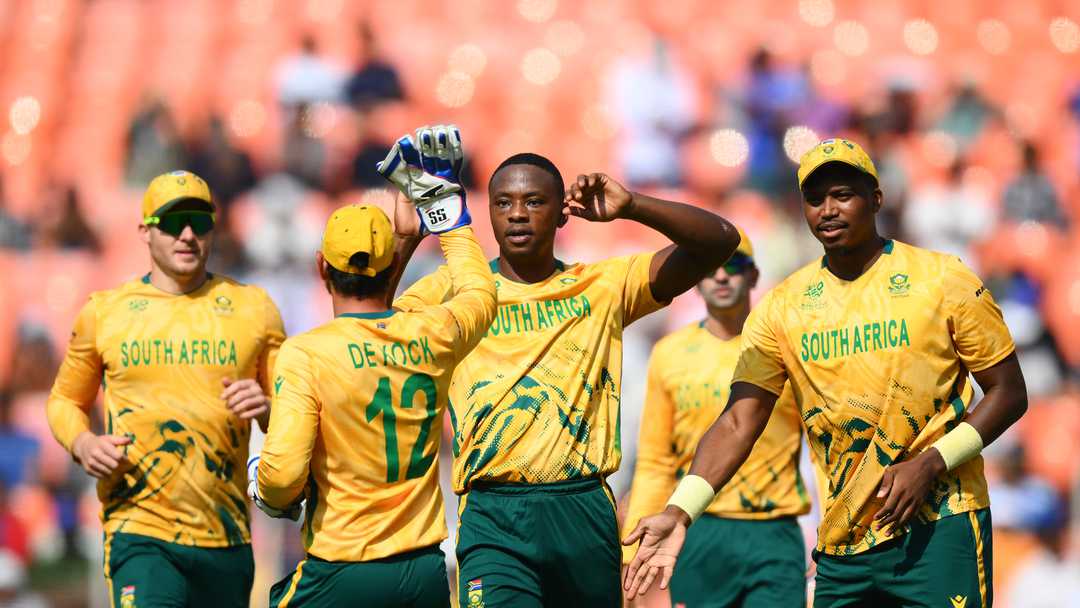
South Africa take another step forward, West Indies under pressure
Kagiso Rabada can smile about it now: "I'm glad we won that game. I would have blamed myself if we had lost. On the positive side, I made it interesting."
Maybe too interesting. On February 11, Rabada was entrusted with bowling the last over of South Africa's T20 World Cup match against Afghanistan. He had a dozen runs to defend and the Afghans were down to their last pair.
What looked like the end of the match when Noor Ahmad drove the first ball into cover's hands was the start of a nightmare—Rabada had overstepped. Another no-ball, a wide, and a six meant Afghanistan needed two off the last delivery. They could manage only a single, not least because Rabada found the athleticism required to gather a wayward throw and lurch at the stumps to run out Fazalhaq Farooqi and tie the scores. From there it took not one but two super overs to make the South Africans winners.
"If we had lost that game, I would have taken it quite heavily," Rabada said. "Get [your foot] behind the line. It's as simple as that."
Fifteen days later, they reeled off their sixth consecutive victory with a nine-wicket drubbing of West Indies in a Super Eights encounter.
They hammered pre-tournament favourites India by 76 runs, and their other wins came against New Zealand, Canada, and United Arab Emirates. South Africa have made a serious case to go all the way to the final.
But the West Indians had also been unbeaten in their five matches before Thursday's game. Now they are likely to have to beat India at Eden Gardens on Sunday to reach the semifinals.
Was that an indication of the merciless nature of the tournament format?
"Massively," Aiden Markram said. "The guys put in a really good performance a few nights ago [against India] and you wake up the next morning and you go, 'This could all be over in a couple of days' time.' It is seriously cutthroat."
Did Shai Hope think it was unfair that his team faced elimination after losing just one game in six?
"This is how it's supposed to be," Hope said. "When you get to crunch time in a tournament, every opposition and every game you play is supposed to be a challenge. We've got to make sure we turn things around quickly and get a good result against India."
Romario Shepherd put it even more bluntly: "We don't have time to sulk. We need to keep a level head and try and recover as quickly as possible."
The South Africans will be in Delhi on Sunday to play Zimbabwe—who beat Australia and Sri Lanka to qualify for the Super Eights.
"It can sometimes be more nerve-wracking [to play a theoretically weaker side]," Markram said. "But you absolutely give them the respect they deserve; they have beaten some quality teams."
What might Markram's message be between now and Sunday?
"To win a competition, you want to keep the good things going for as long as possible. You don't want to take your foot off the gas."
Maybe there will be a moment to think about what would have happened had Rabada got his foot behind that line, or had not found the skill to effect Farooqi's run out, or if the super overs had swung in Afghanistan's direction.
In any of those cases, the South Africans would likely have been looking down the same barrel as the Windies. Interesting? Too interesting.
Related Posts
 Gujarat Titans-Chennai Super Kings fixtures swapped
 Macheke earns maiden call-up for T20I series against India
 Tim David sanctioned for refusing to hand over ball to umpires