


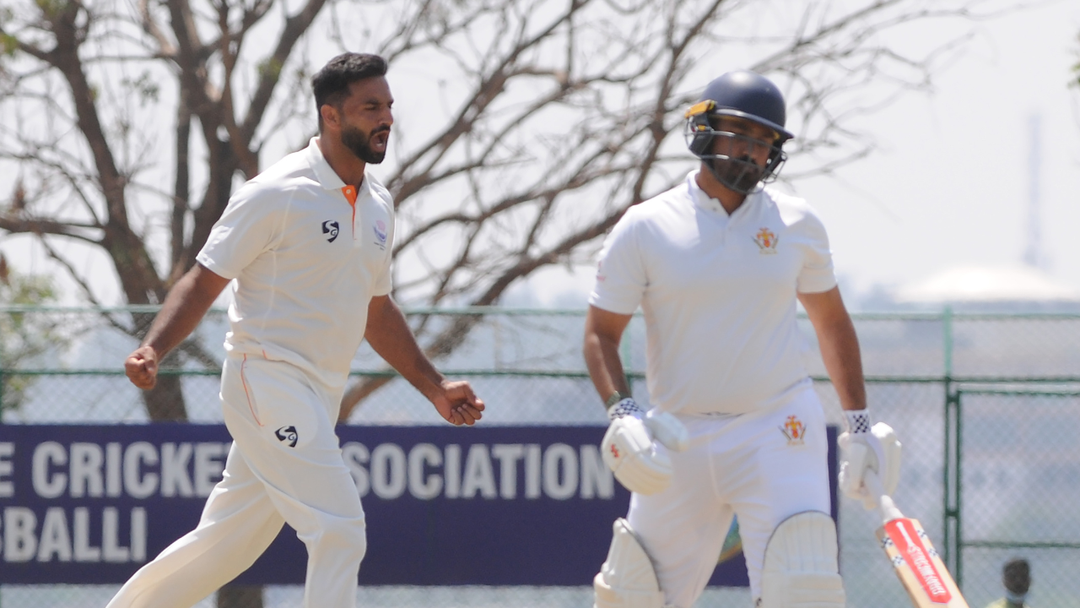
Three strikes and a statement: Nabi turns the final on its head
Some days are better than the rest. For Auqib Nabi, that day was February 26, 2026.
By his own metrics—and with due recognition to his 55 wickets in the Ranji Trophy 2025-26 season—taking two wickets in successive deliveries on Thursday afternoon wasn’t a big deal. He had taken at least four wickets in each of his last four innings in the knockouts, and was instrumental in Jammu & Kashmir’s maiden charge to the final. Yet, on the biggest stage of Indian domestic cricket, against the strongest batting line-up, on a pitch that asked more of the bowlers, he didn’t just take the spotlight—he seized it, delivering when it mattered and potentially deciding the fate of the championship.
On a surface offering minimal assistance to bowlers—evident from Karnataka’s two-day toil to bowl out a side that had passed 400 only once—Jammu & Kashmir assessed smarter. Their plan: target the stumps. With some late movement available with the new ball, Nabi’s skills became crucial.
The target was KL Rahul, Nabi’s Delhi Capitals teammate for the upcoming IPL. Rahul was watchful, even crafty, and looked in charge alongside opening partner Mayank Agarwal. Jammu & Kashmir’s first-innings total of 584 seemed daunting, but with Rahul’s quality, patience and application were key.
Then Nabi intervened. A length ball straightened, squared up the batter, and took a faint edge to the keeper. Strike one.
After lunch, the collapse began. Sunil Kumar had Devdutt Padikkal caught at slip, then Nabi took over. Karun Nair was beaten by a delivery that moved away and was cleaned up. The next ball, Smaran Ravichandran edged one to the keeper that straightened from around the stumps. Karnataka were 57 for 4, needing a miracle.
Mayank Agarwal salvaged some hope for Karnataka, adding 105 with Shreyas Gopal and an unbeaten 58 with Kruthik Krishna to become the game’s highest scorer. But at 220 for 5 by day’s end, the hosts need a gigantic partnership.
Nabi has taken three of the five wickets. How potent would this attack be without him? How different would the match be if more batters had attacked his lengths, as Mayank did? What if those dismissals had coincided with the bowlers’ 10 no-balls?
Nabi’s bowling highlighted not just the gulf in class between him and other bowlers, but also the critical application required from Jammu & Kashmir’s batters.
Even on a lifeless track, one period of play can define a five-day match. Had Karnataka’s batters evaded Nabi, the rain-lost hours on Wednesday evening could have been critical—the ball was old, bowlers were tired, batters were set. More runs seemed promised.
Nabi punched in the defining details. Calls for his Test inclusion have grown louder, especially with the national team seeking a definitive third seamer who can bat. A late bloomer, Nabi has already earned rewards: a stint with North Zone and a prized catch in the IPL 2026 auctions.
On paper, the work before the final doesn’t change how deserving the 29-year-old Nabi is for greater rewards. But sports—and Indian cricket especially—shows that some days and moments are more critical than others, for both the team and deserving individuals.
It was a casual Thursday, played under the baking sun, and Nabi claimed his rewards, owning the hour and the day with nothing special—just the routine.
Related Posts
 Gujarat Titans-Chennai Super Kings fixtures swapped
 Macheke earns maiden call-up for T20I series against India
 Tim David sanctioned for refusing to hand over ball to umpires