


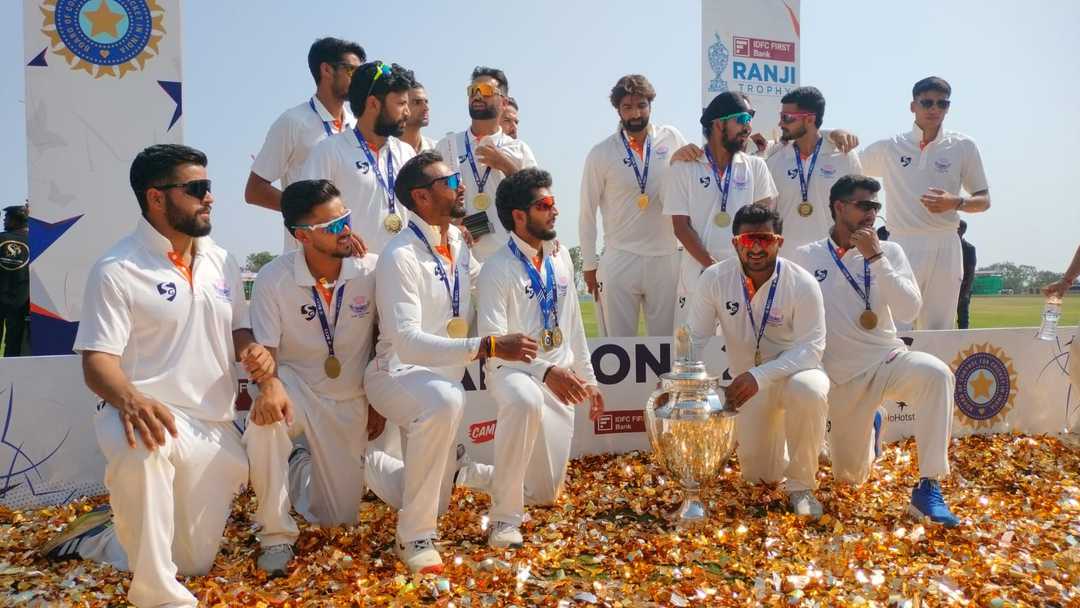
From curfews to champions, J&K's long road to Ranji glory
In August 2016, Jammu & Kashmir's former pacer Samiullah Beigh was bowling with a tennis ball against the wall of his house compound. That was the limitation of his preparation for the upcoming Ranji Trophy season. "I wasn't the only one preparing like that," Beigh recalls.
The encounter of Burhan Wani in July that year led to violent protests across Kashmir, resulting in a 53-day strict curfew. Understandably, cricketers' preparations were impacted. It wasn't the first time. Curfews during civil unrest in 2008 and 2010, the floods in 2014, and the abrogation of Article 370 in 2019 all coincided with pre-season preparations. No pre-season tournaments and scrapped selection matches became routine, leaving players to turn up for the domestic season unprepared.
For players content with just participating, winning the odd game, and keeping their first-class status, even that limited preparation sufficed. Hope for anything more seemed unrealistic.
"All that changed once Bishan Singh Bedi came in as coach in 2010," Beigh says. Jammu & Kashmir started winning. They nearly beat a Delhi team featuring Virender Sehwag, Ashish Nehra, and Ishant Sharma that season, reached the Ranji Trophy quarterfinals in 2013-14, and beat Mumbai in Mumbai in 2014-15. Through all that, Parvez Rasool and Umran Malik went on to play for India. Hope was instilled, and aspirations soared.
In subsequent years, players from the state made a mark in the IPL—Abdul Samad, Umran Malik, Rasikh Salam Dar, Yudhvir Singh Charak. And in 2025-26, they became Ranji Trophy champions.
Jammu & Kashmir asserted their dominance by beating Karnataka, a team with five internationally capped players, in the final. Doing so in front of a 5,000-strong crowd cheering for the home side added pressure.
Captain Paras Dogra laughed when asked if the big audience fueled pressure. "Our boys are used to playing in front of lacs of people in local games," he said.
Beigh validates this, recounting a story from September 2025 when the entire district of Pulwama came to a standstill to watch a local cricket match.
"Roads were blocked, police had to be called in. Had it happened in Srinagar, it would have been understandable. We are used to seeing tens of thousands turn up for local games. That such a craze existed even in a remote region like Pulwama was surprising," Beigh says.
He adds that Dogra may have forgotten to mention the sight of hundreds of children playing cricket on Fridays and Sundays in Eidgahs across Srinagar.
"Just like Aazad Maidaan, hundreds of kids play there just for the love of the game, with no aspirations of going to a higher level in cricket."
When asked why there's no aspiration to take that passion higher, Beigh shoots back, "Because there is no hope."
"The absence of hope is the one missing link. J&K's cricketing talent is outstanding, passion is unmatched, but there's no hope of graduating from a local maidaan to an IPL team."
As celebrations were planned back home, Omar Abdullah, the chief minister of Jammu & Kashmir, arrived in Hubballi on the final day. The victory felt personal.
Waheed ur Rahman Para, a member of the J&K assembly, tweeted, "At a time when so much around us feels fractured… this victory feels different. Hindus and Muslims stood shoulder to shoulder, playing for one badge, one dream. They transcended divides, taking on and defeating elite teams from across the country."
But what would this victory really mean for Jammu & Kashmir's cricket?
Over the past decade and a half, many states have won their maiden Ranji Trophy title—Rajasthan, Vidarbha, Saurashtra, Gujarat, Madhya Pradesh. But how much has cricket in those regions benefited? How many players from those title-winning sides have gone on to play Test cricket for India?
Has Jammu & Kashmir—with much bigger infrastructural and social challenges—just given its youth a moment of hope? Dig deeper, and real issues emerge.
"Here, schools have very limited infrastructure for cricket," Beigh says. "Barely any have turf wickets; local cricket is mostly played on matting wickets. There are no professional academies for grooming talented kids. At 14-16, when you need an academy to hone skills, there are none.
"Since we have no professional training on turf wickets, when selected for Under-19, we suddenly realize everyone else is technically sound, while we are raw. That's the first shock. It disappoints players so much that many give up, believing they're too far behind.
"The third shock comes at the Ranji Trophy level. Although things have changed slightly since the Mithun Manhas committee, infrastructure is still lacking. There's only one JKCA-owned ground in the entire state with a turf wicket, in Srinagar. Everyone has to travel there to practice. We have no professional coaches or trainers."
One reason for this disadvantage is constant turmoil within the Jammu & Kashmir Cricket Association, marred by allegations of corruption and local club issues.
"There's a caretaking body, but their hands are tied. These internal bickerings won't die down soon. The BCCI has to stand up and own JKCA, even if it means running it from headquarters. We wouldn't mind. As cricketers, we'd be happiest if academies and infrastructure are built, and we get proper coaching and support. Without that, all this buildup will die down in a few years."
The last few years have been slightly easier for current players, but Beigh asks how much has really changed.
"There have been no curfews, but without infrastructure, the situation remains the same. The only difference is that in 2016, I had to play in my compound; now players train on the ground. But they train alone, without supervision or facilities. We need more grounds, coaches, camps, and Under-19 zonal camps in J&K so players get hope."
Without infrastructural support, the Ranji Trophy win counts for little, Beigh believes, because as professional cricketers, excuses count for nothing. Even his tennis-ball practice was his ray of hope.
"I had to do that because I was competing with people who practice and compete all year. At that level, there's no room for excuses. Growing up in tougher situations, J&K cricketers become mentally tougher. When we see a ray of hope, we cling to it like it's the last."
That ray of hope was cricket then. And it's cricket now.
Related Posts
 New Zealand Women vs Zimbabwe Women,3rd T20I,Zimbabwe Women tour of New Zealand, 2026,2026-03-01 00:15 GMT
 BCB facilities committee chairman slams board structure