


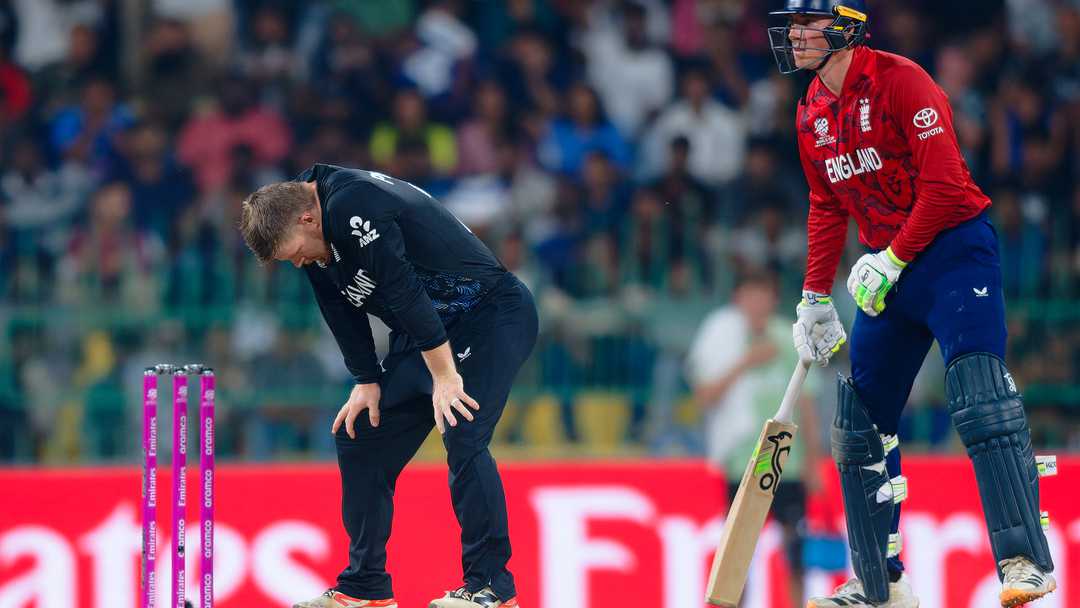
Six balls that changed the night
For most of the evening, Glenn Phillips looked like the safest investment on the field.
He batted with clarity. Against spin, anything too full was driven straight, anything too short was pulled with control. He finished as New Zealand's top-scorer without appearing to force the pace.
With the ball, he delivered a crucial breakthrough. Harry Brook looked to make room but Phillips, bowling his offbreaks from round the wicket, drifted the ball away. The shot travelled straight into the hands of long-off.
Minutes later, Phillips sprinted in from the deep and dived forward to take a low catch inches above the turf to remove a set Jacob Bethell.
It felt like the making of one of those complete T20 performances—runs, a wicket, a catch. Influence in every phase.
Then came the inflection point.
England needed 53 from three overs. The decision to hand Phillips the ball was not casual. The pitch had rewarded spin. England had bowled 16 overs of it in the first innings. With two right-handers at the crease, Phillips' offbreaks would spin into them, theoretically inviting hits to the longer boundary.
The alternatives were limited. Ish Sodhi had conceded 21 in two overs. The seamers had not found exaggerated assistance at the death in the previous match on this strip.
New Zealand captain Mitchell Santner's thinking was about control and geometry—forcing England to hit against the turn into the bigger side of the ground.
For a brief moment, it felt aligned with the script. Then Rehan Ahmed, playing his first-ever T20 World Cup match, charged down the track and struck cleanly over long-on for six.
Will Jacks sensed the shift. "I think that ball that Rehan hit… that gave me energy as well," Jacks said. "From that moment I think the mindset changed."
Twenty-two runs came off Phillips' over—6, 4, 4 to close it from Jacks. The required rate shrank. The belief grew.
The defining image of Phillips's night is not the dismissal of Brook or the catch. It is of Jacks standing tall and hitting straight, once over the large boundary and again with enough conviction to make field settings feel secondary.
"I think as soon as he came in, we needed 12, maybe 13 an over, so we knew we had to put some impetus into the game," Jacks said. "We knew off-spin to us was a good matchup and we had to take a risk… That 18th over was a massive turning point."
Santner did not retreat from the logic. "GP bowled a good length and he charged and he wasn't quite there, but great swing of the bat, goes for six," he said. "On another day, that could be caught or that's the option we want them to take."
Wicketkeeper Tim Seifert put it bluntly: "You've got to take your hats off. One of them went straight over that big boundary. Sometimes you've got to tip your head."
For 37 overs, Glenn Phillips had influenced the match in small, decisive ways. In the 38th, one over—built on a decision that made sense at the time—was met by three shots struck cleaner. In T20 cricket, that is often the difference.
Related Posts
 Pakistan hunt elusive higher gear in semi-finals bid
 Late Jacks storm leaves New Zealand’s semifinal fate hanging