


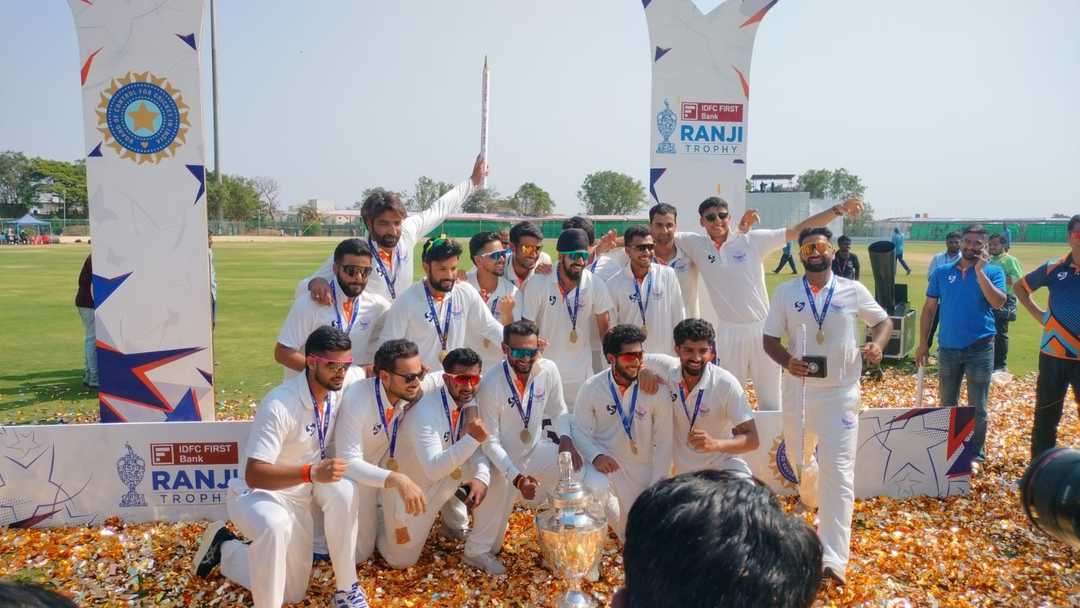
From no structure to Ranji Trophy glory: Mithun Manhas on J&K's rise
Mithun Manhas, now BCCI president, spent four years closely involved in the development of cricket in Jammu & Kashmir. Hours after J&K scripted history by lifting the Ranji Trophy for the first time, he spoke about their journey.
As a domestic cricket giant, how do you view J&K's win?
It is a proud moment for the entire state. I think a lot more boys and girls will take up cricket after this achievement. You will surely see the rise of J&K in the coming years.
What steps were taken for J&K to reach this level?
The journey started in 2021 when a sub-committee was appointed. There was no structure. Nothing was being done at the grassroots. We faced difficulties at every level, so the whole structure had to be revamped.
We put the structure in place and got the ball rolling. Many camps were held. We prepared turf wickets—initially, we did well on black soil wickets but struggled in the West and South Zones. So, we introduced red soil turfs and prepared turf wickets in Jammu. Now we have about 10-15 red soil turf wickets and about 10 black soil wickets. The same was done in Srinagar.
The sub-committee started using SG balls in training, so players get a proper feel of what they use in national games. That helped a lot.
Every year from April, we conduct a talent hunt across every district of J&K and Ladakh. Scouts move across regions, and whoever shows potential is picked. We create a pool and train them, ensuring they stay fit year-round with multiple camps and clinics.
When I joined, we had just one or two Level 1 coaches. Now we have more than 40 Level 1 and Level 2 coaches, supported by physios, trainers, and umpires. We worked on the entire system. Everything was changed.
We started sending teams to play tournaments. It is mandatory to play in the Buchi Babu tournament before the first-class season, and that’s what we do.
Can you identify specific factors that contributed to this success?
There are no one or two single factors. It's a collective effort. We keep improving. I don’t think J&K has peaked yet. There is a lot more to do.
What we lack is infrastructure. We don’t have stadiums. Other state teams have four or five grounds, stadiums, IPL matches—everything. We have the Jammu College ground. There is one stadium in Kashmir, and it does not belong to us. So, we lack infrastructure. The rest has been taken care of.
I thank Jay Shah, then BCCI secretary, who made a great effort to visit Jammu. He was the first BCCI secretary to visit Jammu in 67 years. Once he saw the ground realities, there was no looking back. Whatever we needed to take these boys forward was given. I thank him and the BCCI for their continued support.
We were not happy with the quota system of 8 and 8 [players from Jammu and Kashmir]. We wanted talented, disciplined young boys eager to play for the country to come forward—and that’s what we did.
How did you bridge the gap between Jammu and Srinagar cricket-wise?
It might appear like a regional divide, but in cricket, it’s about tapping the right talent and bringing the right kids to the fore. You pick the best talent, nurture them, and performance should be the only criteria.
Yes, there were difficulties. Some wanted to push their own players. But once you organize enough games and make performance the sole criterion, that changes everything. Otherwise, we wouldn’t be able to compete with the best.
We played a lot of matches—all age-group and senior teams played about 30-35 games before the season, which gave them confidence. We back them consistently. Earlier, if a player failed in one or two games, he would be dropped. The same was the case in women’s cricket. But now that’s not the case.
We back them because we know they are talented. It’s just a matter of time before they excel. The boys showed that. They played exceedingly well in the final, quarter-final, and semi-final. They dominated all sessions in the final across all five days.
We have beaten top teams at their home grounds—Mumbai, Baroda, Delhi, Madhya Pradesh, Bengal, and now Karnataka. When you support them, they start believing in themselves. Once that belief comes, the tide turns. That’s exactly what happened for J&K cricket.
How do you rate Auqib Nabi? What makes him special?
His consistency, clarity of mind, and the way he goes about his business. He is meticulous. He understands conditions and the wicket, and knows what will work best for him.
How difficult was it to bring Ajay Sharma as coach, given his background?
He has played five finals and has been a top domestic player. His inputs have been very useful to our batters. The best thing about him is that as a coach, it’s all about the players. He has worked hard on that, and I’m glad things have worked out.
What went behind the decision-making process?
Batting has been a concern because bowlers have taken the limelight in J&K—we have superb bowlers. We wanted to utilize our bowlers’ potential fully, so we decided to play on greener tracks, as that was our strength. But we needed someone with the right batting background—a domestic giant who has played many finals—to handle the pressure.
J&K is already on the rise. Over the past three to four years, they have qualified for knockout stages in different age groups seven or eight times, in sub-men’s and men’s cricket. J&K cricket is definitely rising, and I’m sure you will see many playing for the country, scoring runs, taking wickets, and winning premier tournaments.
Are you hoping selectors will consider J&K cricketers for the national team?
It’s their job and entirely their decision. It’s about the combination when selectors make a team.
Is there a chance J&K women replicate the men’s success?
They have been playing good cricket. In the coming years, you will definitely see it. Women have done well in the last 3-4 years. Whether it’s the under-15 team or the senior women’s team, they have made their mark. They are a force to reckon with, and I’m sure you will soon see them winning trophies.
Related Posts
 Pakistan find their perfect start – a little too late
 When Shanaka’s late blitz revived hope in a lost cause
 India aim to reframe unfamiliar pressure as privilege