


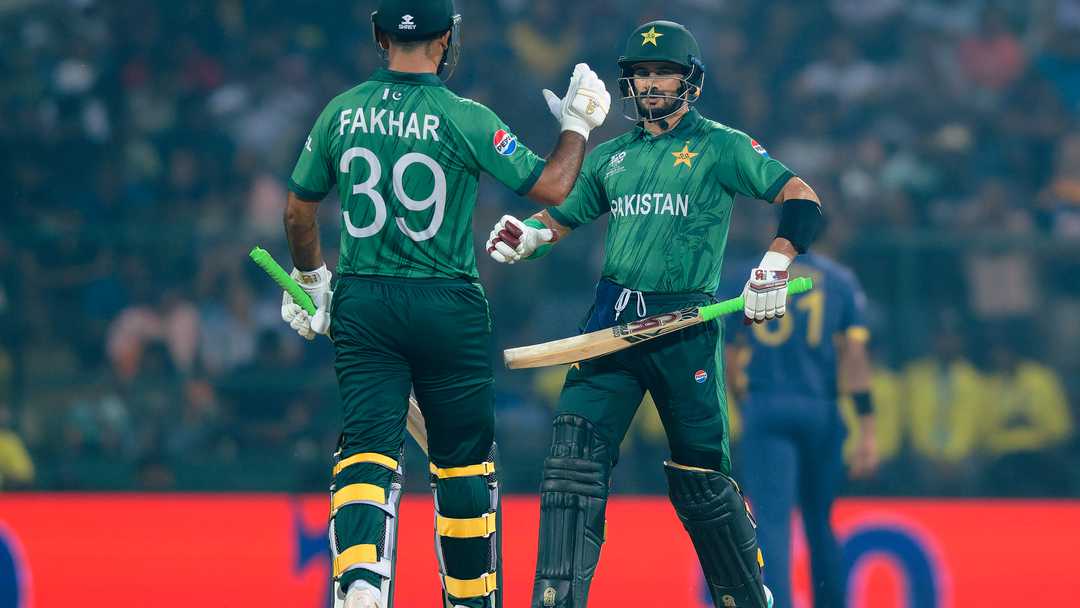
Pakistan find their perfect start – a little too late
Pakistan posted a sizable total of 212 against Sri Lanka, a score they needed to stay in contention for a semifinal berth. They required a victory margin of 64 runs or more, demanding a batting gear that has largely eluded them recently.
They left out Saim Ayub and Babar Azam, promoting Fakhar Zaman to open alongside the in-form Sahibzada Farhan. Against full-member oppositions before this game, Pakistan's opening stands in 2026 had produced only 113 runs across seven innings at an average of 16.14.
"We had an idea that whether we batted first or second, we would need a player like Fakhar to utilise the Powerplay. Saim was not in perfect form, so we felt Fakhar was the right option," said Pakistan captain Salman Agha.
The move worked decisively. Fakhar and Farhan exposed Sri Lanka's bowling with a powerful display. A half-century opening stand was raised in just 4.4 overs. By the end of the Powerplay, Pakistan had raced to 64, their joint third-highest in T20 World Cups. The team's 100 came up in only 9.5 overs, their quickest in a T20 World Cup match.
The pair took only 14 overs to bring up 150. It became the highest partnership for any wicket in T20 World Cup history. The stand finally ended in the 16th over when Fakhar chopped a Dushmantha Chameera delivery onto his stumps. Farhan went on to score a 59-ball hundred, becoming the first to score two centuries in a single edition of the World Cup.
"The way Fakhar was playing, I actually felt that if he had scored a hundred it would have been even better for the team. But it was my destiny to get it," Farhan said.
The scale of the effort is stark in context. Across their first five innings in the 2026 T20 World Cup, Pakistan's opening pairs had managed a combined 135 runs. This stand alone produced 176.
The numbers pointed to a clear shift in intent. Pakistan attacked 78.8% of deliveries in this innings, a sharp jump from the 65.6% recorded across their first five games. Their dot-ball percentage, previously the highest among Full Member teams at 39.2%, dipped to 29.1%.
The magnitude of Fakhar's knock was underlined by what followed. The opening partnership constituted 83% of Pakistan's total. In the 25 deliveries after Fakhar's dismissal, Pakistan managed only 36 runs and lost seven wickets.
"We batted really well for 18 overs, but if we had handled the last two overs better and scored 10-15 more runs, it could have been a different story," Captain Agha admitted.
The partnership marked a timely turnaround for Fakhar. Before this game, he had opened only eight times for Pakistan since the 2024 World Cup, averaging 19.25.
In the end, Pakistan were effectively defending 146 on a good batting surface. The tweaks, including the inclusion of Naseem Shah and Abrar Ahmed, did not yield the desired result as Pakistan bowed out at the Super 8s stage.
The takeaway lay in the approach at the top. The manner of that opening surge offered Pakistan a clearer template for what could work going forward. If only that switch had been flicked on earlier.
Related Posts
 When Shanaka’s late blitz revived hope in a lost cause
 India aim to reframe unfamiliar pressure as privilege