


The man who takes March off
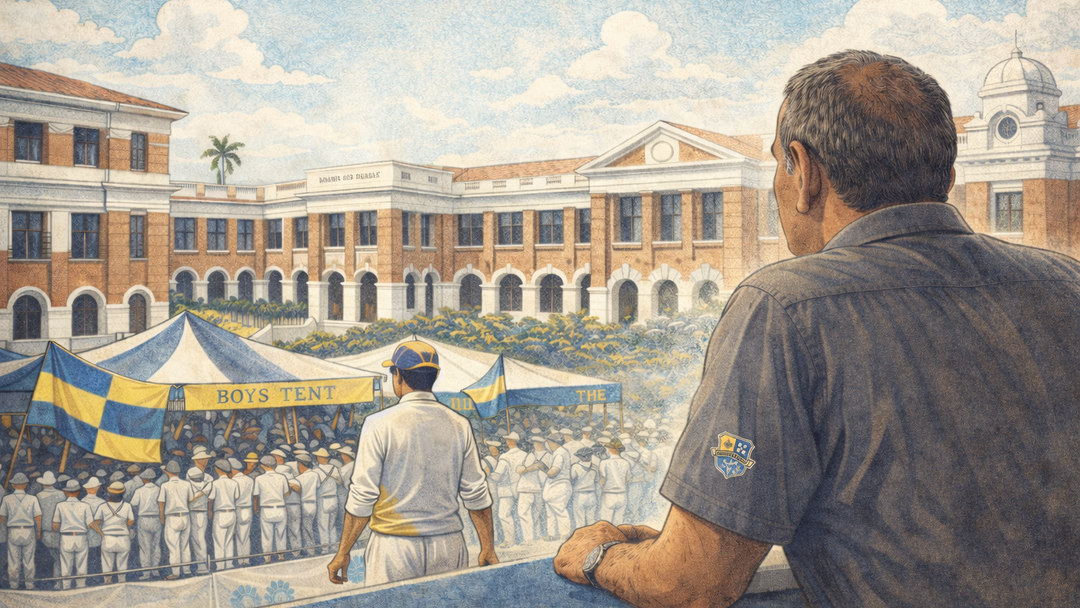
On a humid afternoon in late February, Ramesh Abeywickrama sits at a long table with a bottle of water beside him. A year ago, his cardiologist told him to slow down. He left a demanding job at KPMG and, after a break, joined a tech firm in Malabe. Before accepting, he made one request: he would need time off from mid-February to mid-March. He was not negotiating for rest, but for the Royal-Thomian Cricket Encounter.
For 146 years, boys from Royal College and S. Thomas' College in Colombo have met in the "Battle of the Blues." The rivalry has never missed a year.
Class of 1985, Abeywickrama now serves as Co-Chairman of the Royal-Thomian Joint Match Organising Committee. As a student, he never played in the Big Match. "I was never good at playing cricket," he says. "But I didn't want to be away from it. If I couldn't be on the field, I wanted to be somewhere around it."
After graduating, he stayed involved—first as a volunteer, then rising through the organising committee. Now, as Co-Chairman, he measures the rivalry by its endurance. It did not stop during the most volatile years of Sri Lanka's civil war, nor when the pandemic shut borders and silenced stadiums.
"It was a bubble before a bubble," he says of the 2007-2009 period. "People know the SSC as this historic cricket ground. But those three years, we had anti-aircraft guns inside the premises. Metal gates everywhere. Armed personnel. You could see rifles. It wasn't just cricket."
Security was tightened further because the families of the President and Prime Minister often attended. Spectators were ferried in organisers' buses, each checked before boarding. "A bomb can explode in the bus too, right?" Abeywickrama says. "So we had to think of everything."
The tents still went up along the boundary, more numerous than for most international fixtures at the SSC. The papare bands still played. The three-day match still began on time.
A decade later, COVID brought a different silence. In March 2020, the Royal-Thomian match went ahead before the threat was fully understood. A Thomian pilot who attended was later identified as one of the country's earliest cases. "The test results came out only on the last day," Abeywickrama says. "The match was done."
Health authorities ordered attendees to quarantine. The following year's match was postponed repeatedly before being played in October 2021, behind closed doors. The 143rd encounter was pushed to July.
Organising during bubbles required extraordinary measures. "We had to prepare for every possibility," Abeywickrama says. "Each school readied two teams. If one positive case meant the first XI had to isolate, another would step in. The match still had to go on."
Royal was also in administrative transition, without a permanent principal. S. Thomas' warden stepped in, working closely with authorities to ensure arrangements held.
"To be a chairman, you have to be a Royalist or a Thomian but there were no sides in that moment," Abeywickrama says. "Inside the committee, when we are responsible for the match, we are not thinking as Royalists or Thomians. We are thinking about the tradition. If one school is going through difficulty, the other has to step up. Rivalry cannot come before responsibility. That's how it survives."
The saying is simple: there is no Royalist without a Thomian, and no Thomian without a Royalist. The contest defines them, but so does the dependence.
Outside the committee, differences are clearer. Royal College, a government-funded national school, sends out nearly 800 boys yearly. S. Thomas', an Anglican private school, graduates about 200. On Big Match weekend, Royal's student tent dwarfs its counterpart. Alumni tents operate on donation and invitation. "We have undercover cops to ensure that students don't go into the Old Boys' tents and drink," Abeywickrama says.
But beyond the SSC, lines blur. The alumni networks often converge into a single sphere of influence.
Inside the committee, that convergence is practical. "When we deal with ministries or defence, Royal handles much of that," Abeywickrama says. "Government is more involved with Royal, so we are more in touch. Everyone works to their strengths."
The rivalry is loud. The cooperation is quieter. Abeywickrama wears a shirt embroidered with the Royal-Thomian logo. "Royal colours are blue and gold, Thomian colours are blue and black," he says. "So on the ticket, the words 'Battle of the Blues' have to be in blue. We are very particular about that."
Less than two weeks remain before the 147th edition. Ranjan Madugalle, former Sri Lanka captain and ICC match referee—a Royalist—will serve as chief guest, as tradition dictates.
Abeywickrama is at the Royal College Union office to sign cheques, clear invoices, and handle calls about tickets and tent allocations.
"March is a month of half-days and full attention," he jokes. "At heart, we just want a good game, keep the history going."
When the last tent is dismantled, Abeywickrama will return to his office in Malabe. Emails and spreadsheets will be waiting. But come next March, he will ask for time off again—not for himself, but for the one thing his heart does not mind beating a little harder for.
Related Posts
 Alyssa Healy’s greatness, in numbers
 India to play Afghanistan in New Chandigarh’s maiden Test