


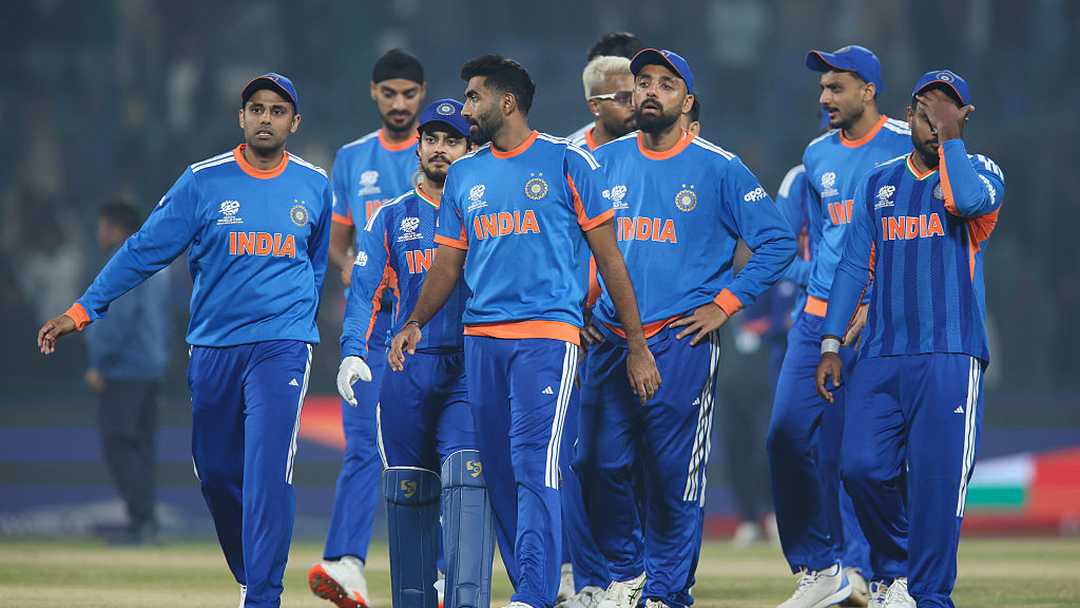
The tactical fault lines of the India-New Zealand final
The 2026 T20 World Cup final brings a sense of deja vu. Defending champions India face New Zealand in a global tournament final again. For India, the stakes are layered with history: no defending champion or host nation has lifted the T20 World Cup. New Zealand arrive as perennial outsiders, armed with a spotless 3-0 record against India in this tournament.
Both teams have lost only once during the Indian leg of the competition—both defeats coming against South Africa in Ahmedabad, the venue for the final.
What does Ahmedabad offer?
Ahmedabad has been one of the more batting-friendly venues. The average first-innings score is 189 with a scoring rate of 9.13. Since 2021, 11 T20Is have been played under lights here, with teams batting first holding a 7-4 win-loss record.
A pattern: in all seven wins by teams batting first, totals of 185+ were posted. In the four defeats, targets were below 180. New Zealand prefer chasing. They have won all four games batting second in this edition, while both defeats came batting first. That makes them more dependent on the toss than India, whose squad depth allows them to both post par-plus totals and defend them.
Venue-wise record in T20 WC 2026
| Ground | Mat | Avg 1st Inns | RR |
|---|---|---|---|
| Chepauk | 7 | 197 | 9.41 |
| Ahmedabad | 6 | 189 | 9.12 |
| Wankhede | 8 | 184 | 9.14 |
| Eden Gardens | 7 | 182 | 9.03 |
| Colombo SSC | 5 | 175 | 8.08 |
| Pallekele | 6 | 172 | 8.69 |
| Colombo RPS | 8 | 171 | 7.91 |
| Delhi | 6 | 158 | 8.01 |
The final will be on a mixed soil wicket. Only one game has been played on this strip: South Africa vs Canada, where 213 was replied with 156.
Ahmedabad has been the worst venue for spinners in the tournament. For seamers, the good length band (6-8m) has been most productive: 14 wickets at 19.29, economy 6.35/over. Variation of pace has been effective: pace-off (<128 kph) deliveries have produced 26 wickets at 18.80, compared to 26 wickets at 31.07 for pace-on (>128 kph).
Pace vs spin in Ahmedabad this WC
| Type | Balls | Wkts | Avg | ER | SR | Dot% |
|---|---|---|---|---|---|---|
| Pace | 911 | 52 | 26.05 | 8.92 | 17.5 | 38.6 |
| Spin | 480 | 21 | 35.57 | 9.33 | 22.8 | 27.7 |
On paper, these conditions could give New Zealand a slight edge.
New Zealand's dominance against pace
New Zealand have been the standout batting unit against fast bowling, averaging 55.50 and striking at 177.12. They are destructive in the good length zone (6-8m), averaging 52.50 with a strike rate of 185.84. They handle slower balls exceptionally well, scoring 197 off 113 balls against deliveries under 128 kph while losing only two wickets.
New Zealand batters vs pace by length
| Length | Dis | Runs | Avg | SR |
|---|---|---|---|---|
| Full (< 6m) | 5 | 246 | 49.20 | 193.70 |
| Good (6-8m) | 4 | 210 | 52.50 | 185.84 |
| Short (> 8m) | 3 | 210 | 70.00 | 154.41 |
This dominance is driven by openers Finn Allen and Tim Seifert. Allen scores off pacers at a strike rate of 223.76, with 226 runs for two dismissals. Seifert strikes at 166.66, averaging 63.33. The pair has scored 48% of New Zealand's runs; no other batter has crossed 200 runs.
India's distribution is more balanced. They have four players with 200+ runs, while Hardik Pandya and Tilak Varma have 199 each. Five of those six batters strike above 150.
Allen's numbers dip against spin: dismissed three times in 41 balls, strike rate 153.65. Since July 2024, he has been dismissed by spin five times inside the first 10 balls of his innings in T20s. In this tournament, he fell twice inside the Powerplay to mystery spin—a potential opening for India's Varun Chakravarthy.
Allen's preference to stay deep against spin could bring Axar Patel into play. Axar's skiddy trajectory from around the wicket can cramp him. In Allen's only bilateral appearance against India, Axar dismissed him that way.
Seifert's matchup favors Jasprit Bumrah: 46 runs off 37 balls with two dismissals. Arshdeep Singh has also troubled him, dismissing Seifert twice in 18 balls recently.
If India break the opening pair early, their spinners could target New Zealand's middle order. Axar holds favourable head-to-head numbers: he has dismissed Glenn Phillips three times in 21 balls, and removed Mark Chapman and Daryl Mitchell twice each.
Axar Patel H2H vs NZ batters in T20s
| Batsman | Balls | Runs | Dis | Avg | SR |
|---|---|---|---|---|---|
| Phillips | 21 | 31 | 3 | 10.33 | 147.62 |
| Mitchell | 26 | 34 | 2 | 17.00 | 130.77 |
| Chapman | 24 | 33 | 2 | 16.50 | 137.50 |
| Allen | 10 | 15 | 1 | 15.00 | 150.00 |
| Seifert | 10 | 10 | 0 | – | 100.00 |
How do New Zealand neutralize Jasprit Bumrah?
India have backloaded Bumrah's overs recently, but strategy could change against New Zealand's opening threat. Bumrah has succeeded across lengths; batters find his slower balls difficult. He has nailed 20 yorkers this tournament.
Most New Zealand batters struggle against him, but Daryl Mitchell is an exception. Mitchell scored 44 runs off 33 balls against Bumrah in ODIs without dismissal, and 56 off 33 in T20s. In a recent bilateral series, he took 40 runs off 15 balls.
New Zealand's spinners and the matchup puzzle
India's left-right balance is remarkable: 55.7%-44.2% distribution between left and right-handers, the most balanced in the competition.
However, a vulnerability has emerged: off spin. India have lost 15 wickets to off spin at an average of 15.86 and strike rate of 120.20, the worst among any team. Left-handers struggle: Ishan Kishan has fallen five times, Abhishek Sharma three times, while Tilak Varma's two dismissals came at a strike rate under 100.
India batters vs off spin this World Cup
| Player | Inns | Runs | Balls | Dis | Ave | SR |
|---|---|---|---|---|---|---|
| IP Kishan | 6 | 65 | 48 | 5 | 13.00 | 135.41 |
| A Sharma | 5 | 29 | 27 | 3 | 9.66 | 107.40 |
| NT Tilak Varma | 5 | 43 | 44 | 2 | 21.50 | 97.72 |
| HH Pandya | 3 | 20 | 8 | 2 | 10.00 | 250.00 |
| SA Yadav | 5 | 39 | 34 | 1 | 39.00 | 114.70 |
Cole McConchie dismissed two South African left-handers in the semifinal. With India fielding five southpaws in their top eight, he could have a larger role. Abhishek Sharma's three dismissals to off-spin came attempting cross-batted shots.
India's counter could be Sanju Samson. If he settles, he can target McConchie. New Zealand have options: Matt Henry dismissed him twice in 10 balls recently; Lockie Ferguson has dismissed him twice in 21 balls in T20s.
Captain Mitchell Santner has favourable matchups against India's right-handers: he has dismissed Samson three times in 10 balls, restricted Suryakumar Yadav to a strike rate of 119 for five dismissals, and dismissed Hardik Pandya twice.
Santner vs India's batters in T20s
| Batsman | Balls | Runs | Dis | Avg | SR |
|---|---|---|---|---|---|
| Surya | 79 | 94 | 5 | 18.80 | 118.99 |
| Samson | 10 | 2 | 3 | 0.67 | 20.00 |
| Hardik | 50 | 62 | 2 | 31.00 | 124.00 |
The importance of Shivam Dube
Shivam Dube's entry point could be decisive. In the semifinal, promoted to No. 4, he attacked Adil Rashid with 22 off 8 balls. This World Cup, he has been devastating against spin: vs leg-spin and left-arm orthodox, 56 runs off 24 balls at 233.33 strike rate. His presence could deter Santner from using Rachin Ravindra.
There is a defensive window: Dube doesn't score much behind square. Bowl full within his step-hit range (<5m) at straighter lines—eight balls yielded five runs. For back of length (5-6m), bowl wider outside off—12 runs off ten balls. Anything shorter than 6m, his strike rate shoots above 200.
However, high pace and hard lengths may counter him. Against seamers this World Cup, Dube has faced 51 balls pitched good length or shorter (>6m), scoring 60 runs with three dismissals. Against fuller deliveries: 0/66 off 35 balls. Suryakumar Yadav has an excellent record against Lockie Ferguson: 93 runs off 44 balls without dismissal.
Selection dilemma for New Zealand
Given India's left-right combinations, New Zealand may consider adding another specialist bowler. While James Neesham's 13 overs have yielded three wickets at an economy of 10.38, Kyle Jamieson's height could be valuable. His high release point may make variations harder on this surface. He has recent IPL experience in Ahmedabad.
Related Posts
 New Zealand Women vs Zimbabwe Women,2nd ODI,Zimbabwe Women tour of New Zealand, 2026,2026-03-07 22:00 GMT
 Bharat Arun backs Chakaravarthy, calls for attacking approach in final