


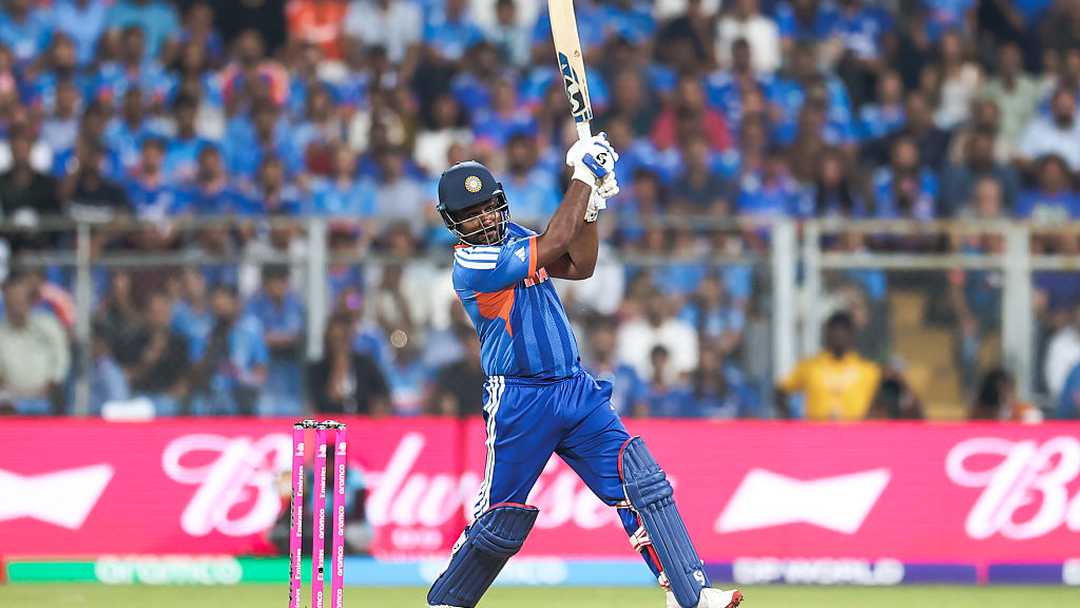
Losing early wickets made us think that we had to utilise Sanju – Kotak
Sitanshu Kotak, India's batting coach, reflects on the 2026 T20 World Cup journey in an exclusive interview with Cricbuzz.
Looking back now, how do you reflect on this World Cup campaign? Was the approach to strike a six from the first ball?
No. With eight good batters, our approach had to remain consistent. If we did not lose more than two wickets in the PowerPlay, we would always go at over 10 runs an over from the start. Our only real worry was losing three or four wickets quickly.
Our thinking was to go hard from ball one. Even if we lost a couple of wickets, we would not slow down. For the next six to eight balls, we would play shots with a lower risk percentage to rebuild a partnership.
We focused on partnerships. In the last two games, we scored over 250. In the semifinal, we had partnerships like 22-ball 45 and 8-ball 24. With a strong batting unit, you can only lose if there is a big collapse.
The loss against South Africa was important because it reminded us we cannot lose three or four wickets together. You simply cannot win a T20 game if that happens. The guys were very selfless in the way they batted.
Head coach Gautam Gambhir has advocated for a high-risk, high-reward style of batting. As a batting coach, how do you get the policy implemented?
From the openers to No. 8, everyone had a role. We knew the match-ups—when to send Shivam Dube, when to promote Hardik Pandya, and when Tilak Varma could go in. We knew we had to go hard.
Gautam and Suryakumar Yadav are two of the best leaders in this format. They knew exactly what we needed. I was very sure we would do well. I told them if we lose three or four wickets together, we could get stuck. Surya would try to play the first 8-10 balls carefully to build a partnership. He knew his role and sometimes sacrificed his own position.
Before the semifinal we discussed that we did not know what a safe total was. You could score 254 and still be in a fight. The ideology was the same for all of us—play with positive intent. If a player felt confident enough to hit a six off the first ball, he could. Even if he got out, it was not a crime.
From a batting perspective, what stood out for you in the last three knockout matches?
What I used to say was: we won four, we lost one—now we will win four again. So we will win the World Cup. We treated the last four matches as a pre-quarterfinal, quarterfinal, semifinal and final.
In the dugout, the atmosphere was very positive and confident. There was far more confidence than doubt. I always believed that our eight batters were unbelievably capable of changing the game at any time.
As a player, you were essentially a red-ball classicist and now you have coached the best T20 side in the world. What did it require you to change or adapt?
Once you start coaching, you should forget that you were a cricketer. I am not coaching a player to become like me. I am coaching a batsman to become the best version of himself.
Every player is different. Abhishek Sharma is completely different from Ishan Kishan. Sanju Samson is different from Tilak Varma. Tilak is different from Surya. Hardik is different from Shivam. Rinku Singh is different from the others as well.
Coaching is not about one style. When I am coaching a player, I look at his strengths. Then I see which areas might be a concern and where I can help him improve.
How do you fine-tune a ramp shot that you have never played?
I have completed BCCI, Cricket Australia, and ECB coaching courses. Those courses teach you about biomechanics and the technical aspects of batting.
Then comes the practical side—being on the ground, working with teams, gaining experience and sharing ideas. I came into the NCA when Rahul Dravid was there. I learnt a lot from him. Working with Gautam has also been a big learning experience.
I try to learn from the players as well. When they talk about certain things that I may not have thought about, I am very open. All that has taught me a lot technically.
The first four wins were comprehensive, if not all convincing. And then in the last four matches, India scored close to 1000 runs. Can you explain the sudden transformation?
After the South Africa game, every match was like a knockout. In all the bilateral series, as a batting unit we were creating momentum right from the start.
During the tournament, Sanju was a little out of form and Abhishek fell ill and also went a little out of form. The momentum we had created wasn't coming through 100 percent. The key was not to lose more than two wickets in the powerplay.
The USA game was a bit of a wake-up call. Surya's amazing temperament took us to an above-par score. The South Africa loss reminded us that all remaining matches were knockouts. A lot of credit must go to the players and the leadership of Gautam and Surya.

Sanju Samson struck half-centuries in each of India's last three games ©Getty
How did you keep Sanju Samson initially and Abhishek Sharma later motivated?
The belief was always there. I remember before COVID-19, during the India A vs South Africa series in 2019, Sanju had been sidelined but Rahul Dravid selected him. I promoted him to No. 3 in a rain-affected match. In about 30-35 balls he scored close to 90 runs against an attack with Anrich Nortje. From that day I always knew he was outstanding.
Later, in an ODI series against South Africa, I promoted Sanju to No. 3. He scored a hundred. I used to tell him, 'Sanju, you know how much I trust you. You should be ready because you might be the one who wins us the World Cup.'
Abhishek had three or four rough games. He is a wonderful kid—always smiling. At one point I felt he was trying to hit the ball too hard. That is not really his strength. He is more about timing. We tried to make small adjustments. Gautam suggested he use the crease more. Surya also played a big role in keeping players mentally relaxed.
I used to tell Abhishek that if he had scored in all those matches, I would actually be worried—because then the team might be too dependent on just one or two players. With the Indian team, if one player gets out, another will step up.
And then suddenly the opposition teams changed their strategy with off-spin upfront. What exactly happened there and how did you address that issue?
We had three left-handers at the top because Tilak was batting at No. 3. We had four games where we lost a wicket in the first over, and that was the moment we started thinking differently. It made us think that we had to utilise Sanju.
Rinku was not getting many opportunities at No. 8. We also needed to break that left-left-left combination. That is how Sanju came back. We decided we would go with two wicketkeepers. Once Sanju opened, the combination became left-right. That worked really well.
A lot of credit must also go to the selectors, the BCCI, Gautam and Surya for keeping faith in him.
How was the dressing room environment during the World Cup?
We kept the environment positive even during tough times. A lot of credit goes to Surya for maintaining a friendly and positive environment. Gautam was also absolutely brilliant. He never said anything that would put Abhishek or Sanju under pressure.
Tilak's strike rate looked a little low for a couple of games. In the Colombo match we wanted partnerships. We told him, "If you feel you could have been more aggressive, then don't hold back next time. Even if you get out, it's okay."
And when Ishan came back, how has it been working with him?
Ishan has been brilliant. I have known him since my time with the Gujarat Lions in the IPL. He is an unbelievably talented kid. When he came back, he was already a ready player. A lot of credit should go to the BCCI for the way our domestic structure is organised.
Gautam says he will not settle for totals of 150 or 160. The target should be 200-plus. We planned right from the powerplay that if we executed properly, the score should reach 220-plus.
Everyone talks about fearless batting. A lot more goes into it into being fearless.
I always tried to keep the players in the right frame of mind. I kept reminding them how good they are. The idea is to forget the last game if it didn't go well and remember the good innings.
We tried to give them everything they asked for—good practice sessions, specific bowlers in the nets. Once confidence is there, you can slowly introduce certain ideas. The player already knows where he might need to improve. Our job is to help him without making him feel it is a big flaw.
This high-risk, high-reward approach—do you think it will work in conditions like Australia, New Zealand, South Africa and England?
In team meetings, the first point is to assess the conditions and decide the par score. We analyse data on whether the new ball is doing more, or if scoring becomes difficult later. Our analysts put in a lot of work.
It's not just about different countries—even within India, conditions vary. We make tweaks based on what we see. Overall, I believe the high-risk, high-reward approach will always work in T20 cricket. The key is assessing conditions properly.
Now that everyone will copy the Indian template, what are the challenges before the Indian team?
We always try to bring something new. Styles can be copied, but it is better to create your own style. It comes from your nature, your thinking process, and the way you communicate.
How do you adjust your coaching to three different formats?
In T20 cricket, it is more about creating a solid base early to generate maximum power. In one-day cricket, a lot is about rotating strike and footwork. In red-ball cricket, footwork is very important—planning your innings, leaving the ball.
For me, T20 cricket is largely about aligning yourself well and creating a strong base to hit the ball.
What, according to you, was the difference between the 2024 and 2026 sides?
The earlier team was very experienced, with players like Rohit Sharma, Virat Kohli and Ravindra Jadeja. This current team has less experience. But having someone like Jasprit Bumrah helps.
The bigger difference was in the way the innings were planned. Rohit was fearless from ball one. Virat builds partnerships and takes the innings deep. Different players bring a different flavour.
Looking ahead, how do you see T20 batting going from here?
Scoring patterns are changing very quickly. By 2028, if conditions are batting-friendly in Australia and New Zealand, I would not be surprised if teams start thinking 250 might be a competitive first-innings total.
Players are becoming stronger and smarter. The game will continue to challenge players, coaches and everyone involved.
Related Posts
 Botswana vs Lesotho,3rd T20I,Lesotho tour of Botswana, 2026,2026-03-12 07:30 GMT
Titans vs KwaZulu-Natal Inland – Tuskers,16th Match,CSA Provincial One-Day Challenge Division One 2026,2026-03-12 11:00 GMT
Botswana vs Lesotho,3rd T20I,Lesotho tour of Botswana, 2026,2026-03-12 07:30 GMT
Titans vs KwaZulu-Natal Inland – Tuskers,16th Match,CSA Provincial One-Day Challenge Division One 2026,2026-03-12 11:00 GMT