


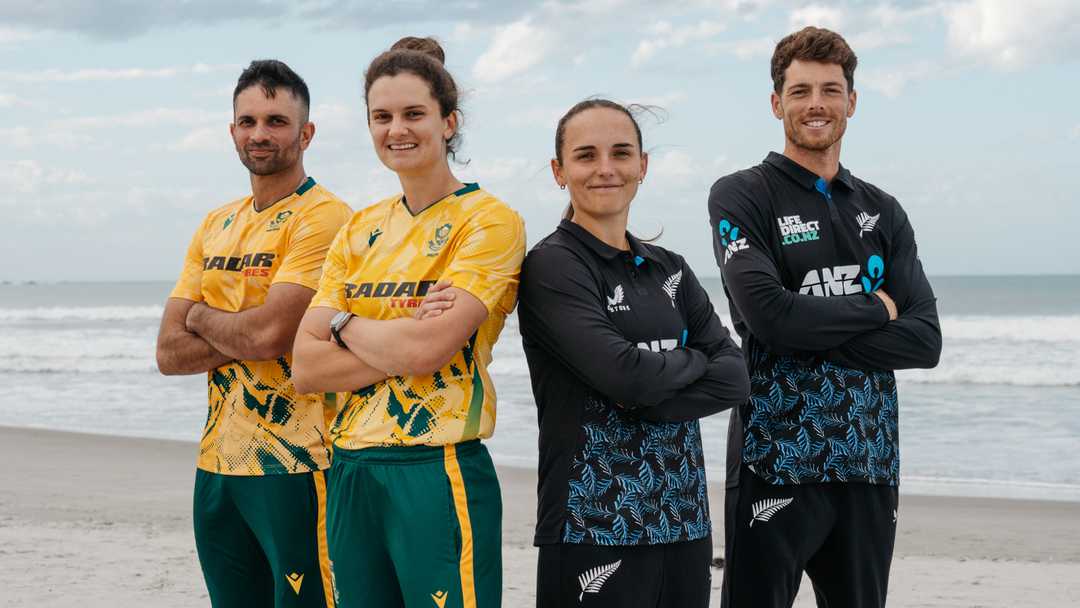
South Africa go far to get away from it all
New Zealand is far from anywhere. But is it remote enough for South Africa to forget what happened at the men's T20 World Cup?
No. Their meltdown in the semifinal at Eden Gardens was only 11 days ago, and they suffered it against New Zealand. It will take far more than 11 days to explain how the only unbeaten team in the tournament could flop so abjectly, crashing to 77/5 and losing by nine wickets with 43 balls to spare.
Maybe you don't explain it. Maybe you consign it to catastrophe and move on. After all, they're in Mount Maunganui, where they will play the first of five T20Is on Sunday.
The New Zealanders will also be hurting after their 96-run defeat by India in the final. Mitchell Santner's men were surprise semifinalists, nevermind finalists. But how could they play so poorly against India having dismantled the tournament favourites just four days previously?
Or perhaps not, if Devon Conway's view is to be believed: "Obviously it was a fantastic World Cup for the group… We were a little bit gutted not to get over that final hurdle admittedly."
A "fantastic World Cup"? And how is it possible to be only "a little bit" gutted?
It's the incomprehensible versus the incredulous, and it's coming soon to a ground near you.
"We're good to go and it's going to be a wonderful day of cricket come Sunday," Keshav Maharaj, South Africa's captain for the series, said. Maharaj is among the most indefatigably optimistic of humans, but even he might have asked himself if he believed what he was saying.
There is a mitigating factor. Maharaj is among only three T20 World Cup squad members in South Africa's current group – compared to eight New Zealanders. The other two, George Linde and Jason Smith, played in just half of their team's eight matches. The South Africans have just 160 T20I caps collectively, less than a quarter of the home side's 649.
There is a healthy departure from all that in the shape of the women's teams, who will play T20Is before the men's games on the same day and pitch at all five venues—a rarity in bilateral cricket.
"It's an opportunity to see what the conditions are like first," Maharaj said. "But, more importantly, women's cricket has come along leaps and bounds, and it's wonderful for them to have the stage as well… It's exciting for us to be able to witness it live."
Laura Wolvaardt concurred: "It's a cool way to tap into [the men's] knowledge as well… You feel like one big team, sharing knowledge and talking to each other. And seeing how they go about things."
It's tempting to hope the men learn from the women. The South African women will take 921 caps into the series and the New Zealanders 864. That makes the women more than twice as experienced as their male counterparts across both squads.
But that theory works for one side only. Wolvaardt's team shambled to a 32-run defeat against New Zealand in the 2024 T20 World Cup final—a performance as inexplicable as the men's zombie display 11 days ago.
However, that Dubai disappointment was almost 17 months ago. Besides, that failure has been relegated by India's 52-run win over South Africa in the 2025 ODI World Cup final in November.
Unlike the men's games in this series, which hold little relevance with the next global T20 tournament two years away, the women are playing for something. The start of the T20I World Cup, in England and Wales, is only 91 days away.
That's a lot closer, if we allow ourselves to be non-specific about time and space, than New Zealand is from anywhere.
Related Posts
 Cayman Islands vs Suriname,10th Match,ICC Men’s T20 2028 World Cup Americas Sub Regional Qualifier B, 2026,2026-03-14 19:30 GMT
 Dravid, Binny, Mithali to be honoured with BCCI lifetime achievement awards