


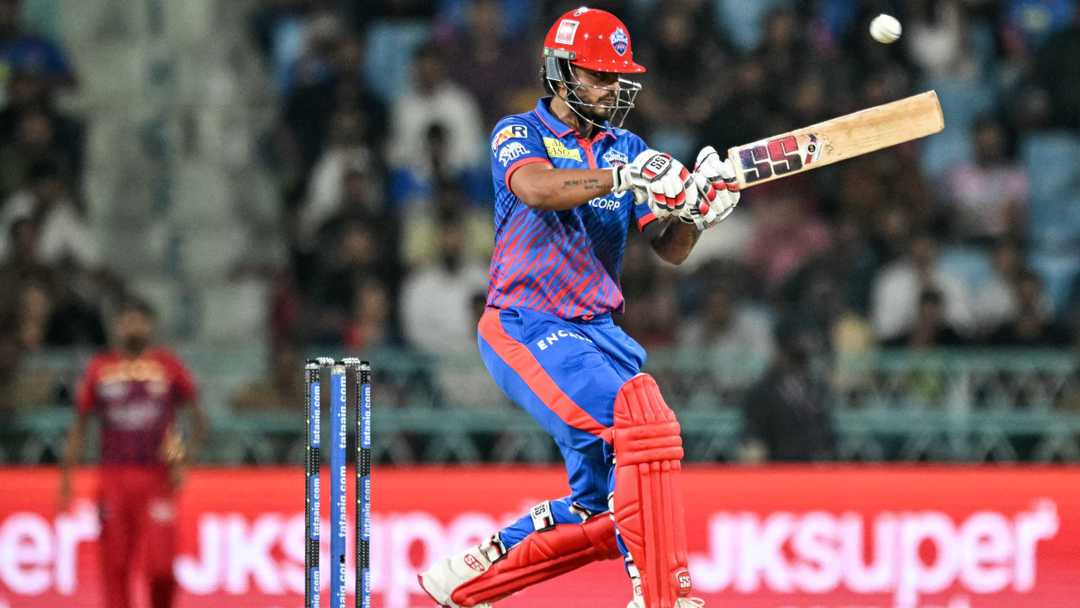
Nitish Rana: 'I had self-doubts in 2016, I am more sorted now'
Nitish Rana is in his 11th IPL season in 2026, but doesn't feel like a veteran yet. In a freewheeling chat, he opens up about his trade to Delhi Capitals, his favourable match-up against R Ashwin, how captaincy has elevated his game, and an early IPL memory involving Sachin Tendulkar.
What was your first-ever IPL memory?
In my second season with Mumbai Indians in 2016, I was playing a practice game. I had scored around 40-45 runs. A childhood friend of mine had come to watch. He was sitting very close to Sachin Tendulkar sir, who was there watching. Sachin sir was asking about me and praising me a little. When we got back to the hotel, my friend told me about this. That memory has stayed with me. If such a great player has good things to say about you, it gives a different level of confidence.
Can you break down the whole trade process that brought you from Rajasthan Royals to Delhi Capitals?
When this trade proposal came to me, it was on the last day. I got a call around 7:30 PM. I had only spoken to a few people. I called Rishabh Pant because no one knows this franchise better than him, and he's a close friend. Then I had a call with Axar Patel. As a captain, he showed a lot of interest and explained the system and his plans for me and the team. After everything was signed, I got messages from KL Rahul bhai, the management, coaches, and owners.
There was no better opportunity for me. I've been playing all my cricket from childhood at the Feroz Shah Kotla stadium. I am a Delhi boy, so I always felt this opportunity would come.
If you had asked me 4-5 years ago, maybe my answers would have been different. I was playing for another franchise and was very happy there. But whatever was written, it happened. I am very glad to represent Delhi Capitals at this stage of my career.
In 2023, you captained KKR. It was also your best season with the bat—413 runs in 14 innings at a strike rate of 140.96. Did captaincy elevate your batting?
I feel that when I am given a responsibility, my performance is better. I have played cricket like that since childhood. I was 15-16 when I was captaining in club cricket. I learnt to take responsibility from there—thinking I am the only player who can win my team the match. I would think about how I can become the best player among the 22 on the field.
That mentality was instilled in me by my childhood coach, Sanjay Bhardwaj sir. He gave me that responsibility early.
When I got that responsibility in the IPL, I won't say I was under pressure. I knew it would take my game to the next level. Initially, in a couple of games, there was pressure because it was a very big stage. To captain there, manage everything, focus on your batting even when results aren't going your way—there were a lot of things. But as we won one or two games, I got a lot of confidence. That season taught me a lot.
What difference do you see in Nitish Rana the batter of 2016 and Nitish Rana the batter of 2026?
In 2016, as a batter, unless you do something worthy at any level, you always have a little doubt. I had that doubt—was I made for this big stage? Have I prepared in such a way that I can prove myself? Can I play IPL for 10-12 or 15 years?
I had these questions in 2016. Even in my first year, I scored 70 off 36 in the last game of the season. Once you do something at that level, and when you start to believe in your system and processes, you start to think your preparation was good. You learn from any season what you have to improve in your batting or off the field to become a better player.
That was my process from 2017-2018 till now in 2026. That journey has taught me a lot. I probably can't tell the difference as such, but yes, I am more sorted now. I have learned to avoid a lot of things. I've got a lot of belief in my game now.
I know the T20 game involves a lot of failure because there are many risks. Before, when I used to get out early, I'd punish myself. As a kid, I had a habit: if in a 40-over game I got out inside 10 overs, I would sit out in the sun for the remaining 30 overs to punish myself. So the next time, I knew the importance of staying in.
I used to do that in my early years, but now I've changed. Over the years, I've understood that the more you complicate cricket, the tougher it gets. You have to keep it simple. A ball will come at you, and you have to react. You have to control yourself, not external things. I've learnt all that over the years and am enjoying myself now.
You have a great record against R Ashwin in the IPL—71 balls, 141 runs, 10 fours, 10 sixes. What is it about this match-up that you do well?
I have never thought about this. I've learnt this stat for the first time. I've been playing spin from my childhood because I practiced on slow wickets in Delhi. So I don't have a problem facing spin. But I haven't thought about getting the better of any off-spinner or Ashwin bhaiya.
There are match scenarios and situations, and I try to bat accordingly. If I feel in a game that I could hit a particular bowler for 20 runs in an over, why shouldn't I? It's not about match-ups for me.
In a T20 game, if you're batting in the middle-order, it is very important to have two big overs. If you don't, you'll end up with a total under 180. So that's the mindset. The risk-reward mindset is very important. I never thought about particular match-ups.
But yes, before a game, I do think about which bowlers to target, from which end, in which situation. It's not that I can go out and start hitting from the first ball. Sometimes I need to do that, and I've done it too. I try to play for the situation and the demands of the game, and try to take 1-2 big overs. So maybe because of that, this stat sounds so good.
In this impact player era, with so much focus on six-hitting, has there been any noticeable change to your training methods?
No, for me there's not been any change because I've been playing my cricket the same way. That doesn't mean I don't want to learn anything new or add something to my batting. But I haven't changed anything because I am a top-order batter. I like to run the game, take it deep, and bat according to the situation. I like to bat in both gears.
If the team needs me to build a partnership over four overs without risks, I enjoy that. If the team needs me to attack from the first ball, I like that too. Overall, I feel I am a smart batter rather than a free-flowing batter who will bat only in one gear. That was never my type, and I never wanted to become like that.
I bat in the nets with this mindset. Sometimes in Kotla, you get a tough practice wicket—slow with low bounce. I try to gauge the wicket in the first 3-4 balls and adjust. If playing shots is tough, I try to rotate strike or hit fours instead of sixes.
If I know I have to play on a very flat wicket, like in Eden Gardens or Wankhede, I practice accordingly and get a little more attacking because the ball comes with good bounce. My practice is tailored like this, and it has always worked for me.
What's been your most memorable knock in the IPL?
When my father-in-law expired in 2020. It was a game against DC in Abu Dhabi when I was playing for KKR. Just the night before the game, I got the news of his death, and a few hours before the match, I found out I had to open the innings. That was the first time in my life I was opening in T20 cricket. It was a very uncomfortable zone—I had lost someone, there were a lot of emotions, and I was about to do something I hadn't done in the IPL.
That innings is always in my mind because that zone was very different. I probably can't explain it in words. I scored 81 off 53 in that game, and after that, I felt I did really well considering the emotions I was going through. So that knock is very memorable for me.
Related Posts
 Independent probe committee recommends ‘free and fair elections’
 ‘I will be the last person to go’ – Aminul on resignations in BCB
 Minhas stars in Islamabad United’s facile win