


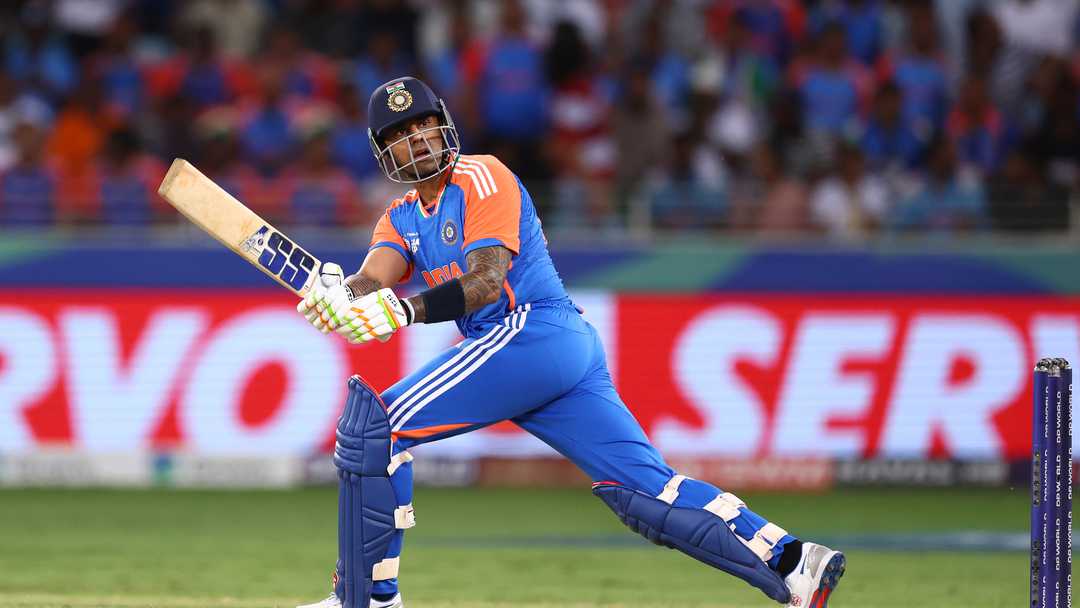
What the data shows about Suryakumar Yadav's recent slump
Suryakumar Yadav insisting he is "out of runs, not out of form" is a batter's familiar act of self-belief. It is also an important distinction in cricketing language. A player out of runs is assumed to be doing most things right but lacking outcomes, while a player out of form is thought to be battling deeper technical issues. In Suryakumar's case, however, the numbers from the last 15 months suggest the line between the two may no longer be as clear-cut as he would like it to be.
From his debut in early 2021 to late 2024, Suryakumar was arguably the most disruptive T20 batter in the world. His ability to score at will, regardless of field placings or matchups, made him a once-in-a-generation outlier in an Indian batting order otherwise built on orthodoxy. He not only accumulated volume of runs but scored them in a way that warped bowling plans of opposition captains.
A third of his runs against pace came from the quarter-pie region behind square on the leg side, an area most batters treat as a release option rather than a scoring zone. What made him exceptional was that bowlers could not overcorrect, as anything outside off stump could disappear over extra cover just as easily.
That version of Suryakumar, which even made a certain Virat Kohli at the non-striker's end awestruck, now feels distant. Since November 2024, his returns against pace have collapsed in a scarcely believable way.
In 19 dismissals during this period, 18 have come against seamers. His average of 8.11 and strike rate just under 110 against pace represent a drastic fall from the heights of his prime. More telling than the raw numbers is the manner of those dismissals: 16 of the 18 have been caught dismissals, and almost all have come from genuine aerial strokes rather than forced mistakes or defensive prods.
This pattern challenges the idea that he is merely "out of runs". Suryakumar's dismissals show intent without control, which is often a dangerous combination in T20 cricket, especially early in the innings. Thirteen of his 18 dismissals to pace have come within his first 10 balls, a phase in which he has faced close to 80% seam bowling in international cricket over this period.
The contrast with IPL 2025 is instructive. In that tournament, batting largely in the same positions (three and four), Suryakumar put together 16 consecutive scores of 25 or more and was not dismissed once in his first 10 balls. The key difference was the bowling composition he faced. In IPL 2025, his first 10 balls were almost evenly split between pace and spin – 82 balls of pace and 77 of spin – allowing him to ease into innings without being rushed by high-pace, hard-length bowling. Across the season as a whole, he faced virtually identical volumes of seam and spin (213 balls of pace and 214 balls of spin).
Internationally, the context has been far less forgiving. Eighteen of India's last 25 T20Is since November 2024 have been against SENA oppositions, teams that rely heavily on pace even in the middle overs. Suryakumar has walked in repeatedly to confront a barrage of seamers and this has created what can reasonably be called a perfect storm – his most difficult matchup arriving at his most vulnerable phase.
Yet context alone does not explain the decline. There has also been a measurable shift in his shot selection and execution. Until October 2024, Suryakumar hit 16.1% of balls in the air against pace in his first 10 deliveries. Since November 2024, that number has risen sharply to 23.3%.
More concerning is the drop in control. Previously, he was in control of 86% of aerial shots in that phase; that figure has now fallen to 52%. In simple terms, he is hitting more balls in the air and controlling far fewer of them – a recipe for frequent dismissals.
Changes of pace have further exposed this vulnerability. Five of his 16 caught dismissals against seamers in this period have come off deliveries clocked under 80 mph – the genuine pace-off deliveries like cutters or slower balls. Bowlers have become smarter not to offer him pace that he can use to his advantage and are rather taking pace off, dragging him into mishits and trusting the deep fielders. For a batter whose game is built on rhythm and bat speed, these slower balls early in the innings have proven especially disruptive.
The erosion of his scoring zones underscores how fundamental the shift has been. From averaging 58.55 scoring behind square on the leg side against pace until October 2024, he has averaged just 7.83 since – a collapse of the area that once defined him. Bowlers, no longer fearing his flick and whip, have been able to hold straighter lines without conceding easy runs.
Specific shots tell the same story. The flick shot, long his bread and butter, has gone from an average of 53 at a strike rate of nearly 250 to an average of 6.14. Driving on the up, another high-risk, high-reward stroke, has similarly cratered. They point to repeated outcomes than random failures from the same options, suggesting opponents have decoded Surya's game to the T.
None of this suggests that Surya's game has suddenly deserted him or that his peak years are behind him. The IPL evidence shows that his instincts, range, and scoring imagination remain intact when the early conditions allow him time to settle. The upcoming series against New Zealand and the group stages of the T20 World Cup should serve as a stage for the Indian captain to sort his game out ahead of the bigger challenges. If he does, the version of him that follows can still be one of the most destructive batters the format has seen, the one we are accustomed to.
Related Posts
 Can Dube level it up for CSK?
 Reyneke’s last-ball six on ODI debut seals dramatic win for SA
 Tanzim Sakib nears full intensity return, targets April comeback