


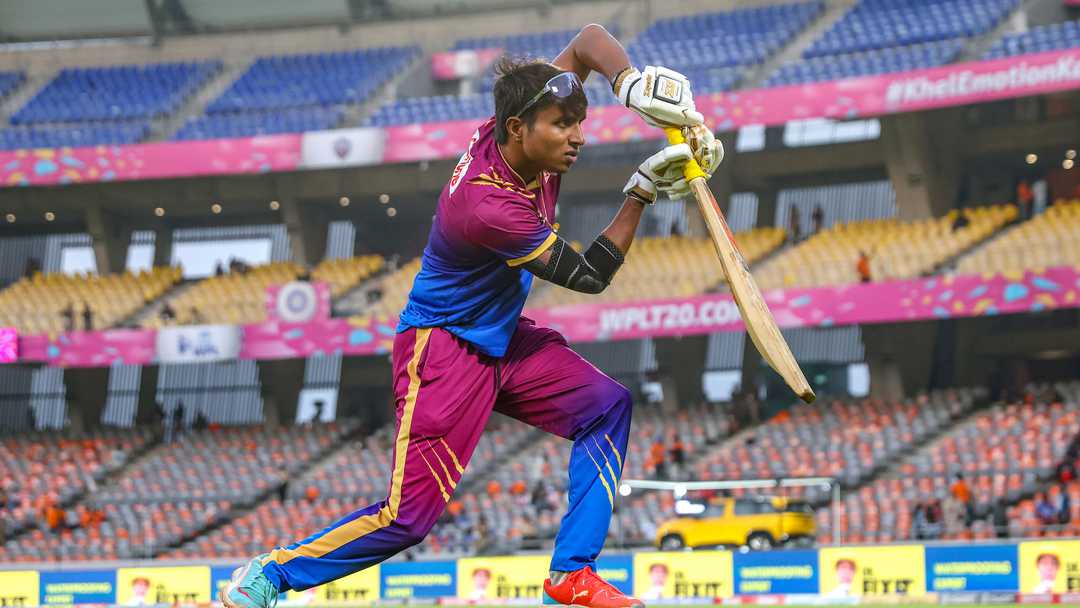
Dropping down to rise again – Bharti Fulmali's road to India recall
Between deplaning from the Mumbai-Vadodara flight and collecting her kitbag, Bharti Fulmali had Gujarat Giants teammates come over to congratulate her. Her phone was on flight mode, so the surprise showed. When she switched it on, it wouldn't stop buzzing. The first call back went to her sister, but the backlog of messages was overwhelming.
When she called home to share the news of her India recall for the Australia tour—nearly seven years after her first and only international series—she found the internet had already informed her family. Amid the noise, Fulmali herself had been the last to know the wait was over.
When Fulmali debuted in March 2019, Indian women's cricket was in a different place. Domestic matches weren't televised, and opportunities once missed didn't always return. After an exceptional domestic season, she earned her cap. Two matches and two failures later, she was sidelined.
"At the time I felt I got very few opportunities," Fulmali tells Cricbuzz. "It all happened in a jiffy—good domestic season, India call-up, two quick games and then the drop. But, it's okay. These challenges are part of a sportsperson's life. I got two games, I had to make it count and I couldn't. That phase after was very hard."
The gap between domestic and international cricket was stark. Fulmali waited for a recall, but it didn't come. Then COVID hit, and a year passed without international women's cricket. Intrusive thoughts crept in, including whether it was time to walk away.
"Once you are dropped from the Indian team, a comeback is quite hard. The thought to walk away always kept coming back."
Her family's support kept her in cricket. "Tu bindaas khel, kuch nahin hoga (you focus on your cricket, we'll take care of the rest)," her father assured her when she discussed household finances.
Finances remained a concern. She wanted to join Railways for security, but they weren't keen initially. When they showed interest, she chose to stay with her state side to improve her visibility. "I had lost the Railways opportunity." She kept applying for jobs through sports quotas whenever recruitment notices appeared.
In 2023, she joined the Income Tax Department in Bengaluru, becoming the first woman cricketer in the country to do so. Financial independence was no longer optional.
Cricket continued alongside work, with leave for camps and tournaments. Her focus shifted from an India comeback—which felt like wishful thinking—to winning domestic trophies for Vidarbha, which could pave her way back.
In staying relevant, Fulmali made a quiet, career-shaping decision. She stopped focusing on where she wanted to bat and instead asked where she could matter most to the Indian side. The top-order was crowded. The lower-order, especially in T20s where India sought finishers, was not.
"One day, on self-introspection, I asked myself 'which slot is readily available?' Middle-order or a finisher's role. 'Right, so, what's in my hand? How do I stake a claim?'"
Thus began the reinvention.
It wasn't popular. Coaches and family questioned why she was "dropping herself." Batting lower meant fewer balls and highlights. But Fulmali wasn't in it for optics.
"Maine socha, yaar, scores kisko dikhana hain? My job was not to put up a big score match after match. My job was to show impact. If the team won because of an impact knock, I knew I'd make the highlights reel enough to get noticed."
Backed by then state coach Anju Jain, she embraced the finisher's role, relishing the challenge of closing games instead of building innings at one-down.
"If I was harbouring dreams of playing on big grounds, in front of packed crowds—for India or in WPL—I had to learn how to handle the pressure of winning games."
This resurgence demanded hard work. She convinced her personal coach, Sandeep Gawande, and they rebuilt her batting for a specific role: maximizing 10-15 balls.
They trained in open nets, on centre wickets, with academy kids as fielders. They used tennis balls—if she could clear 50-60m ropes with those, a leather ball in the slog overs would be easier.
"I'm not big on batting in nets. I needed to know where exactly my shots were going. If I was getting only a handful of balls to make an impact, I need to have my shots, the power-hitting, the six-hitting ability."
Gawande set brutal targets: in 12-ball sets, seven or eight had to clear the boundary. They repeated drills over a dozen times per session, with varying field settings and bowlers. If targets were met, boundaries were pushed back next session.
She added more shots: conventional sweeps, slog-sweeps, inside-out over covers—shots rare in women's cricket, targeting vacant areas. Hitting in the V wasn't enough; she expanded her range to exploit all death bowling.
Despite the work, rewards weren't instant. She went unsold in the first two WPL auctions.
"It was disappointing. I had the runs, the strike-rate was good. But I still went unsold."
Then, while watching a WPL game at home, her phone rang. Gujarat Giants needed an injury replacement for Harleen Deol.
Within 24 hours—packing, traveling, joining the squad, training—Fulmali was in the XI. "It all happened so fast, I didn't get time to process my emotions. It all just went in the flow. Maybe that's a good thing."
In her first game, she scored 21 off 13 balls. In the Giants' last match of the season, she top-scored with 42 off 33. Both were in losing causes, but the impact earned the franchise's faith. Fulmali was retained.
In the off-season, she worked with coaches Michael Klinger and Dan Marsh on improving her strike-rate against pace and her fielding.
She didn't start early in the 2025 edition, but the Giants eventually turned to her. "That trust they showed—it stays with the player. GG started to feel like home."
Watching the 2026 mega auction, she hoped to return to the Giants. Mumbai Indians and UP Warriorz showed interest. Giants matched MI's bid of INR 45 lakh via RTM. MI raised to INR 70 lakh, and GG covered it. Fulmali was returning "home."
"It was the comfort level. With coach Klinger, Ash Gardner, Beth Mooney still around. People knew me, I knew them. My role was clear. There's a level of trust after two seasons. At a new franchise, I'd have to redevelop that."
In the first game of the new cycle, she played an unbeaten 14 off 7 (strike-rate 200)—executing exactly what GG wanted. Against MI, she hit 36* off 15; against RCB, 39 off 20—a sure way to grab attention.
"We literally have this ongoing, but friendly, competition of who's gonna hit more sixes!" Fulmali laughs, referring to banter with teammate Sophie Devine.
Those sixes were getting noticed. After more than 2500 days, the India recall arrived—the dream that had begun to feel like only a dream.
Related Posts
 Can Dube level it up for CSK?
 Reyneke’s last-ball six on ODI debut seals dramatic win for SA
 Tanzim Sakib nears full intensity return, targets April comeback