


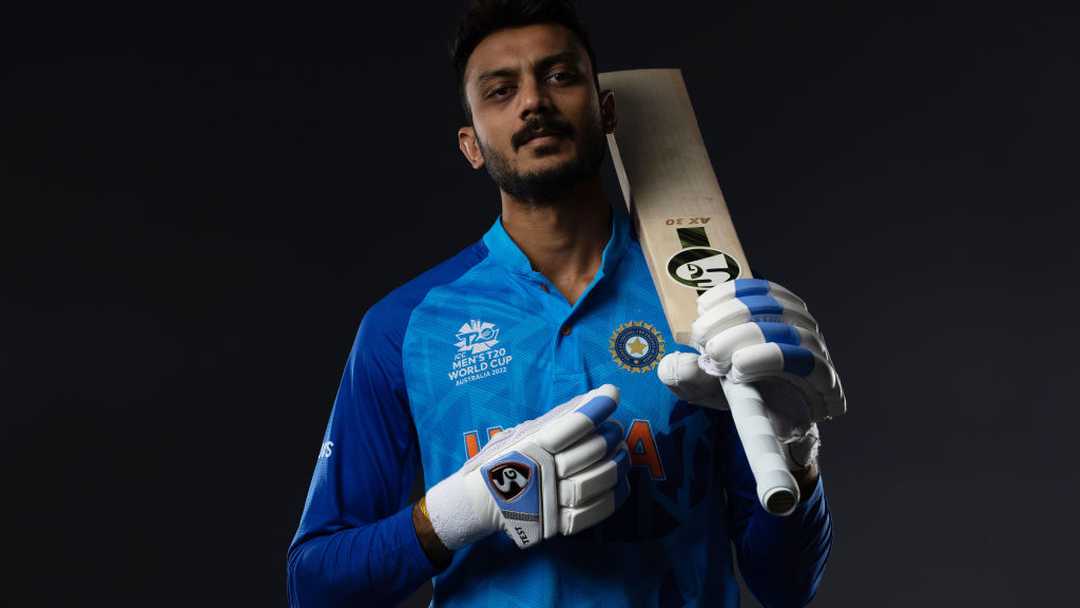
The reluctant headliner from Nadiad
After Axar Patel won the T20 World Cup with India in 2024, his homecoming offered a rare glimpse into the cricketer whose public profile tends to exist in inverse proportion to his performances. The Kheda District Cricket Association planned a grand felicitation, expecting over 40,000 people. The plan was scuppered.
"When Axar found out about our plans, he just didn't come back home," recalls Manish Desai, president of the Kheda District Cricket Association. "He gets awkward when we try to make him feel special. I called him and requested him not to leave me red-faced. He said he wouldn't mind the felicitation if it was limited to a gathering with kids who play cricket. So we called all the kids of the academy and had a small function where they asked him questions, and he regaled them for a couple of hours."
Axar's humility is echoed by his home town, as well as the clarity he has about where home is. When he walks into the vast Narendra Modi Stadium to play the Netherlands on Wednesday, as the vice captain of the Indian team, some may call it his maiden World Cup game at his home ground. Yet Axar is particular that Ahmedabad is not his home. It's a city he has long resisted. For him, home is Nadiad, around 60 kms from Ahmedabad.
Speak to those close to him and there are no tales of grandeur or largesse, or even a sense of knowing what Axar thinks about his own ambitions as a cricketer. Here is someone who has been critical to India's plans across formats over the last few years, but whose importance is rarely noticed.
Nadiad, a small town of approximately 250,000 people, had not produced a cricketer of any note before Axar. Axar's resistance to moving to a bigger city couldn't have come from a more ironic place. But neither could the dream to excel in the most competitive vocation in the country come from a person who enjoys his relaxed life – surrounded by friends.
On the surface, there are no shades of an elite athlete in Axar's personality. He likes his junk food and soft drinks, gym training isn't the most appealing aspect of his cricket routine, he doesn't get bogged down by a bad day, and doesn't dwell too much on his success.
"I've never seen him get angry – whether he gets out on zero, whether he misses a century, or when Rohit Sharma dropped a catch when he was on a hat-trick," claims Soham Desai, a strength and conditioning trainer with the Gujarat and Indian team. "I've seen him upset and irritated, but never angry. Axar is a very mature and balanced individual who trusts his destiny – very content and simple."
There is a theory that Axar would have been just as content with his life if he was not to become a cricketer. He was academically bright, holding an aspiration to become a mechanical engineer. He took up cricket because his father, a cricket buff, had enrolled him to a local academy at the age of 12.
Yet this laidback approach to the game changed in the wake of a family tragedy. "Once while playing an inter-district Under-16 game, Axar lost his grandmother," Manish Desai says. "When he returned home, his father told him that it was her wish to see him play on television. He was asked to get serious about the game. It was the turning point."
Long before Axar came to be known as Bapu, courtesy MS Dhoni, he was Akki for his friends. "Axar is exactly what you see, there is no pretense to him," says Roosh Kalaria, Axar's long-time Gujarat teammate. "He may have travelled around the world, but he is still a small town guy at heart."
Axar's cricket is very much a reflection of that simplicity. His success has been built on a free bat swing and an uncluttered short run-up, bowling consistently on one channel with subtle variations. As effective as it is, his cricket isn't glamorous. He isn't a player that will make promo campaigns for the World Cup. But the fact that he's vice captain of one of the most dominant T20 sides assembled by India speaks volumes.
He made his first-class debut at 18, was picked by Mumbai Indians soon after, and made his international debut at 20. The season before Axar was promoted to the national team, three left-arm spinners had outperformed him in Ranji Trophy. What stood in Axar's advantage was his ability to win games with both bat and ball – much like Ravindra Jadeja.
"The biggest element of surprise with Axar is the way he uses his height with a short stride," explains former teammate Manpreet Juneja. "Secondly, with his bowling style you won't know which ball will turn and which one will keep straight – there are very subtle changes in his point of release. A couple of seasons before his Test debut, he started using those slower balls and now has control over his speeds, which is one extra weapon he has got up his sleeves."
In T20 cricket, 199 times batters have attempted to cut Axar, out of which they have been cleaned up six times. Every time a batter has attempted a cut shot off Axar's bowling, he has conceded runs at an economy rate of only 6.12.
In the first half of IPL 2023, Delhi Capitals were struggling. Axar, coming out to bat usually at No 7 or 8, was left to resurrect the innings. When asked if he had a word with the coaches seeking a promotion in batting order, Axar's response was laced with humour. "Waise bhi jab mein batting karne aata hoon, 10-12 over to bache rehte hai. To kya farak padta hai?"
"He can quickly switch off from what has happened, how the game has gone – good or bad," says Juneja. "He loves his time with his buddies, and he keeps them very close."
Axar is a player who has developed his game without the need of a formal coach. He takes instructions from his coaches and trainers, and trains with the help of a few teenagers at a local academy in Nadiad.
"He is not one of those guys who would speak to you in a very presentable or convincing manner in which you feel that this guy has a lot of substance," Juneja says. "He is not a pseudo-intellect. But he is intelligent. He understands the game very well. The choice of what he wants to do at what moment, at least for himself, is very good. He controls the game very well."
As loved as Axar is among his peers, there is one aspect of his existence that leaves most of his teammates irritated – his ability to feed on junk and yet not put on weight. But all of that started to change from 2018.
"Axar had a tendency of getting freak injuries," says Soham Desai. "That is when he started asking questions and becoming mature with his life outside cricket. The communication with him took over 3 to 4 years to get him to buy into this pattern of healthy diet and training. I didn't want him to change completely. Otherwise, he would have felt suppressed."
That change started having an impact soon. Those close to him saw a definite shift in Axar's psyche from around 2021-22. The most obvious of the changes resulted in better returns as a batter.
Soham believes the turning point to his confidence as a batter was an ODI against West Indies in Port of Spain in 2022, where Axar hammered an unbeaten 64 off 35, helping India chase down 87 off the last nine overs. "As soon as his second weapon – batting – started coming in, that confidence came into his bowling as well," Juneja says.
That phase coincided with him marking his Test debut, and returning 27 wickets in his debut series. With Ravindra Jadeja's bowling stocks dropping, Axar received more frequent opportunities across formats.
Axar Patel's batting evolution since making his Test debut (on February 13, 2021)
| Format | Matches | Runs | Average | Strike Rate (T20) |
|---|---|---|---|---|
| ODI (Pre-Test debut) | 38 | 181 | 12.92 | – |
| ODI (Since Test debut) | 33 | 677 | 29.43 | – |
| T20 (Pre-Test debut) | 151 | 1695 | – | 130.58 |
| T20 (Since Test debut) | 152 | 1821 | – | 141.60 |
In the 2024 T20 World Cup, he was the only left-hander used as a floater in a right-heavy line-up. In the final, he played a defining innings that separated the two teams – even if it was drowned out by other big moments. It was typical of Axar to make a critical contribution and yet hardly get noticed.
This evasion of the headlines has continued – when the BCCI announced its annual central contracts for 2025-26, which saw Axar being demoted to 'C' grade, there was virtually no public discussion. He was the Player of the Match in the semifinals against England and bowled a critical 16th over in the group game against Pakistan, conceding only two runs.
Irrespective of where Axar is forgotten, in Nadiad, every bit of his performance is remembered and celebrated. "Woh yaaron ka yaar hai," says Kalaria. "Everyone knows that if you need him around, he will come to you even if it's 2 AM in the night."
But it's strange that nobody seems to know what Axar thinks about his own ambitions as a cricketer. Despite spending several hours around him, when asked to share an anecdote, his friends can't offer much beyond 'bahut mazaa aata hai'.
Axar still trains at the small KDCA ground in Nadiad, and trains in the local gym – even when better offers have come his way. Every now and then, Axar turns up to see young kids of Nadiad practise at the local academy. He even rolls his arms over at times, serving up some loose deliveries to let those kids drive him for a boundary.
"He knows it makes their day," Manish Desai says. "They go back home telling their parents 'aaj Axarbhai ko boundary lagaya'."
Related Posts
 Portugal vs France,4th Match,Portugal T20I Tri-Series, 2026,2026-04-06 14:00 GMT
Portugal vs Norway,3rd Match,Portugal T20I Tri-Series, 2026,2026-04-06 10:00 GMT
Multan Sultans vs Rawalpindiz,14th Match,Pakistan Super League 2026,2026-04-06 15:00 GMT
Portugal vs France,4th Match,Portugal T20I Tri-Series, 2026,2026-04-06 14:00 GMT
Portugal vs Norway,3rd Match,Portugal T20I Tri-Series, 2026,2026-04-06 10:00 GMT
Multan Sultans vs Rawalpindiz,14th Match,Pakistan Super League 2026,2026-04-06 15:00 GMT