


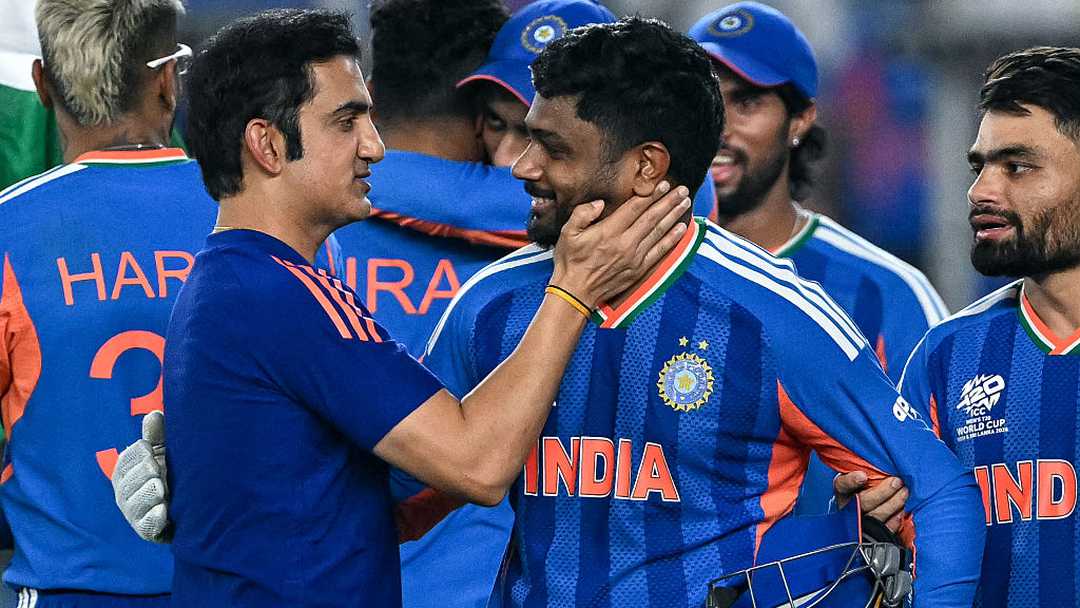
Never felt Samson was out of form, he needed a break: Gambhir
Indian head coach Gautam Gambhir stated that the decision to reintegrate Sanju Samson into the lineup mid-tournament was tactical, not courageous. Samson, after playing only one of India's first five T20 World Cup matches, returned for the Super 6s against Zimbabwe and scored three consecutive half-centuries in must-win games, earning Player of the Tournament honors in India's title-winning campaign.
Samson had a poor run in the home series against New Zealand prior to the World Cup. This, combined with strong performances from Ishan Kishan, led the team management to initially open with Kishan and Abhishek Sharma.
Gambhir refuted the idea that Samson's recall was to counter opposition off-spin targeting India's left-handers, stating it was simply about giving the player a break.
"More than courage, it was a tactical change," Gambhir said regarding selecting Samson for the final three games over Rinku Singh. "We never felt Sanju was out of form. We felt after the New Zealand series he needed a break. Sometimes as a leadership group, you give someone a break to relieve pressure and clear their head."
"We had the luxury of playing different combinations due to our squad depth. We felt we could use someone with Sanju's ability and power at the top to have three explosive batters at one, two, and three. That was the reason. It was tactical."
"The talent Sanju has, and the way he was batting in the nets, left no doubt he would deliver. And how well did he deliver? I don't remember someone coming back and scoring that consistently in three or four games."
"We are blessed as a team with the depth in that dressing room. We could have played three, four, five different combinations. We had three openers who could bat anytime at the top. So it was never about being courageous. It's about being tactical."
Gambhir also defended India's high-risk approach in T20s, which nearly backfired in a Super 8s loss to South Africa.
"I always believe high risk, high reward is the only way to play T20 format. You don't fear losing a game to win a game. If you start fearing loss, you will never win. My ideology with the captain was simple—we will not play for 160-170. I'd rather accept getting all out for 100, because 150-160 takes you nowhere."
"If you play high risk, that's when you make 250-260. There will be days like that. We lost to South Africa by 100 runs, but that ideology never changed. All our matches after that were must-win knockouts, but we played the same way. That's when you give yourself the best chance to win big tournaments."
Explaining the mindset shift, Gambhir said, "The mindset was simple: how much impact can you create on every ball in 120 balls? It's not a 50-over format where you have time to recover. If you try to create maximum impact on every ball, you can reach 250-300."
"If you take four balls to go from 96 to 100, you make your team lose out on 20 runs. That's the difference between winning and losing the World Cup. If you're at 96 and hit a six next ball and get out, that's okay. But if you take four singles, you'll never reach 250-275-300. In the past 1.5-2 years, I don't remember anyone trying to take a single after reaching 95 or 96."
"The simple philosophy was: if you think you can hit a six or a four on the next ball, go for it. Ultimately, in that dressing room, your 97 or 98 will be appreciated as much as 100. That happens through actions, not just words. Fortunately, in that dressing room, everyone played cricket the same way. We weren't thinking about taking a single or needing two balls to make 50 or 100 runs. Those extra 10 or 20 runs are the difference."
Gambhir praised the efforts of his predecessor Rahul Dravid, VVS Laxman, and chief selector Ajit Agarkar in building a strong foundation for the team. He emphasized his desire to create a distinct brand of cricket.
"I don't believe in inheriting anything; I believe in creating something. Hopefully, we've created something you can all be proud of—the brand of cricket we've played. It's not only about inheriting a team; it's about creating something of your own. I wanted to play a completely different brand of cricket where people say this team consistently outscored, outbowled, and was a fearless group that did not fear losing."
"We've spoken many times in the dressing room; our first discussion was always that we're not going to fear losing a game. For too long, it's been important to change that mindset. I think we've created something everyone in the dressing room can be proud of, and the entire country should be proud of them."
Related Posts
 How New Zealand lost the Powerplay and the final
 Litton Das set to take up middle-order role in ODI comeback against Pakistan