


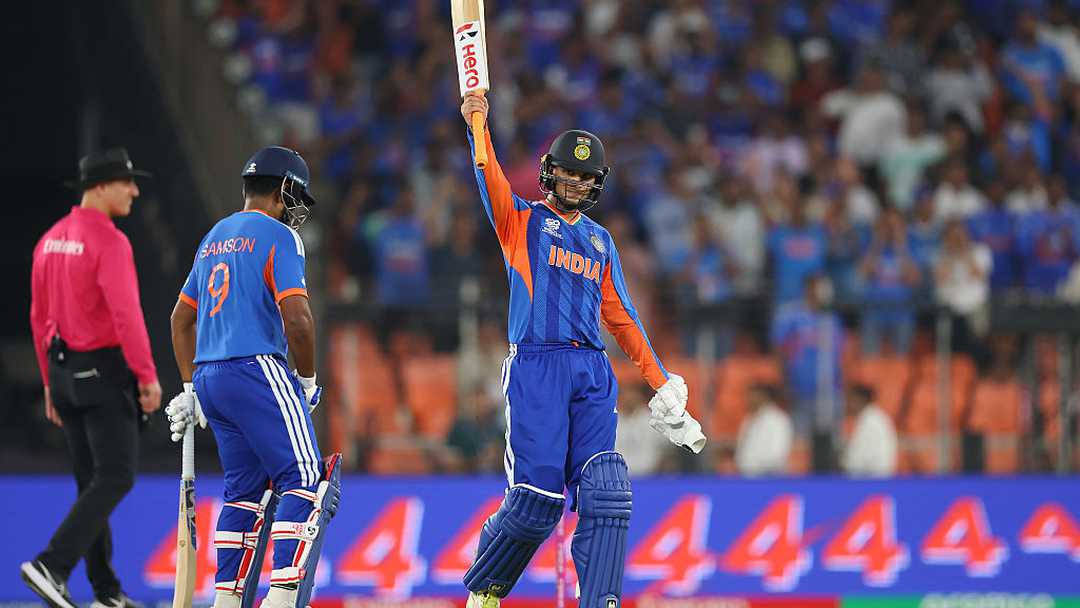
No retreat from the batting creed, even on the grandest stage
Sooner or later, every big moment asks the same question: do you protect what you have or do you reach for more?
A World Cup final is no different, and India made their choice early. It came in the third over of the match, when Abhishek Sharma danced down the pitch to the first ball of pace he faced. India had lost the toss and were asked to set a total on a surface expected to ease later with dew.
With the stakes at their highest, caution would have been justifiable. The tournament had not been kind to Abhishek—troubled by offspin and seamers' slower balls, his usual destructive Powerplay rhythm had been absent. Yet, he stepped out anyway.
He didn't connect, but that hardly mattered. What mattered was the decision to charge, capturing India's mindset: on the biggest night, in front of the largest crowd, they would not change their approach. The next two hours were a continuation of that choice.
India made 255 in the final, having made 253 in the semifinal. Both times, they lost the toss, batted first, and responded identically.
In Ahmedabad, the decisive passage arrived immediately. Abhishek and Sanju Samson racked up 92/0 in the Powerplay, the highest ever in the tournament's history. By the time New Zealand could slow the tempo slightly, the writing was on the wall.
Pre-match predictions had suggested a closer contest. WinViz gave India a 55% chance, based on historical patterns assuming teams behave as they always have. Over the last two years, India have tried to change that.
"The most important thing in this T20 format was that we didn't want to be afraid of losing," head coach Gautam Gambhir said afterwards. "Because if you are afraid of losing, you never win. High risk, high reward is very important. I would have been happier if we had been out at 110-120. But our target was always to make 250 runs, we didn't want to play the 160-180 runs cricket. I think for too long, we played cricket with 160-170 runs."
That idea sounds simple, but in Indian cricket, it is harder to live by. The game sits close to everyday life, with millions playing and following it, instant scrutiny, and relentless competition. The instinct is often to protect what you have. India's leadership has spent two years asking players to move the opposite direction.
"My simple philosophy with Surya has always been that milestones don't matter," Gambhir said. "It's the trophies that matter. For too long in Indian cricket, we've spoken about milestones. And I hope, till I'm there, we're not going to talk about milestones.
"The only thing we spoke about was how we can give ourselves the best chance to win this World Cup. And that was how we react when a batter is close to a hundred. If someone is batting on 94, does he have the courage to get a hundred next ball, rather than thinking about it for three or four balls?… Because those 10 runs and 20 runs are the difference between winning and losing."
This World Cup cycle, India tried to live by that idea. It first manifested in bilateral cricket, where batting rarely slowed and winning totals kept rising. Scores beyond 250 stopped feeling unusual. This World Cup, though, did not always make that approach easy to sustain.
There was a close shave early against USA. Namibia pushed them on a bowler-friendly surface. In Colombo, Pakistan forced adjustments. Even the win against Netherlands lacked control. Then came defeat against South Africa, their first in an ICC white-ball match since the 2023 ODI World Cup final.
India rediscovered rhythm against Zimbabwe, as Suryakumar Yadav admitted after the final. But the South Africa defeat had tightened the group. By Eden Gardens, the clash against West Indies carried greater significance than expected.
India entered as hosts, No. 1 ranked, and overwhelming favourites, but were the last to secure knockout qualification. Their approach had already been tested.
That made the semifinal and final stand out. On the two biggest nights, India did not retreat but leaned further into their approach.
Abhishek's half-century in the final came from 18 balls, though not his cleanest innings. Edges flew, but intent remained. Even his dismissal carried that idea—reaching for a wide delivery from Rachin Ravindra.
The rhythm barely changed after that. Ishan Kishan continued, placing early boundaries before lifting tempo, while Sanju Samson kept opposition tactics at bay with power and stillness, as in previous knockouts. His 89 off 46, falling short of a hundred for the third straight time, became the highest individual score in a T20 World Cup final, yet rarely felt built around personal landmarks.
By the innings' end, Abhishek, Samson, and Kishan had all crossed fifties—a rare alignment for three players whose positions had shifted repeatedly pre-tournament. On the final night, they arrived together.
New Zealand briefly threatened when James Neesham removed three batters in one over, but the total's shape was already decided. India crossed 200 in the fifteenth over, finishing on 255, their third 250-plus score. With Jasprit Bumrah waiting with the ball, anything above par started to look enough.
"We play differently in bilateral tournaments, but ICC tournaments are played differently," Gambhir said. "We wanted to change that. Making more than 250 in the semifinal and final shows the quality, bravery, and courage with which this tournament was played."
In Ahmedabad, with history against them on a ground holding different memories, India's philosophy found clearest expression. It began with an opener in indifferent form stepping down to the first ball of pace in a World Cup final. The moment had been building longer—a generation grown up playing high-stakes cricket in leagues like the IPL, where crowds are loud and expectations arrive early.
"I think that's one of the hardest things, to win a World Cup in your country," Mitchell Santner admitted. "There is a lot of added pressure with home fans. For India to do that tonight, they should be very proud."
Sooner or later, every big moment asks: do you protect what you have, or reach for more? India answered early. Once fear stops leading, remarkable things often follow.
Related Posts
 Hesson optimistic about ‘sporting wickets’ for Bangladesh ODIs
 Ultimate aim is to improve our standard in ODIs: Phil Simmons