


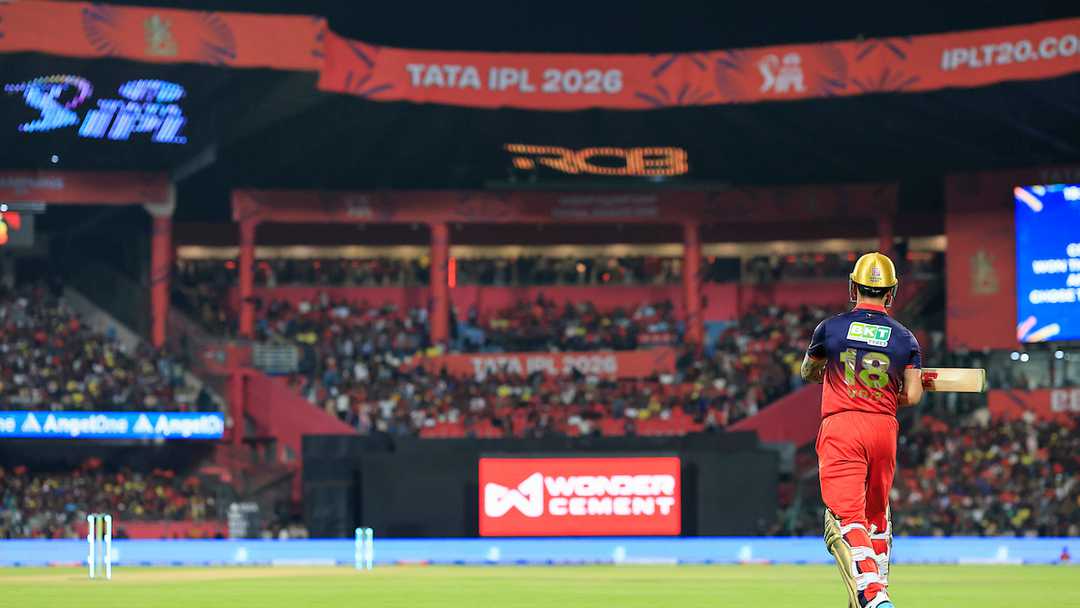
RCB – Increasingly at home in the Chinnaswamy
Could the Chinnaswamy Stadium become RCB's fortress?
That question would have been laughed at not long ago. Between 2017 and 2024, no other IPL team had a worse home record than RCB at the Chinnaswamy, losing 18 of 34 games here. A couple of years ago, RCB's Director of Cricket Mo Bobat noted it "was not easy to get home advantage at the Chinnaswamy," citing factors like small boundaries and squad personnel. Between 2016 and 2023, RCB qualified for the playoffs three times—and in none of those seasons was the Chinnaswamy their home base.
Halfway through the 2025 season, the bogey seemed intact as RCB lost their first three home matches. Their historic title run had a small blemish: they couldn't replicate their perfect away record in front of their home crowd.
But something clicked in the latter half of 2025, with back-to-back home wins. That run has extended to three consecutive home victories this season. You have to go back to 2013—a different T20 era—to find RCB winning as many matches in a row at home.
The tide has turned, and there's reason to believe these wins are not mere happenstance. Different players have won Man of the Match awards, pointing to collective form. Common tactical threads are emerging.
Against LSG, Josh Hazlewood pounded 23 of his 24 balls on a good length or back of a length to claim Man of the Match. His dominance, especially in the first-innings Powerplay, highlighted a pattern where batting could be made difficult.
A two-paced surface with variable bounce compounds batters' vulnerabilities. The unpredictability is hard to gauge, as Rishabh Pant found out painfully. Cross-batted shots become risky; one can clear the ropes, another can chop on from a similar length due to slightly lower bounce. Hazlewood has shown mastery in exploiting these lengths in his return to top-flight cricket. Notably, when RCB began their current home win streak last year, Hazlewood was also the Man of the Match.
RCB benefited from Hazlewood's early impact in a match where the toss also played a critical role. Last season, losing all five home tosses and being sent in to bat left them wounded early. With roles reversed, Hazlewood's value became even clearer. RCB have grown smarter in using him at key moments. Against LSG, he bowled a third straight over upfront, with the last claiming a scratchy Nicholas Pooran, who chopped on a length delivery.
The Chinnaswamy smarts have been brewing. In an interview, Bobat remained coy about revealing secrets but hinted at an internal mindset shift, expressing disappointment that a 2025 home game against KKR was rained off.
In 2026, the answer echoes louder. Visiting teams—Sunrisers Hyderabad, Chennai Super Kings, and Lucknow Super Giants—have failed to exploit Chinnaswamy conditions as RCB does. Under Rajat Patidar, RCB have looked clear and in control, whether defending or chasing. Against LSG, RCB's pacers took five wickets from full-length deliveries, a stat that misleads unless paired with this: over 82% of their deliveries were on a good length or back of a length. No other team has successfully replicated or negated these tactics yet.
Complementing this fast-bowling template is a shift to defensive spin options, moving away from types like Yuzvendra Chahal or Wanindu Hasaranga. Krunal Pandya and Suyash Sharma bring street smarts over fine art, fitting seamlessly into the puzzle. The batting has also adapted to situations and attacks, outbatting opponents in two previous home wins this season and outbowling one here.
"I think this year we are very smart about the wicket, we are adjusting to it, we are tactically working, and that's why we are winning all the games at home. It shows we are working smartly and efficiently," said vice-captain Jitesh Sharma post-match.
Since 2025, only Mumbai Indians have a better home record than RCB in the IPL. If they maintain this, the fortress question will seem less and less of a joke.
Related Posts
 Hardik Pandya out of Australia A series with fresh injury
 Washout eliminates Japan; Nepal, Afghanistan qualify from Group A
 Rizwan’s curious case: Midnight summons, confiscated phone, and a probe shrouded in questions