


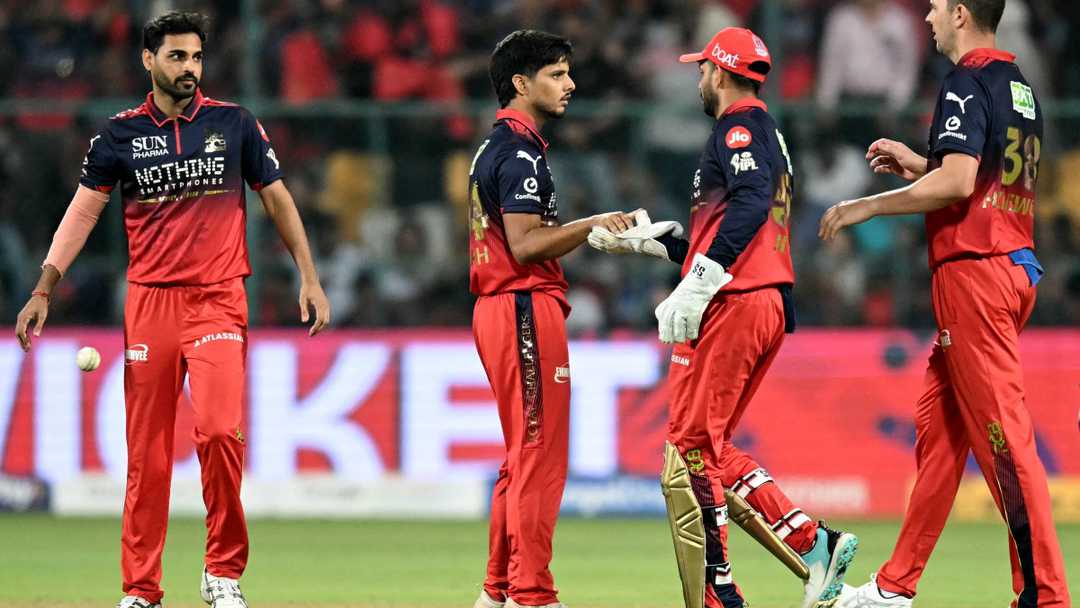
Haunting a different hour: How RCB bite at both ends
Not long ago, death bowling was RCB's open wound. In 2018 and 2019, they bled 11.65 and 11.10 runs per over in the final five overs. Under Mike Hesson during the Covid years, the death bowling conversation shifted.
Then came 2025, and RCB finally lifted the trophy. That title was built on batting depth, but its spine was Josh Hazlewood and Bhuvneshwar Kumar suffocating the Powerplay. RCB's pacers claimed the most wickets in those first six overs (25) with the best strike rate (20.3), the lowest economy (8.27), and the highest dot-ball percentage (43.7%).
If Hazlewood and Bhuvneshwar were dawnbreakers last year, they are haunting a different hour in 2026.
The win against Gujarat Titans told a great story. On what Virat Kohli called the best batting surface of the season in Bengaluru, the Titans had raced to 170 for 2 after 16 overs riding on a Sai Sudharsan hundred. RCB themselves had been 172 for 3 at the same stage against Chennai Super Kings on the same pitch.
Wrist-spinner Suyash Sharma was handed the 17th over and squeezed out just four runs. Bhuvneshwar opened the 18th with two yorkers and a length ball for singles. The fourth was a near-yorker; Joss Buttler tried the reverse scoop but found Hazlewood.
Hazlewood then took the 19th, without Buttler at the crease, and gave away just eight. Over three consecutive death overs, the Titans managed zero boundaries and 17 runs. Long before Kohli and Devdutt Padikkal iced the chase, the game was clinched here.
Krunal Pandya eventually bled 18 off the final over, but he was pressed into service only because Rasikh Dar limped off with a calf injury. GT finished at 205. Compare that to the CSK game where RCB plundered 78 in the final four overs to reach 250; GT managed just 35.
One might argue this was a happy accident against a top-heavy GT side that is the slowest scoring team in the death this season (8.53 run rate). But rewind to the defeat against Delhi Capitals, and the evidence thickens.
Delhi needed 45 off 30 last Saturday. Rajat Patidar held back two Bhuvneshwar overs, even resisting giving him a third in the Powerplay despite him already taking three wickets. He was being saved for that moment.
Bhuvneshwar and Hazlewood nailed yorker after yorker. The only boundary came from a surprise bouncer that required an extraordinary pull from Tristan Stubbs. Dar then bowled the 19th, landing five yorkers, leaving 15 to defend off the last. It turned out to be a talking point, even in defeat.
The numbers seal the argument. RCB have taken the most wickets in the death this season (17), and their boundary concession rate of 18.97% is bettered only by Delhi's 17.44%. Bhuvneshwar is going at just eight an over in this phase. Hazlewood at 9.25. Dar, before his injury, conceded at 7.82 from 23 balls.
They've bowled the most yorkers in the league this season (25 as per Cricviz) and have conceded exactly a run a ball with them. Their full deliveries go at 8.91, comfortably under the league's death-overs scoring average of 10.15.
This is a team that once couldn't defend a total at this ground. They've now become one of the hardest sides to put away, even when opponents get a head start. Right now, RCB have fangs, and they bite at both ends.
Related Posts
 Washout eliminates Japan; Nepal, Afghanistan qualify from Group A
 Rizwan’s curious case: Midnight summons, confiscated phone, and a probe shrouded in questions
 Inside South Africa’s fast bowling hamdemic