


The IPL chase no longer waits for the last over
The last week of IPL fixtures in April 2026 made for fascinating, if counterintuitive, viewing. On the Saturday double-header, a combined 986 runs were scored across two games. Punjab Kings chased down 264. A few hours later, Sunrisers Hyderabad overhauled 228. Neither game saw a 20th over in the chase.
Then, the following day, two of the competition's bottom-feeders – Kolkata Knight Riders and Lucknow Super Giants – kept handing each other the advantage like a hot potato, eventually needing a Super Over to settle things.
That Super Over felt like an outlier. Because Super Overs are outliers now. The last one before this came in Delhi last year, when the 2025 Rajasthan Royals – a side with a recurring habit of leaving games unfinished – ran into Mitchell Starc at the death. Before that, you have to scroll all the way back to 2021. That's three Super Overs in five years and four in the year before that.
But if you read the headline, you already know Super Overs are not the point. They are merely a consequence, the extreme end of a last-over thriller. And last-over thrillers, where drama-seekers find their bread and butter, are not as frequent as they once were.
The numbers tell an interesting story. In 2021, 45% of IPL matches went to the final over with the result still in the balance – we defined that as the chasing team needing 24 (four sixes) or fewer runs off the last six balls, widening the net enough to capture enough data points. That same number in 2024 was 28.6%. In 2025, 29%. So far in 2026, 30.6%.
Frequency of Last-over finishes (LOF), 2020-2026
| Year | Total matches | Needed ≤24 in over 20 | % of matches |
|---|---|---|---|
| 2020 | 60 | 21 | 35.0% |
| 2021 | 60 | 27 | 45.0% |
| 2022 | 74 | 29 | 39.2% |
| 2023 | 71 | 29 | 40.8% |
| 2024 | 70 | 20 | 28.6% |
| 2025 | 69 | 20 | 29.0% |
| 2026 | 39 | 12 | 30.8% |
It wouldn't help to go too far back into IPL history; the game was a different animal then. But stack the three years before the Impact Player rule against the three since, and the numbers crystallise into something meaningful. Between 2020 and 2022, 39.7% of matches needed a last-over finish. In the current era, that figure is 32.5%. Nearly seven percentage points lower. Chasing teams now tend to win or lose more decisively, well before the final over.
And nowhere is that decisiveness more apparent than when teams are staring down a 200-plus target.
Consider what has happened to big-total chases. In the 2020-22 era, teams faced 21 targets in the 200-219 range. They won just three of them – a win rate of 14.3%. Since 2023, they have faced 60 such targets and won 22, a win rate of 36.7%. More than doubled. The 220-plus block is starker still in terms of volume: 8 such matches in '20-'22 became 45 in the following three.
Two days after that manic weekend, still in April, Sunrisers Hyderabad chased down Mumbai Indians' 243 at the Wankhede in the 19th over – the 10th successful chase of 200-plus this season, breaking the 2025 full-season record with more than a third of the matches still to come.
| Target block | 2020-22 matches | Won | Win% | LOF | LOF% |
|---|---|---|---|---|---|
| Under 180 | 131 | 90 | 68.70% | 58 | 44.3% |
| 180-199 | 34 | 9 | 26.50% | 10 | 29.4% |
| 200-219 | 21 | 3 | 14.30% | 6 | 28.6% |
| 220+ | 8 | 1 | 12.50% | 3 | 37.5% |
| Target block | 2023-26 matches | Won | Win% | LOF | LOF% |
|---|---|---|---|---|---|
| Under 180 | 94 | 71 | 75.53% | 30 | 32.3% |
| 180-199 | 48 | 23 | 47.90% | 21 | 43.8% |
| 200-219 | 60 | 22 | 36.70% | 20 | 33.3% |
| 220+ | 47 | 10 | 21.28% | 10 | 21.3% |
The margin of those victories tells its own story. In the 2020-22 era, teams that successfully chased 200-plus finished the job with an average of three balls to spare. Since 2023, that number is 7.6 balls. More than an over to go, the game is already done.
Which means something structural has changed. And to understand this change at the finish, we simply need to look at the top – the first six overs.
The Powerplay is where chases are now won. When chasing 220-plus, teams in 2023 scored at a run-rate of 9.71 in the first six overs. In 2026, that figure is 13.17 – a 35.6% jump in three years. In raw terms: teams chasing 220-plus now average 79 runs in the Powerplay. In 2023, it was 58. That is not a marginal shift. That is a philosophical one.
The 200-219 block tells a similar story. Powerplay run-rate is up 19.1%, from 8.37 to 9.97 runs per over. The consequence of that early aggression is visible through the innings. Chasing 200-219, the average score after 15 overs has jumped from 128.4 in the 2020-22 era to 140.2 now – nearly 12 extra runs on the board entering the death. That cuts the required run-rate for the final five overs from 16.14 to 13.56. The finish line gets moved closer, and the grandstand ending gets quietly cancelled.
Devdutt Padikkal, who made his debut in the first era and has unlocked a very different version of himself since, explained this mindset plainly. Last week, he and Virat Kohli decided to target Rashid Khan and Prasidh Krishna through the middle overs where the two Gujarat Titans bowlers are statistically at their best. And after RCB chased down 205 with more than an over to spare, he offered a rather telling insight: "We want to make sure that whenever we go out there to bat chasing any total, we have to stay ahead of the rate. If we are looking at 10 runs per over, we have to try and stay at 11 or 12. And when you have that advantage, it gives you that cushion – if you end up losing wickets, you are already ahead of the rate and that helps you go ahead and finish the game off."
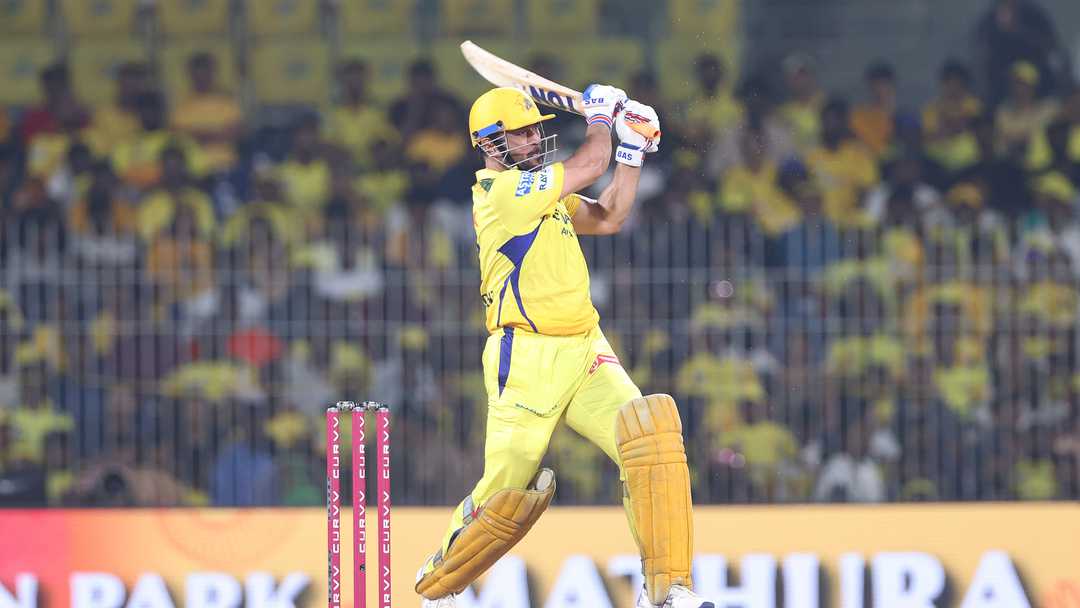
It was not always this way. MS Dhoni, at his most imperious, did and preached the opposite. He liked taking chases deep, the contest stripped to its bones – one bowler, one batsman, six balls, everything riding on it. The final over was not something he endured; it was something he cultivated and arrived at by design. Think of his famous last-over finish in Bengaluru in 2018: CSK needed 16 off the last over against Corey Anderson and Dhoni serenely finished it off with a last over six. That philosophy produced unforgettable cricket and kept spectators engaged for that final 1v1 contest. Even though Dhoni himself earned great success, that method also left room for the near-misses, like the following year when Dhoni and CSK fell short by one run at the same venue.
The modern IPL team has looked at those near-misses and decided to eliminate them. The Impact Player rule, introduced in 2023, handed teams an extra specialist batter and, with it, more license to attack across more phases without the fear of running dry. The knock-on effect on chasing strategies has been considerable.
Curiously, there is one target range where there are more games reaching the final over. In the 180-199 block of targets, the percentage of last-over finishes has risen from 29.4% to 43.8% between the eras. The explanation is almost counterintuitive: teams chasing 180-odd know the target is well within range, so they don't necessarily come out swinging from ball one the way they would against a 220 total. A more measured approach through the middle overs means more games are still alive in the 20th. A tricky pitch, too, tends to produce scores in that range, and tricky pitches breed close finishes. The 180-199 zone, it turns out, is the last refuge of the nail-biter.
For everything above it, though, the final-over drama has largely evaporated. LOF percentage for 220-plus chases has fallen from 37.5% to 20%. When modern teams are chasing a monster total and their Powerplay goes well, they simply don't leave it for the last over. They don't need to.
So if you're wondering where all the last-over thrillers went: of course they haven't disappeared entirely, but they have become rarer, and there's no great mystery about why. The IPL has gotten too good at chasing. Teams have more batting depth, clearer plans, and the collective wisdom of a decade of data telling them that buffer is everything. The drama has not left the competition; it has just shifted its location – to a stunning Powerplay, a counter-intuitive middle-over burst, a chase completed in 19 overs that leaves you wondering how they made it look so easy.
The last-over thriller used to be IPL's favourite cliffhanger. These days, it increasingly prefers to skip to the end.
Note: Only full 20 over games are considered for this exercise. All stats correct till April 29 (MI vs SRH game).
Related Posts
 Nigeria vs Ghana: 5th Match Prediction & Preview | Quadrangular T20I Series in Nigeria
Northern Cape vs Border, Pool A, CSA T20 Challenge 2026
Malaysia vs Oman, 6th Match, Group B, Asian Games 2026
Nigeria vs Ghana: 5th Match Prediction & Preview | Quadrangular T20I Series in Nigeria
Northern Cape vs Border, Pool A, CSA T20 Challenge 2026
Malaysia vs Oman, 6th Match, Group B, Asian Games 2026