


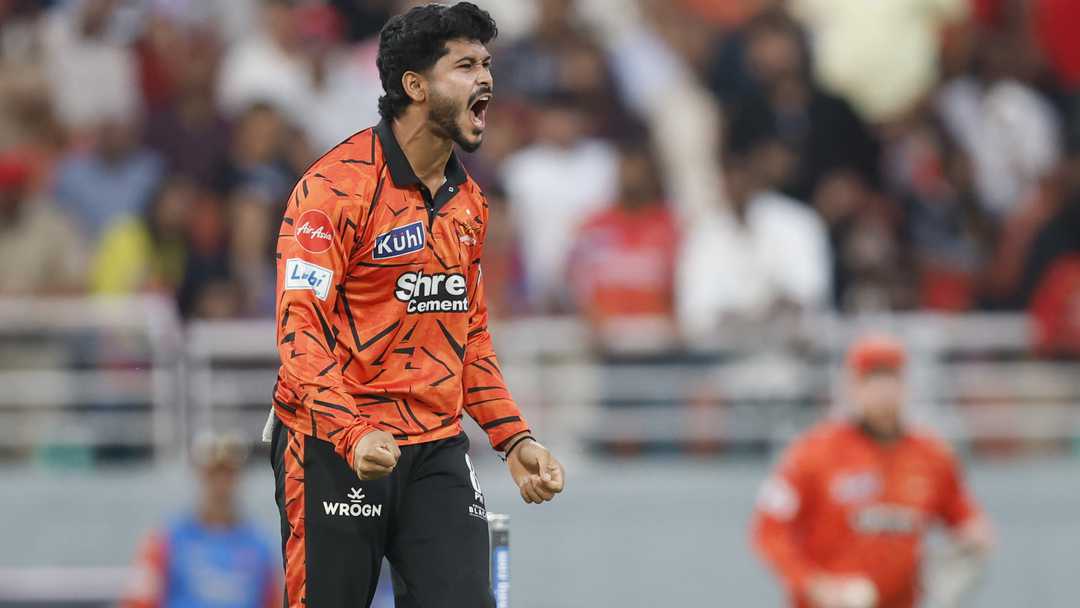
How an 'obsessed' Shivang Kumar found his niche
Success is never final and failure is never fatal.
Shivang Kumar stumbled upon this quote a while ago that resonated and stayed with him. In 2026, he's enjoying the bright lights of the IPL, but the ride till this point will tell you he isn't offering a rehearsed line just to sound clever.
Shivang is a rarity in the IPL — he's the only player in the entire league who bowls left-arm wrist spin and can bat well. SRH haven't needed his services with the bat yet and he is often slated to come in way down the order, but the skill exists. Across age-group cricket, Shivang opened the batting for Madhya Pradesh, and curiously, started out as a finger spinner.
Mirza Danish Alam, his coach at the MPS Academy in Moradabad (Uttar Pradesh) where he started training since he was 13, recalls Shivang as one of his strongest batters, who had the knack to play late and with fast hands. But when opportunities at the Under-23 level dried up despite all the runs, Shivang realised he needed more to his profile of a batter who could bowl. The solution for him was in the sleight of a hand — to become a wrist spinner.
"I was practicing it [left-arm wrist spin] for a long time. It so happens that left-arm spinners don't get to bowl to left-handed batters," Shivang tells Cricbuzz.
"Teams use this match-up. If a left-handed batter comes in, then teams don't want to bowl a left-arm spinner. I recognised this pattern in the IPL. And even in junior cricket, I used to feel that when a lefty batter comes in, a left-arm spinner doesn't bowl."
"So I felt that I have to at least develop a carrom ball. There should be an away-going delivery (to the left-handers). So that they also have some fear of getting out and realise that this bowler has another trick. It started from there."
Theoretically it made sense. A left-arm wrist spinner was rare, and one who could bat even rarer. But practically, the shift wasn't as easy as saying it out loud. Shivang had to re-train and re-wire his brain for this change to work, and then it would take hours of practice for him to perfect what has always deemed as one of the toughest bowling disciplines.

"When I was playing U-23, my leg spin was coming out well and a lot of people around me also encouraged me saying you can try this, and that I can bowl a good ball to lefties. So, from there, I felt that if I can do this, then it will be very effective," Shivang says. There's a great deal of game awareness in his 23-year-old mind when he then offers: "Kyunki abhi variations ka zyada khel ho chuka hai cricket. (Because cricket has now become a game of variations)".
He also saw just two possible paths ahead for him down this road. "There's variations, and the wickets too aren't spin-friendly these days. So there's not much happening for the bowlers. So either you need a bit of mystery from the hand or you develop a Ravindra Jadeja-like skill. I decided to build variations," he says.
Even before he could find himself amidst IPL trials, or in the Madhya Pradesh T20 league, Shivang was thinking far ahead. He didn't zero in on the outlandish idea of becoming a wrist spinner just so he could find his way back into the Madhya Pradesh U23 setup. His sights were set at much bigger goals.
"It became an obsession for me. In my mind I'd decided that I have to do this [develop wrist-spin] as soon as possible. Because if something is working out well, then I have to develop it quickly. If I try and master it within 2-3 months, then I can be ahead of a lot of people and I could get an edge," he says.
"Because I have some good variations, if my combination from this point comes good – if I can become a batter who can bowl good wrist spin – it is a rare combination in cricket… at least for now," he says with a chuckle, and the clarity of knowing how the churn works in the IPL.
"It is rare for now, but many more are coming. So I was like how quickly can I hone this? If I do, I'll have better opportunities to play as well. I was just straight-minded that I have to do this, irrespective of what others say. Whether I end up bowling full-tosses, or even getting hit for six sixes, I just have to do this. That was my mindset," he says.
A lot of this single-minded obsession came from his support system. His father — Praveen Kumar — was a domestic cricketer himself and offered unwavering backing for anything that Shivang set his mind on. Shivang also took encouragement from the fact that Piyush Chawla, a left-arm wrist spinner, excelled at the highest level. Closer to home, he had fellow MP cricketer Kumar Kartikeya take the exact same route he was going to tread: a left-arm finger spinner who added wrist spin to his repertoire and found takers in three seasons of IPL. Some lessons also came through hours of watching videos on YouTube.

"At that time, I used to watch a lot of videos of Varun CV, Rashid Khan, Noor Ahmad, and Kuldeep Yadav. With that, I started understanding the patterns of their bowling and mine. Earlier, I used to bowl slow. Then I understood that if I have to play well at the higher level, I need to give less time to the batters. So, I had to bowl quick. That was a lot of hard work. Because not everyone can turn the ball with pace. So, it was like if I put in a little more effort, put in a little more thinking, then I can bowl at that pace," he says.
The little effort he talks about came in the form of four hours of just bowling wrist spin at the MPS Academy, split into two sessions of two hours each in the morning and evening. He did this every single day and then had the urge to take this skill to a match situation.
"In 2023, we played in an academy tournament in Amroha district called the Sadbhavna Cup," Danish Alam tells Cricbuzz. "During a match, Shivang came to me and said Danish bhaiya, I want to bowl an over. This was when he just started bowling chinaman. So I told him that the situation that we're in, we shouldn't give away runs.
"I didn't have that level of trust on it [his wrist spin] at that time. When I gave him an over, the first one went well. He went for runs in the second and then his third one went well. Then I spoke to him and asked if he would only bowl chinaman going forward, because he was a good left-arm finger spinner. He said haan bhaiya, I will bowl chinaman only."
Understandably almost, there was resistance to this shift from Shivang in the early stages. That's when his brother's conviction came through.
"At the start, everyone was doubting me. Throughout age-group cricket, I've played as a top-order batter. I used to bowl good part-time left-arm spin. So, if someone then tells me to think like a bowler, then everyone will take it as a joke. They'd be like what is he doing with his career?
"At that time, there was only one person to trust – my brother. We used to practice a lot and talk a lot. So, at that time, I needed a little self-belief. That if something good is happening off my hand – if the ball is coming out well, then it doesn't matter what people around me say," Shivang says.
"At the start, I used to bowl only full-tosses (with wrist spin). Because it is a difficult art, to get a bit of control. In the beginning when I used to play local tournaments, I used to think of trying that (wrist spin). So my captain at that time would say 'Bro please, you bowl finger spin. Don't bowl chinaman, or else we won't give you bowling.'
"So what I used to do was bowl one ball of finger spin and the next five would be chinaman. For me it was like I have to bowl this in a match, whatever happens. So doing this in competitive matches helped me build my confidence."
Shivang then found allies at the Madhya Pradesh T20 league in the inaugural season in 2025, where his captain Arshad Khan and Sanjay Pandey at Bhopal Leopards offered him an environment of trust and unconditional backing to play the entire season.
Training everyday for four hours also gave Shivang an important lesson — that mastering wrist spin was going to be down to repetition. "My mindset was that if I can bowl one good ball out of six, then I should be able to do that for all six deliveries. I felt I could do it. It was all about how much work I wanted to put into it and how quickly I wanted to develop it.
"It was like I just have to focus on building myself. And I don't have to think that I have to play for India in three years or play in the IPL in one year. I just wanted to get good at what I was doing, and the rest would take care of itself," he says.
Shivang's cricket has developed through two different timelines — and at both times perception was key for what followed. "There's a story that when I was 7-8 years old, I used to bowl wrist spin. I was a finger spinner but automatically my wrist would roll. It was just natural. So my father spoke to Piyush Chawla. The thing was at that time, Brad Hogg was the only chinaman bowler in world cricket. So people around me used to say that this (left-arm wrist spin) won't work. That this is the kind of skill that won't go ahead. It is very tough. So my father got me to switch to become a left-arm finger spinner."
Shivang has managed to come a full circle since those days. Though he missed SRH's trials, they invested INR 30 lakh in him at the recent auction and have since trusted him in nine of the 11 league games so far. He has repaid that with eight wickets while being a genuine middle-overs option for the team. He may have developed wrist spin with the idea of becoming a threat against left-handers, but six of his IPL wickets this season have been right-handers — all taken out with googlies.
Finding his feet at the IPL level perhaps serves as the biggest validation for Shivang's ballsy switch made just three years ago. Over at the MPS Academy, it has also triggered a shift in Danish Alam's thinking. "I was always in doubt whether he'd be able to do this or not. This [Shivang's ability to switch] became a learning period that if a player is trying to do something different, I should let him try it. So I've decided that if any of my student wants to do something different, I will fully support him."
Shivang put an ambitious thought into practice and stuck to it relentlessly to find his niche. Through him and stories of his journey, many more might.
© Cricbuzz
Related Posts
 Malaysia vs Oman, 6th Match, Group B, Asian Games 2026
Japan vs Nepal, 5th Match, Group A, Asian Games 2026
Malaysia vs Oman, 6th Match, Group B, Asian Games 2026
Japan vs Nepal, 5th Match, Group A, Asian Games 2026
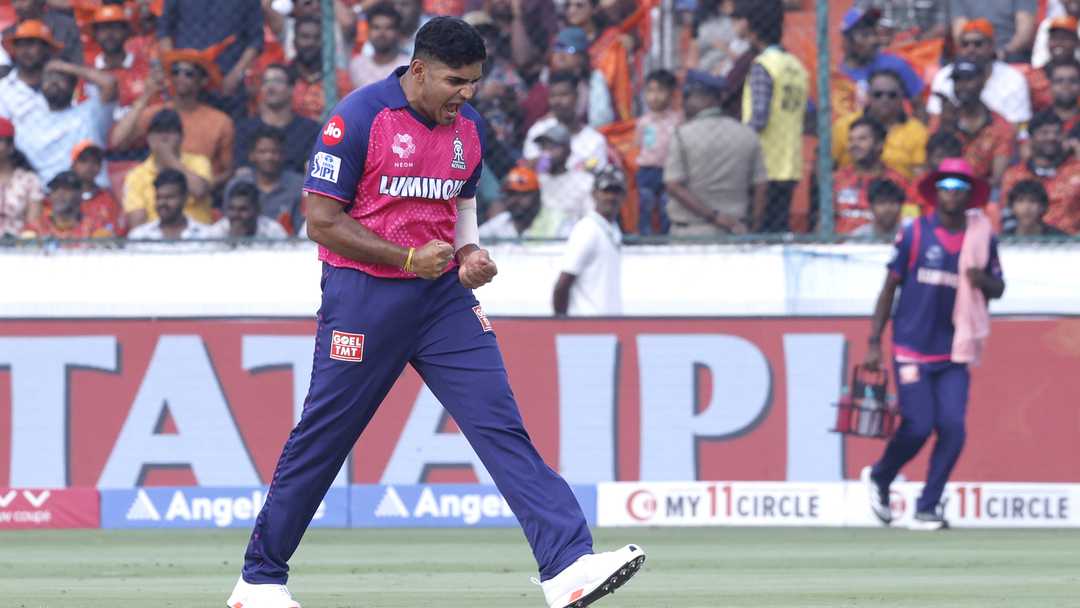 Deshpande, Kamboj wreak havoc to hand India A 1-0 lead