


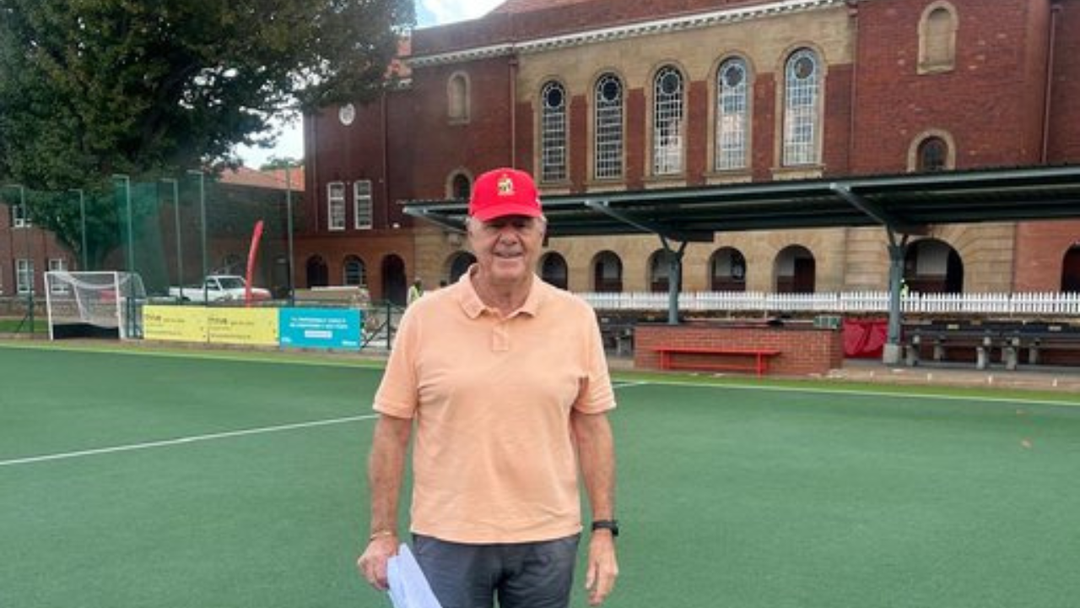
Kevin McKenzie: a 'proper, decent human' goes down swinging
Kevin McKenzie went down swinging. He took the last, lusty swipe of his life on a golf course in Johannesburg on Saturday, when he died. He was 77.
"He was healthy, he played his golf, he walked a lot, he gymmed, so it came as a shock," his son, Neil McKenzie, told Cricbuzz. "But if there's one way he would have wanted to go, it would have been on the golf course. And it was really quick. I think the only thing he'd probably have been irritated by was that he was holding up play."
South Africans of a certain age will remember a shortish, strong-shouldered, determined-looking man, his jaw set, his head covered by nothing except a mullet haircut and a cap, hooking and pulling even the fastest bowlers sending down even their most fearsome bouncers. His courage extended to the field, where he clung to balls hit as hard as he was, often in the sniper alley of the gully.
The team then officially called Transvaal won the Currie Cup 11 times during McKenzie's first-class career, which started in 1966/67 and ended in 1986/87. He was part of seven of those campaigns, including their hattrick of triumphs from 1982/83 to 1984/85.
Unofficially this team were called the Mean Machine because they bristled with the likes of Jimmy Cook, Alvin Kallicharran, Graeme Pollock, Clive Rice, Alan Kourie, Ray Jennings, Vince van der Bijl, Rupert Hanley and Sylvester Clarke. And McKenzie.
He was from a different time and place in the game in other senses, too. Chiefly that he was a white man in a country that held whiteness, particularly of the masculine type, above all and everyone else. Everyone else was punished, systematically, brutally, for their unwhiteness. This cruel craziness stained sport as well – people of different races were legally barred from playing with or against each other.
So we will never know how good McKenzie might have fared hooking and pulling the best West Indian quicks. Or what method he would have employed in entirely foreign Asian conditions facing entirely different types of bowlers than he did in spin starved South Africa.
This unknowability is frustrating. Kevin McKenzie never had an official international career because of apartheid. Because apartheid ended in 1994, Neil McKenzie played 58 Tests, 64 ODIs and two T20Is. Neil proved himself at the highest level. Kevin couldn't and didn't. Kevin's story captures the essence of that era of South African cricket.
The fact that McKenzie was granted a benefit year by his province is further evidence of the contrast in time and place. The practice is unheard of now except in England, and rare even there.
What McKenzie wrote in the brochure published to mark that occasion is illuminating: "I would hate to think of cricket as just a job, or a grind, or as a means of feeding my family." He did that by working in the signage and outdoor advertising industry.
"Come the end of summer, I've had enough of cricket and can't wait to have a game of soccer or hockey, watch some good rugby, or hack my way around the golf course on weekends. I actually feel sorry for the pros who have to gear themselves for another English county season."
Neil relayed his father's philosophy on the hook shot: "He would say, 'The ball wants to go to the boundary. So don't try to fight the pace. Just use the pace and help it on its way.'"
Among the contributors to McKenzie's benefit brochure were Graham Gooch, former Springbok rugby captain Morne du Plessis, prominent South African radio presenter John Berks, golf great Gary Player, "And many more", the cover promised.
"We've got so many messages saying what a good guy he was; always engaging, always interested in the people around him, always looking for a chat and a beer," Neil said.
But he wasn't always easy to live with: "He was very consistent in his habits, and very, very old school. There weren't too many grey areas with him. It was right or wrong.
"He believed in teams. A stipulation he had with us kids was that we had to play a team sport. My sister was a decent tennis player, but she had to play a team sport at a certain point.
"His whole life revolved around sport. He believed in the values of a team dressingroom, in getting on with people, enjoying everybody's success, not just your own. He was the last to leave the dressingroom."
Talking to Cricbuzz, Jimmy Cook, McKenzie's roommate during the Mean Machine era, remembered "a fantastic cricket player as well as a fantastic friend. And just a proper human being.
"He never had a bad word to say about anybody. He was very neat and tidy, and he never did things that were out of place.
"He batted at No. 6, so he was right in the middle of the order. And he was our middleman who sorted out any nonsense, in a nice controlled manner, if there was an altercation. He was a wonderful bloke to have around and a great guy to spend the evening with."
In his benefit brochure, McKenzie named Ali Bacher as the best captain he played under. Bacher joked with Cricbuzz that he wasn't so sure about that: "He might have said that because in the '70s, I was still in general practice and the family were our patients. So he had to say decent things about me otherwise I might have caused him some pain!"
Bacher spoke of McKenzie shunning a helmet: "Whether that was to tell the bowlers, 'Listen, you're not going to frighten me', I don't know. But it showed his guts and determination." And of his prowess in the field: "A square cut was hit like a bullet. Kevin caught it. Then somebody bowled a short ball that was pulled hard. Kevin caught it. Those two catches, both in the second innings of an important match, won us the game, and we went on to win the Currie Cup."
Bacher also valued McKenzie off the field: "He had a strong personality; he had his own mind. And he wouldn't deviate unless you could give him a good reason why. I never saw him lose his cool, but unless you had a good argument he would stand firm. He wouldn't yield to the other side's viewpoint."
Bacher said he and McKenzie remained in regular contact for the rest of Kevin's days: "He's got a hell of a good name as a decent human being. I've lost a great friend."
Many will say the same when hundreds, maybe thousands, pay their final tribute at a memorial next Wednesday. There's something neatly apt and sensible about the fact that they will gather at the Country Club of Johannesburg, where Kevin McKenzie went down swinging.
Related Posts
 Malaysia vs Oman, 6th Match, Group B, Asian Games 2026
Japan vs Nepal, 5th Match, Group A, Asian Games 2026
Malaysia vs Oman, 6th Match, Group B, Asian Games 2026
Japan vs Nepal, 5th Match, Group A, Asian Games 2026
 Deshpande, Kamboj wreak havoc to hand India A 1-0 lead