


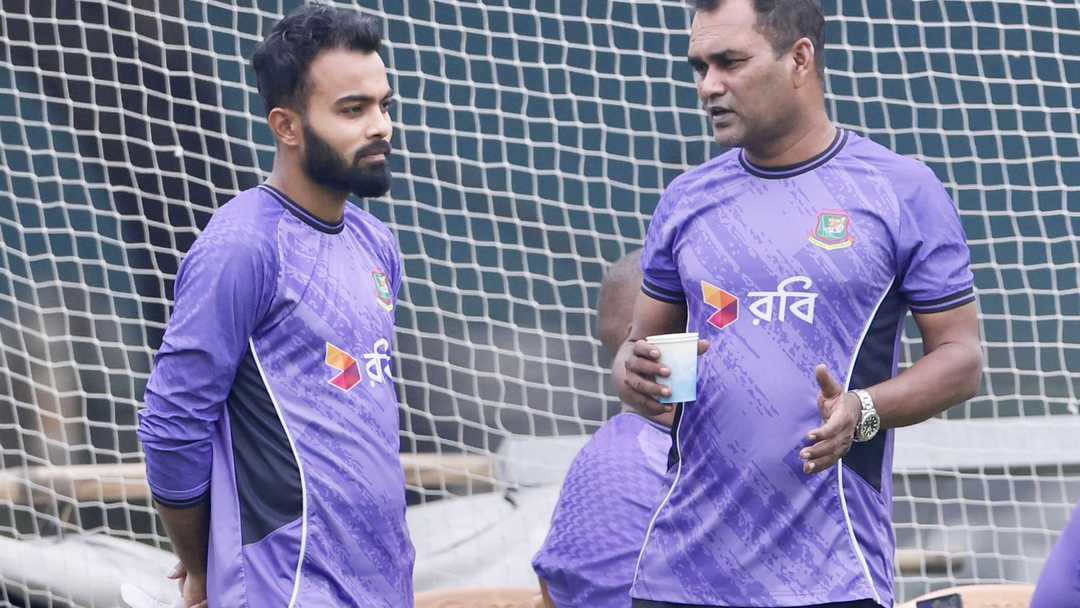
I didn't resign because of reports, it was out of personal protest: Salahuddin
Bangladesh senior assistant coach Mohammad Salahuddin signed off from the senior national team following the conclusion of the two-Test series against Pakistan. Salahuddin will now take charge of the High Performance (HP) unit as its head, with the aim of strengthening Bangladesh's player pipeline.
In an exclusive interview with Cricbuzz, the veteran coach said he was "shocked" by allegations that he favoured Najmul Hossain Shanto and Litton Das in the dressing room. He also clarified that he was not "calling all the shots" in the national setup, contrary to perceptions and media reports.
How was your last day in the national team dressing room?
Since we won a Test match, the joy of winning a Test is different. When the boys win a Test match after five days of hard work, that feeling is different. It always feels good to win a Test. This time we also had more Test wins, so we enjoyed it a lot. The boys were in a good mood. It is also nice to see the boys returning home with smiles on their faces at the end of the day.
Do you think the players are handling emotions better now, and has that been an area of growth for the team?
I think we as Bengalis go up and down emotionally very quickly. But for a sportsman, it doesn't bring anything good. Even if you play well, it's not right to keep your emotions too high, and even if you play badly, it's not right to carry them for two or three matches. Everyone will fail in sports. But how quickly you can shake off that failure and move forward is what matters. I think it's okay to have that emotion for 10-20 minutes, but it shouldn't last longer. You have to move on. Earlier, if someone didn't score, they would sit in a corner of the dressing room all day. This doesn't create a good atmosphere. Now, these places are improving. If these things are developed culturally, the team will be better.
What were the specifics of your role within the national team setup, given there was a perception that you had significant influence over decisions?
I was the senior assistant coach, not the head coach. I had two big jobs. One was to make communication between the boys and the foreign coaches easier. Explaining to the foreign coaches what our boys want, their language or cultural issues. Again, making the coaches' ideas clear to the boys.
Sometimes there can be misunderstandings, so they need to be reconciled. This job may have been unseen, but I think I played a good role there. But the team decisions, the player selection – these were done the way other teams do them. I was seen talking for a long time, with the coaches, with the players, about net-planning, so maybe people thought I was doing everything. Actually, that's not the case.
The head coach is a very knowledgeable person. His job is to run the team smoothly. He gave freedom to the boys, he gave freedom to the coaches too. Many times in the meetings we would remain silent, letting the boys speak. This has taught them to make their own decisions. Many decisions have also come from the leadership group. I didn't do anything alone. The head coach, the players, the coaching staff – everyone worked together. There were talks regarding Jaker's captaincy. But the board at that time knew these answers. It's not like I can make anyone captain whenever I want. This is a matter for the country, not the club team.
Many times the blame has been on me. I could have said a lot if I wanted to, but I didn't. Because at the end of the day, the team is what matters. If I had said too much, the team could have been hurt. So I thought, okay, if the blame goes on me, so be it. The head coach, captain, players know how the dressing room works, how decisions are made. People from the outside can have an idea. But for me, it was more important that the team runs well.
What led to your resignation from the national team setup?
Yes, I did it for other reasons. Not because of what journalists or supporters are saying. I feel bad because my organisation, my board, who knew everything, why would they discuss me in a board meeting… that I was doing everything? Another thing is that players are often not protected from false news or pressure. If the board knows that a news is false, they can come forward and say, 'No, that's not the case.' Then many things are resolved immediately.
This should be the case for everyone, whether it's a player, an official or a coach. A player is the board's asset. There is a lot of investment behind him. If a player breaks down due to pressure from the media or supporters, it is difficult to bring him back. The saddest thing is that we abuse our own country's players. Whether in good or bad conditions – it is very sad. A player represents the country. He will not succeed every day, he will fail sometimes. So disrespecting him requires a change in our culture. My resignation was out of personal protest. I felt that employees or players should be given protection when there is false news. If you work under me, I should stand by you when there is wrong talk from outside. If not in front, then at least inside I should say – "You keep working, I see what you are doing."
There have been allegations that you were more supportive of Najmul Hossain Shanto and Litton Das over other players, including Mehidy Hasan. How do you respond to that?
I was very shocked that I only backed Shanto and Litton. But look, as a human being, I can't go to everyone and convince them 'I'm a good person.' You're free to hold your opinion. But from our side, from this coaching staff, we never did that. We always wanted the team to get better – that's not a personal matter for anyone. If you disagree, you have every right to say so. Even the freedom to say 'your communication is bad, you're not helping' – that freedom has been given. What more can we do?
Look, I believe that right now, if you ask who has the best coaching staff in Bangladesh in terms of communication – I'd be doubtful you'd find better. There's no dictatorial-type coach here. Every coach here has strong communication skills, and the players can approach anyone at any time. Even if they're unhappy with something the head coach is doing, we've said in meetings: 'If you feel something needs to change – a culture, a role – you can come directly and say it, no problem.'
We're not the revenge-taking type of coaches who'd think, 'He spoke up, how dare he, throw him out.' I don't think anyone on this coaching staff is like that, which is why the culture is improving. So that allegation is completely wrong, and I was quite shocked by it. If someone feels we didn't, that's another matter. We did what we thought needed to be done. Misunderstandings happen – sometimes someone comes and says something. I heard this favouritism bit only towards the very end, in the last series. We never thought about it this way – maybe those who thought it did, but we never did. It's painful to hear but I've accepted it. You can't make everyone happy in this world.
There has also been speculation that your relationship with Tamim Iqbal influenced your move away from the national setup. Is there any truth to that?
No, look – if someone says that Tamim or Shakib don't like me, that's a wrong idea. Or they're saying it irresponsibly. There can be hurt feelings, sure. But if someone says Tamim or Shakib dislike me, I think that's incorrect. Hurt feelings are one thing; dislike is another. Look, I'm not a child anymore. It's not like if I don't get this particular role, I can't do anything else. From my perspective, as board president, Tamim approached me with good intentions. He didn't say, 'Sir, from now on you'll work only in HP.' He didn't put it that way. He told me, 'Sir, if you want, you can stay with the national team – it's your decision, take your time and think about it.'
He also said, 'If you want, you can remain here.' And then he added, 'I feel that if you go down to the lower levels, our pipeline can become stronger.' To me, that sounded like a very positive thing. If someone believes I can improve Bangladesh cricket further, then why not? Realistically, how much more can I change in the national team right now? Maybe another five percent at most. Beyond that, it's difficult at this stage. But if I work at the lower levels, maybe I can create much bigger changes. That's why Tamim told me we're giving you the raw materials meaning the young talent and the support system.
Honestly, as a coach, I don't think I could ask for a better offer than this. I can still serve Bangladesh cricket, help develop young players – and at the end of the day, I'm a coach. In the end, history won't remember whether I coached here or there. What matters is where I enjoy coaching most and where I feel I can contribute best.
Related Posts
 Malaysia vs Oman, 6th Match, Group B, Asian Games 2026
Japan vs Nepal, 5th Match, Group A, Asian Games 2026
Malaysia vs Oman, 6th Match, Group B, Asian Games 2026
Japan vs Nepal, 5th Match, Group A, Asian Games 2026
 Deshpande, Kamboj wreak havoc to hand India A 1-0 lead