


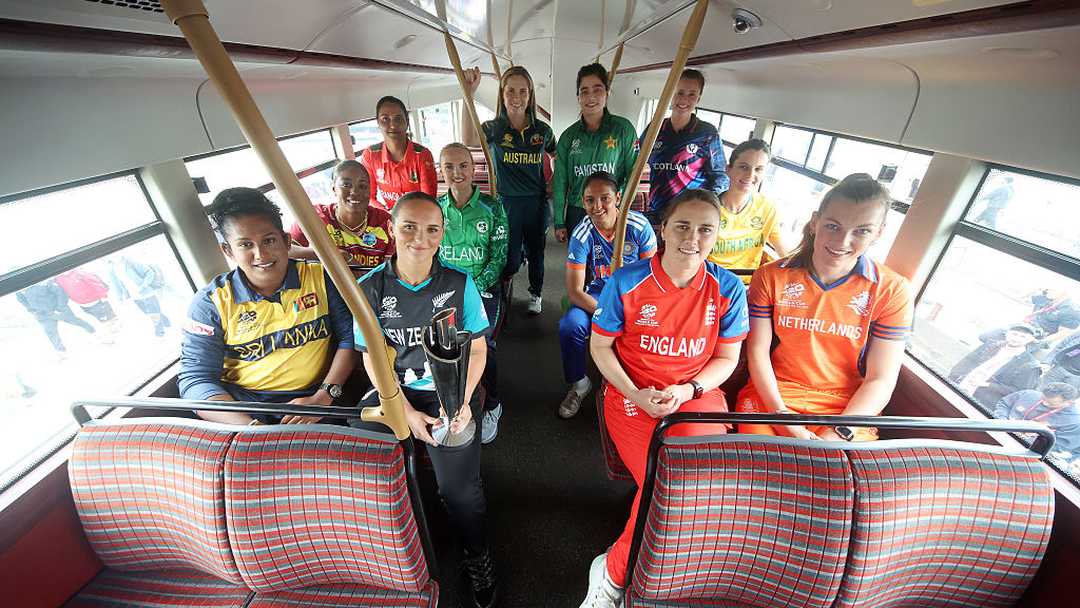
A handbook to the nuances of Women's T20 cricket
If you're getting back to women's cricket after a deluge of the men's sport, here's a quick guide to follow the upcoming World Cup better. It's the same sport, but played with different tactics and gameplays. The match-ups may not make sense, the stroke-making may seem different, and the ball may not disappear into the crowd nearly as often as you're used to watching.
Understanding the nuance of what you're watching is critical to enjoying it. If you're trying to get on board with the women's game for the 2026 T20 World Cup in England (starting June 11), here are answers to questions that might come up.
1) Deepti Sharma bowling the final over to two right-handers with 9 needed. Poor tactic or no options?
In all probability, the captain would have run out of frontline bowling options. Yet, Deepti is not the worst candidate for two reasons beyond her reputation as an effective death bowler.
Firstly, the match-up conventions of men's cricket (offspinner to left-handers, legspinner to right-handers) don't hold true in women's cricket, especially for right-handers.
Women batters vs bowling types in T20s since 2025
| Technique | SR | Ave | DR | Dot% | Bnd% |
|---|---|---|---|---|---|
| off break | 105.85 | 20.33 | 19.2 | 39.8 | 12.3 |
| leg break | 104.35 | 20.54 | 19.6 | 39 | 11.74 |
Left-handers have fared slightly better against incoming deliveries:
| Technique | SR | Ave | DR | Dot% | Bnd% |
|---|---|---|---|---|---|
| off break | 123.23 | 25.87 | 21 | 36.7 | 14.81 |
| leg break | 134.74 | 24.82 | 18.4 | 31.6 | 15.96 |
These are broad segregations. Height, trajectory, speed, turn and angles all matter. Australian offspinner Ash Gardner may still bowl to Smriti Mandhana. Conversely, Nicola Carey scores at 149.58 against offspinners but just 91.83 against offies since 2025. Deepti herself is equally adept against both left and right-handers.
Secondly, spinners frequently operate in the death overs. Since the WPL's inaugural season, 57.2% of death overs have been bowled by spinners—consistent in internationals too.
The reason: putting the onus on middle/lower-order batters to generate pace. 13 of the 20 most economical death bowlers in international cricket (min 10 overs for World Cup teams) are spinners. In English conditions, six of the ten most economical bowlers in The Hundred's death phase are spinners (Deepti third-best).
However, power has increased. In the WPL, spin at death declined from 67% (2024) to 44.3% (2026).
2) Why so many sweeps and scoops?
Women's cricket is largely a back-foot game. Since 2024 in the WPL, WBBL and The Hundred Women's, nearly one-third of runs against spin came behind square. Among those, 1,731 balls were swept—one-quarter earning boundaries.
Sweeps yield a strike rate of 152.79 versus 125.43 through the straight 'V'. Scoops and reverse sweeps are also more frequent—173 scoop attempts in these tournaments versus 75 in men's equivalents (despite more men's games).
The distribution: 38% of runs in the straight V for men vs 34.4% for women (against spin). This is despite fuller lengths from both pacers and spinners in women's competitions.
Lengths by spinners since 2024 (WBBL, WPL, The Hundred)
| FToss% | York% | HalfV% | Good% | Back% | Short% | |
|---|---|---|---|---|---|---|
| Men's | 1.8 | 1.1 | 7.2 | 34.2 | 26.9 | 28.6 |
| Women's | 1.9 | 4.9 | 29.9 | 31.1 | 21.2 | 10.6 |
One reason: most women cricketers are shorter. There's also far less reliance on bouncers and hard lengths.
This varies by team. Australians, with stronger power games, play more through the V. Barring Georgia Voll, every Australian World Cup squad player (min 50 T20I runs since 2024) scores over 25% of runs there. Bangladesh players rely more on drives and sweeps—some like Sobhana Mostary and Juairiya Ferdous score under 10% of runs through the V.
The power game is evolving rapidly. Coaches are encouraging players to open new scoring areas and not let bowlers settle into lengths. Dedicated net sessions remove the fear of hitting on the up.
3) Is the ball swinging more because of England?
Probably. But women's cricket generally has more swing.
Since 2024 in The Hundred and T20 World Cups, 60% of women's deliveries in the powerplay had large swing movement (>1 degree); the men's figure was just 33%.
The reason: optimal swing speed ranges from 98-128 kph. Most women's pacers operate around 100-115 kph. (If you see mid-120s, that's Shabnim Ismail doing her thing.)
The smaller, lighter ball used in women's cricket may also factor in. There's no drastic difference in seam movement, but women's competitions have witnessed lesser turn and drift than men's.
Avg turn and drift for spinners (The Hundred + T20 WC since 2024)
Men's: 2.226 (turn) | 1.200 (drift)
Women's: 1.944 (turn) | 1.181 (drift)
4) Will we see more sixes in this World Cup?
Maybe. Conditions matter. In T20Is played in England over the last five years, balls per six averages 67.5.
Venue breakdown: Edgbaston (71.1), Old Trafford (74.33), Rose Bowl (80.33), Bristol (88.87), Headingley (122). Only at The Oval (44.73) and Lord's (63.28)—the semi-final and final venues—does it drop.
Compare with the WPL (27.51 balls per six): for every five IPL sixes, only two were hit in the WPL. Similar patterns in Australia and England.
However, fours were hit more frequently in women's competitions:
| Women's (Balls/4 – Balls/6) | Men's (Balls/4 – Balls/6) | |
|---|---|---|
| India | 6.08 – 27.51 | 7.17 – 11.73 |
| Australia | 6.63 – 44.9 | 7.65 – 17.13 |
| England | 6.97 – 58.04 | 8.83 – 17.41 |
Margin of difference in scoring rate: barely 1 run per over higher in men's cricket. Dot ball percentages are also similar.
Despite improved power-hitting, there hasn't been a linear rise in World Cup sixes. The 2024 edition actually saw more balls per six (131.71) than any previous edition—but the third-highest scoring rate, with fewer dot balls and high boundary percentage.
ICC Women's T20 World Cup over the years
| Years | Balls per six | Run rate |
|---|---|---|
| 2009 | 127.40 | 5.71 |
| 2010 | 65.62 | 5.82 |
| 2012 | 122.56 | 5.24 |
| 2014 | 110.26 | 5.71 |
| 2016 | 123.53 | – |
Boundary dimensions and conditions often determine six frequency more than raw power alone.
Related Posts
 Twist in OCA case; its president calls for election amid Sports Act debate
 Pakistan survive Thailand scare to reach Asian Games semifinals
 Two former BPL team officials charged under ICC’s anti-corruption code