


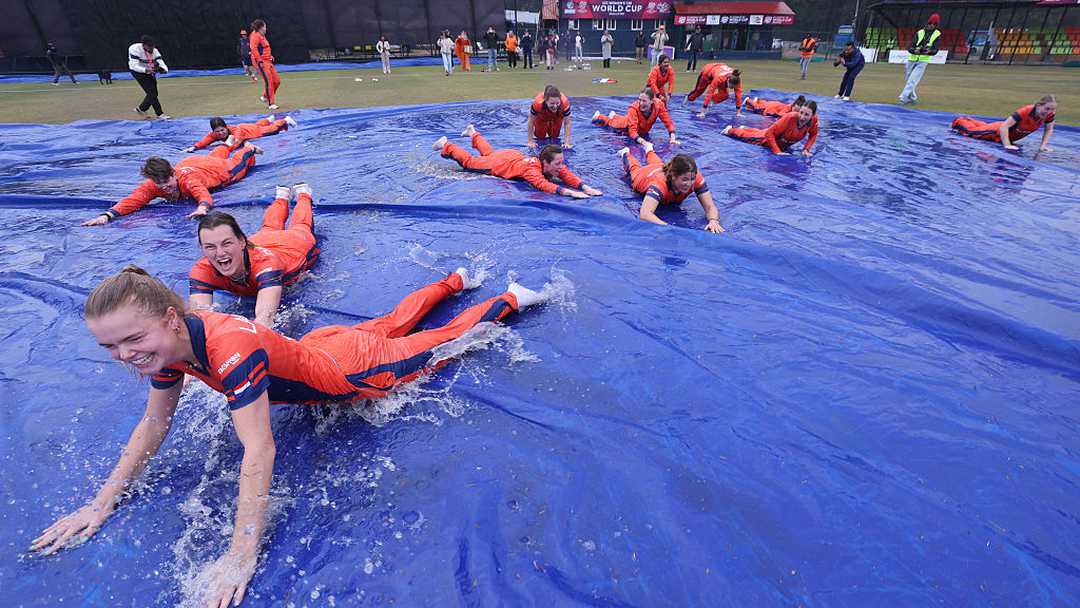
How Netherlands Women returned to the World Cup after 26 years
On January 28 this year, Helmien Rambaldo, a 45-year-old university professor, was nervously pressing refresh on her screen. Far from Kirtipur in Nepal, she tracked the DLS numbers in the rain-affected game between USA and Netherlands, with the latter needing 39 runs off eight overs with eight wickets in hand. It was a must-win.
With Netherlands set to face Ireland and Bangladesh next, this was their best shot at securing a maiden T20 World Cup berth.
Rambaldo had coached several players since their early teens, and had long experienced the national team falling short. Netherlands women's cricket had slipped from being among the world's best, often losing to teams nowhere on the international scene. Rambaldo lived that journey, now serving as assistant coach at the 2026 T20 World Cup.
As a 20-year-old, she was part of the last Netherlands side to play a World Cup — the 2000 edition, their fourth successive appearance (1988, 1993, 1997). Then, as Rambaldo entered top-flight cricket, Netherlands kept dropping off.
Through those years, she carved a prolific career with 57 internationals, including a Test. The medal for best woman cricketer in the Netherlands is named after her.
But one memory haunts her: "Where were those three runs?"
That question stems from the 2014 World Cup qualifier, when Netherlands fell two runs short of Ireland's 137. Rambaldo batted through all 20 overs. She recalls a full delivery from Ireland's Isobel Joyce in the 17th over, to which she offered no shot. "When the fuse goes off in the socket — I felt like that in my mind."
She made up for it with boundaries off Joyce, but it wasn't enough. "With four runs needed, I was at the non-striking end off the last ball. Devastating. That game I still replay. We were literally playing for a World Cup ticket."
It wasn't the first near-miss. In 2003, they finished third in the first World Cup qualifiers, with only the top two advancing to 2005. In 2011, they finished sixth in qualifiers for the 2013 50-over World Cup.
"I had been to a World Cup before. In quality or fitness, it was the best Netherlands women's team I was ever part of. We lost our ODI status.
"That was a big realisation. The rest of the world had gotten so much better and invested more in women's cricket. Bangladesh came out of nowhere. They invested not just money but time in their players and overtook us.
"There were eight teams in that 2000 World Cup; West Indies, Pakistan, Bangladesh weren't there. Other countries overtook us after 2000.
"In my career, that was the most difficult moment. We lost everything. We lost funding. It didn't match our feeling — we felt we were a better team than in years when we had more opportunities."
While other teams benefited from larger funds after merging men's and women's boards, for Netherlands, that move proved counter-productive. Matches against higher-ranked teams were reduced, and the gap between Full Members and Associates widened drastically in the decade after the mid-2000s merger.
Ingrid van der Elst, now in her 70s, gave up hockey (she was a national team goalkeeper) and retired as a sports writer, but still plays cricket for the Still Going Strong club and Kampong Cricket Club in Utrecht. She's been part of Netherlands' cricket community for 59 years, since the 1960s.
Cricket sustained within a limited circle, largely in Hague and Amsterdam. Whether it was Ingrid in the 1960s or Babette de Leede in 2026, they're stuck explaining that cricket is neither a board game nor a sport with horses.
Cricket had a rich legacy in the Netherlands. Clubs swelled in the late 19th century; many now-pure football clubs in Hague and Rotterdam were formed as cricket and football clubs. Women started playing cricket in the 1930s, hosting a touring Australian side in 1937. Netherlands became an early member of the International Women's Cricket Council. The European Championships started in 1983, involving Denmark, Ireland, Netherlands and Scotland.
By 1990, there were about 40 women's teams with four divisions. For Rambaldo's generation, they trained in school halls once a Saturday, rolling out mats on gym floors with shared kits.
"My hands are still sore from playing that 2000 World Cup," Rambaldo says. "Everyone was hitting so much harder. And bowling… Fitzpatrick!"
Elise Reynolds, who featured in the 1997 and 2000 World Cups, adds: "The biggest shock was that in Holland I was a feared bowler. In the World Cup I wasn't. I had speed and swing, but experienced players had no trouble.
"I'm part of the non-trained generation. I had no idea what I was doing. I'd just try to bowl fast. The other teams strategically intimidated batters with field positions. I was powerful but never strategic. We didn't have that knowledge."
Through the mid-2000s, it all went down.
Reynolds stopped playing in 2002. More than a decade later, the national board requested her services, until she learned the state of women's cricket. "I found out there were only 8 teams in the whole country. When I started, there were so many girls playing."
She offers a reason: "I had children. Cricket takes a lot of time. People have less time now. They want to play padel for 30 minutes and be done. Times are different."
Rambaldo points to another factor: "BBC would air cricket matches. After Sky Sports took over, we couldn't access cricket anymore. Now you have to actively search for it."
Reynolds adds: "The World Cup had 11 teams in 1997, shrunk to eight for 2005. We couldn't compete if we weren't among the top. It's 12 teams now and we're in again."
Rambaldo: "In 2008, we played Pakistan and South Africa in Potchefstroom. Those tournaments were so beneficial. Now you play qualifiers and you're always at the bottom."
Despite the gulf widening, the community keeps cricket alive. "It's a small world, but passionate," Reynolds says.
Legends like Caroline Salamons and Sandra Kottman still play in the league. Rambaldo gave up playing last year.
"Cricket is not on television — totally not," Ingrid says. "We sometimes get cricket in newspapers."
Facilities have improved — smaller training batches, better facilities across two cities, a full-time coach and strength and conditioning trainer. All three admit the current generation's quality is far superior.
But who is the star? "The league is so small, everyone knows each other. They aren't star-struck," Rambaldo says. "Now that they're at the World Cup, maybe they'll be seen as stars differently."
Rambaldo has joined the squad in England as assistant coach. She's nervous again, but proud. "I'm excited to go to the World Cup, but I don't know what to expect.
"This group has been together for a while. I've seen many since they were 13 or 14. We were always so close but never crossed the finish line. It's been really nice to see them qualify. This World Cup is going to be tough, but they deserve this opportunity."
Related Posts
 Deshpande, Kamboj wreak havoc to hand India A 1-0 lead
 CWI slashes international player fees by 25% in sweeping overhaul
 How moving down helped Shai Hope move forward