


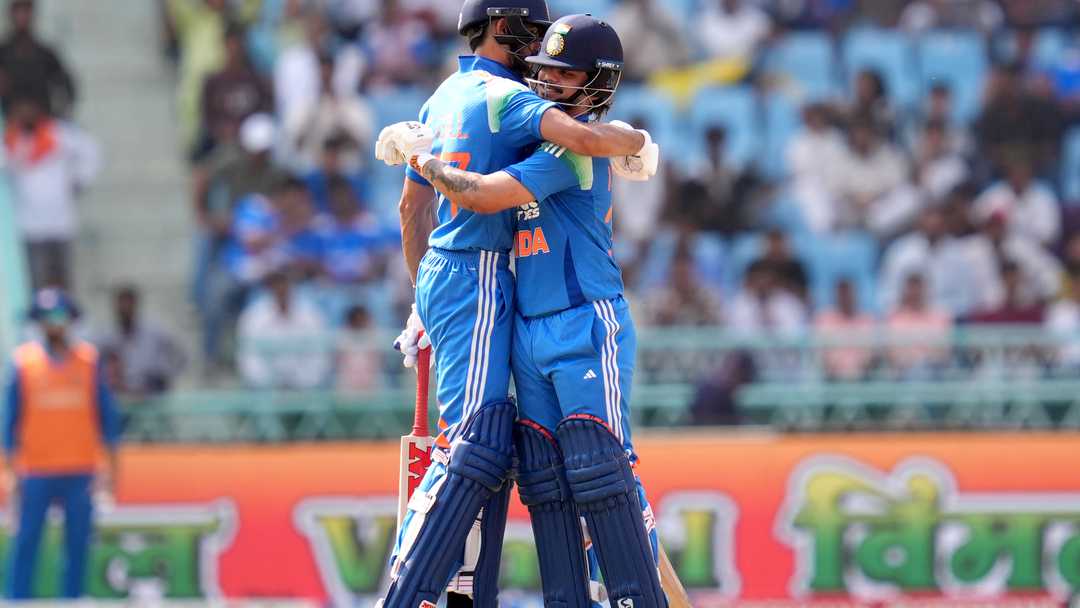
Talking Points: Gill's march, Kishan's dream return and India's growing depth
Gill's run-scoring streak rolls on
A hundred in the one-off Test, an unbeaten 84 in the series opener, and now 154 – Shubman Gill's run-scoring streak rolled on in Lucknow, where oppressive heat proved no obstacle to another commanding display. Batting in temperatures exceeding 40 degrees Celsius and through multiple drinks breaks, Gill barely put a foot wrong during his 110-ball stay, striking 22 fours and two sixes.
He steadily raised the tempo without forcing the pace. A six off Nangeyalia Kharoti brought up a 38-ball fifty, while his ninth ODI hundred came in just 77 balls. By the end of the 40th over, he surged to 146 off only 104 deliveries. Cramps required attention from the physio, yet Gill carried on unfazed before falling for 154 while attempting a reverse sweep.
A ninth Player of the Match award in ODIs since January 2022 drew him level with Virat Kohli at the top of the list.
Kishan's comeback gathers pace
Back in India's ODI side after a prolonged absence, Ishan Kishan has quickly made his presence felt. In the rain-shortened first ODI, Kishan made a brisk 34 off 22 balls at No. 3. In Lucknow, he was handed a different role at No. 4 and responded with a blistering 125 off 79 deliveries, laced with 14 fours and seven sixes. He needed 52 balls to get to his fifty but raced to his hundred in the next 19 deliveries, bringing up the milestone in just 71 balls – the third-fastest ODI century against Afghanistan. Having forced his way into India's T20 World Cup plans, Kishan appears intent on making a similar case in ODIs.
400, yet a sense of unfinished business
By the time India crossed 300 in 35.5 overs – the fourth-fastest instance of a team reaching the mark while batting first in ODIs – Gill and Kishan had already rewritten several records. Their 224-run stand off just 140 deliveries became the joint second-highest partnership against Afghanistan in ODIs. They also scripted a unique first: never before had two Indian batters scored ODI centuries in 80 balls or fewer in the same innings.
However, India lost seven wickets for 62 runs in the final 10 overs and were bowled out for 402 in 49.5 overs. This was the eighth time India breached the 400-run mark in ODIs, drawing level with South Africa for the most such totals. It was also the first instance of a team scoring 400-plus and being bowled out in an ODI.
India's new faces continue to impress
Debutant Prince Yadav got his maiden ODI wicket when he castled Nangeyalia Kharoti, later returning to dismiss Rahmat Shah and wrap up the innings. Figures of 2 for 56 in 7.3 overs scarcely told the full story. He was also unfortunate to be denied a wicket early on when Rahmanullah Gurbaz's dismissal was overturned due to a front-foot no-ball.
Gurnoor Brar continued to strengthen his case, extracting bounce and movement at high pace. He removed Gurbaz with a well-directed short ball before returning to clean up Hashmatullah Shahidi and Mohammad Saleem Safi. His figures of 3 for 60 gave him successive three-wicket hauls to begin his ODI career, making him only the second Indian after Piyush Chawla to take three or more wickets in each of his first two ODI appearances.
Afghanistan still searching for answers beyond Gurbaz
After a blistering hundred in the previous game, Rahmanullah Gurbaz once again shone with a 33-ball 41. But after his dismissal, Afghanistan's batting order struggled to sustain momentum. Support from the rest of the batting order has been inconsistent.
Captain Hashmatullah Shahidi has particularly struggled for fluency since the 2023 World Cup. In 20 innings during this period, Shahidi has scored 420 runs at an average of 26.25 and a strike rate of 65.83 – the lowest among the 61 batters to have batted in the top seven at least 15 times in that phase. Rahmat Shah's half-century underlined his value, but Afghanistan will need more from the rest to consistently challenge top sides.
Related Posts
 Deshpande, Kamboj wreak havoc to hand India A 1-0 lead
 CWI slashes international player fees by 25% in sweeping overhaul
 How moving down helped Shai Hope move forward