


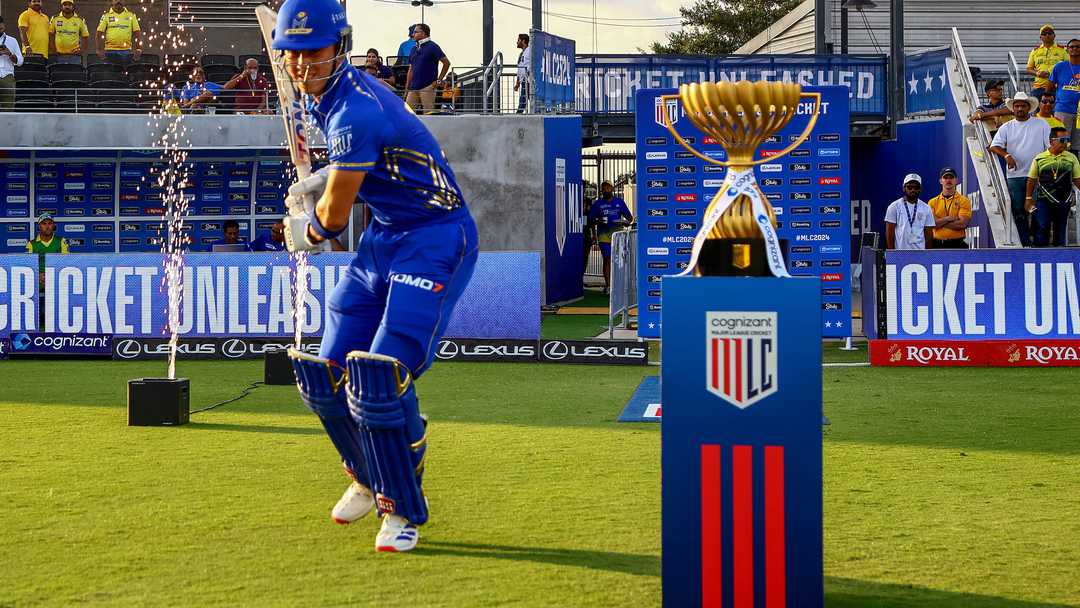
Why MLC Matters
When the fourth season of MLC gets underway later today, it will once again be tempting to judge the tournament through familiar metrics of television ratings, overseas stars, attendance figures, sponsorship deals, or the quality of cricket on display. But those metrics only tell part of the story. To understand why MLC matters, one has to look beyond the familiar matrices and ask a different question: what exactly is being built around the league? And the reasons are many fold.
"It is a symbol of hope, quite frankly," says Sanjeev Joshipura, Executive Director of Indiaspora. "One of the challenges many immigrant families face is that parents and children often grow up in very different worlds. The parents bring memories, traditions and experiences from the country they left behind, while their children are shaped by life in America. Cricket, through MLC can become a bridge between those worlds. It gives families something to share, something to talk about and something to care about together."
Kalyan Jarajapu, a multi-franchise owner of the Super Kings Academy in the United States, believes MLC has taken things beyond merely serving as a social bridge. "MLC has provided an aspiration for kids. For American children, it gives them something tangible to aim for. It gives parents confidence that if their child wants to pursue cricket seriously, there is now a professional pathway at the end of it. MLC has effectively created a career option that never previously existed in America."
With nearly twenty turf cricket facilities across the country built or upgraded in recent years, the United States is witnessing an unprecedented boom in youth cricket participation. Academies have mushroomed across major metropolitan areas. When Jarajapu entered the academy business in 2022, there were only three dedicated cricket academies in the Dallas-Fort Worth area. Today there are nineteen, with an estimated 1,400 children enrolled. Minneapolis, despite having a small South Asian community, now supports three academies with roughly 250 children enrolled. Cincinnati has developed its own academy with around 50 young cricketers.
At roughly $250 per child per month, the Dallas academy ecosystem represents a market worth more than $4 million annually. In the Bay Area, where fees can exceed $400 per month and enrollment is estimated at around 1,800 children, the market approaches $9 million annually.
This is precisely why IPL franchises have arrived with conviction. Chennai Super Kings, Delhi Capitals, Rajasthan Royals and Kolkata Knight Riders have all established academy footprints in the United States. Delhi Capitals now operate two academies. Chennai Super Kings have expanded to six locations.
Beneath MLC sits a 26-team Minor League Cricket structure that has become the officially recognized developmental pathway into MLC. MiLC franchises that generate little to no meaningful revenue today are already changing hands at valuations approaching half a million dollars.
MLC's calendar positioning is equally significant. While leagues such as the BBL, BPL and SA20 largely compete within overlapping windows, MLC is carving out a distinct June-July slot, allowing the league to attract global stars without directly fighting multiple rival tournaments.
MLC has retained broadcast partnerships across Australia, New Zealand, the Caribbean, Africa, the Middle East, Central Europe, Southeast Asia and the Indian subcontinent. This season marks MLC's breakthrough into the UK through a broadcast agreement with Sky Sports.
The league's investor base includes some of the most accomplished Indian-American entrepreneurs, venture capitalists and technology executives. The San Francisco Unicorns ownership group includes Silicon Valley veterans Anand Rajaraman and Venky Hariharan, who have helped foster SFU AI, a comprehensive cricketing artificial intelligence tool. With YouTube CEO Neal Mohan among the stakeholders, MLC has benefited from strategic thinking around digital media and broadcast distribution.
This season introduces a third venue, the Knight Riders-owned stadium in Pomona, California.
For the first time in modern cricket history, the sport is not merely expanding into a new market. It is building an entirely new ecosystem. One where immigrant parents can connect with first-generation American children through cricket. One where IPL franchises invest in academies. One where technology leaders sit on franchise cap tables. One where a 26-team developmental structure is already generating franchise value before meaningful revenues have arrived.
The question is no longer whether cricket belongs in America. The question is how long until America becomes an alternate cricketing power center.
Related Posts
 Deshpande, Kamboj wreak havoc to hand India A 1-0 lead
 CWI slashes international player fees by 25% in sweeping overhaul
 How moving down helped Shai Hope move forward