


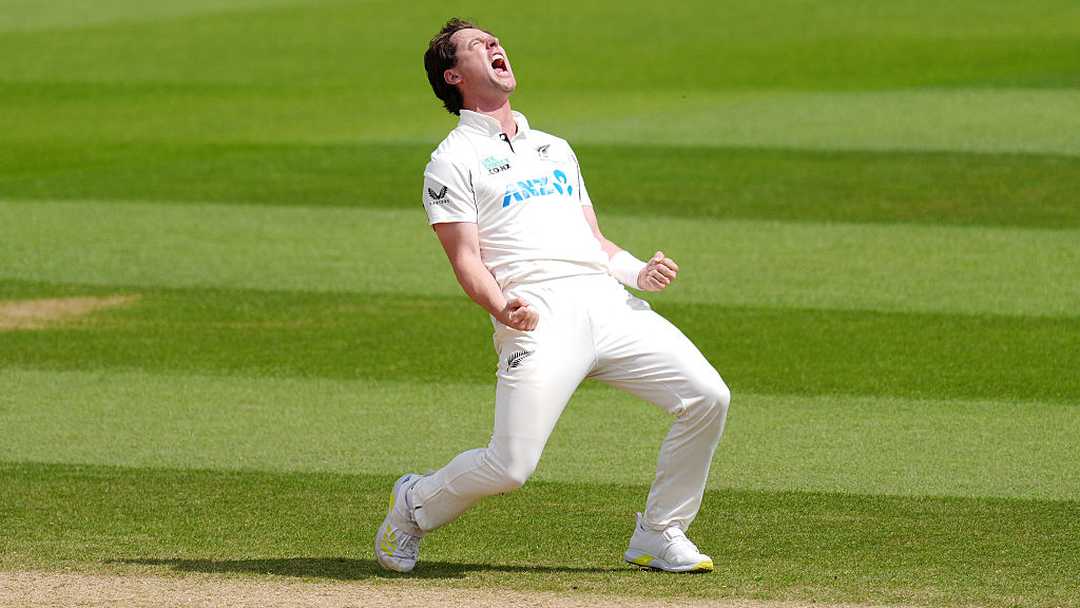
The unassuming greatness of Matt Henry
Matt Henry almost didn't play at The Oval.
A hamstring niggle and back spasms had left his participation in the second Test in doubt. Five days later, he was leading New Zealand off the field after a stirring victory that squared the series 1-1.
From nearly missing the Test, Henry walked away with the best match figures by a New Zealand bowler on English soil and the second-best by a New Zealand seamer in an away Test (11/109), behind only Sir Richard Hadlee's iconic 15-wicket haul at the Gabba in 1985/86.
Yet, for those who have followed Henry's second act in Test cricket, The Oval was less an outlier and more a continuation of a trend. Over the last five years, he has quietly developed into one of the most effective fast bowlers in the world across formats.
The turning point at Edgbaston
It was another English summer that first convinced Henry he belonged at Test level.
Despite making his debut in 2015, opportunities were limited in New Zealand's settled pace attack of Tim Southee, Trent Boult and Neil Wagner. Between May 2015 and June 2021, Henry featured in only 13 of New Zealand's 47 Tests, taking 31 wickets at 51.55.
Southee's absence for the second Test against England at Edgbaston in 2021 opened the door. Henry seized it with a six-wicket match haul that helped New Zealand secure their first Test series win in England in the 21st century.
Since that Test, Henry has collected 121 wickets in 22 matches at 19.51, striking every 38.8 deliveries. Among the 29 bowlers with at least 75 Test wickets during this period, only Jasprit Bumrah (18.51) and Scott Boland (18.58) boast a better average.
The engine behind New Zealand's away success
Henry's resurgence has been central to many of New Zealand's biggest overseas victories.
He was Player of the Match in both of their Test wins in England this decade and Player of the Series during the 2-0 sweep in Zimbabwe last year. His spell of 5/15 in Bengaluru laid the foundation for India's lowest home Test total – 46 all out. Henry finished with eight wickets in the match as New Zealand recorded their first Test win in India since 1988 before sealing a maiden series triumph there.
Against Australia in early 2024, he claimed 17 wickets in two Tests. Two years earlier, he played a leading role in ending another long-standing drought against South Africa, taking 14 wickets in two Tests, including a career-best 7/23 in Christchurch – the joint best innings figures for New Zealand at home, alongside Hadlee.
More than a new-ball specialist
Henry's reputation has largely been built on dismantling top orders. Among the 19 bowlers dismissing opening batters at least 20 times since June 2021, Henry's average of 15.56 and strike rate of 32.5 are comfortably the best.
But reducing Henry to a new-ball specialist would be half-truth. Of his 121 wickets since Edgbaston, 53 with a ball older than 30 overs came at an even better average of 18.26 and a strike rate of 35.4. Every one of his 11 wickets at The Oval arrived between overs 31 and 80.
Why right-handers struggle against him
Henry's greatest weapon remains the combination of a wobble seam release and relentless good-length bowling from over the wicket. All 11 wickets at The Oval were right-handers. Since June 2021, he averages just 17.06 against right-handed batters. Among seamers who have dismissed right-handers at least 25 times in this period, no one boasts a better average.
Elite company
Henry's current run stands among the finest sustained periods by a New Zealand fast bowler. Only five New Zealand bowlers have recorded 100-plus wickets across a 22-Test sequence. Among them, only Hadlee's tally of 139 wickets between March 1984 and March 1987 surpasses Henry's 121.
Only 31 bowlers in Test history have taken 120 or more wickets in a 22-Test span. Of those sequences, only four produced a better strike rate than Henry's 38.8: Waqar Younis, Dale Steyn, Muttiah Muralitharan and Kagiso Rabada.
For a bowler who spent the first half of his Test career on the fringes, Henry has emerged as New Zealand's attack leader and one of the premier seamers in world cricket. Five years after Edgbaston became the launchpad for his Test renaissance, he arrives at Trent Bridge with a series on the line and a chance to shape another landmark result.
Related Posts
 Titans vs Western Province, Pool B, CSA T20 Challenge 2026
Bahamas vs Bermuda: 5th Match Prediction & Preview | North American Cup
Titans vs Western Province, Pool B, CSA T20 Challenge 2026
Bahamas vs Bermuda: 5th Match Prediction & Preview | North American Cup
 Kusal Mendis’ ton, Wellalage’s three-for help Sri Lanka level ODI series