


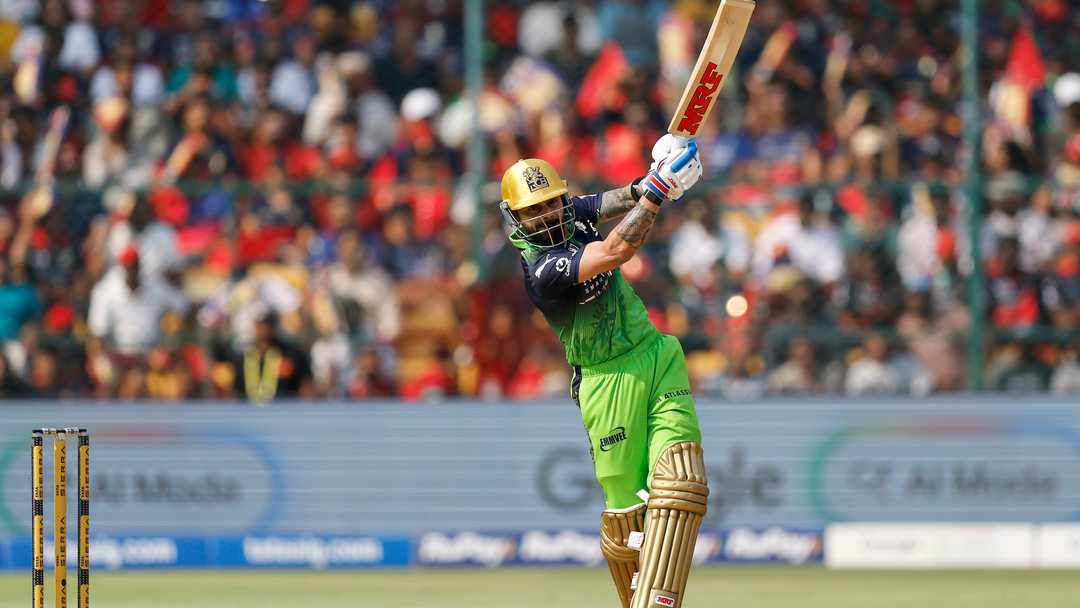
Charging ahead: Kohli's aggressive reset pays off
The contest between GT and RCB presented a compelling tactical clash: two attacks adept at hitting hard lengths with the new ball against opening batters increasingly equipped to counter them. After a probing first over from Siraj – replete with plays and misses but no wickets – the spotlight quickly shifted to a familiar duel: Virat Kohli up against Rabada, a bowler who has historically held the edge.
The first over from Rabada to Kohli went like this.

After negotiating Rabada's opening over, he disrupted Siraj's rhythm in the following over, charging down the track to loft him straight for six – this after being beaten on both edges earlier in the spell. It wasn't an impulsive deviation but part of a broader, clearly evolving method. Long associated with a risk-averse approach designed to endure across formats, Kohli's T20 batting in IPL 2026 reflects a deliberate recalibration.
"I've never been a guy who tries so many fancy shots, because we have to play 12 months of the year," he said. "For me, it's not about playing fancy shots and throwing my wicket away. We've got Test cricket after the IPL, so I've got to stay true to my technique and find ways to win games for my team." – Kohli in IPL 2023 following a century in Hyderabad.
Two technical shifts stand out. First, a greater willingness to go aerial more often and more efficiently. Second, a proactive use of the crease against pace, stepping out to convert length and access scoring areas earlier in the trajectory. The numbers underline the shift. Against seamers this season, Kohli has faced 181 deliveries and played 29.3% of them in the air – his highest ever in a single IPL season and nearly double his career IPL average of 15%. From 40 aerial strokes, he has collected 25 fours and 12 sixes.
The second strand, advancing to pace, has been just as significant. Among opening batters this season, Kohli has stepped out to fast bowlers on 16.2% of deliveries, a figure bettered only by Abhishek Sharma (20.3%). This isn't merely about boundary hitting; it's also a means to disrupt lengths.
This approach was evident in the return fixture as well, where he repeatedly used his feet against Siraj and Prasidh Krishna to negate the hard lengths. Complementing this is his ability to hit on the rise, a high-skill option that has separated him from other players.
There are quantifiable returns to this aggression. Kohli has scored 66 runs off 30 balls when stepping out to pace. Immediately following a charge, he has struck at 177, indicating how effectively he capitalises on the immediate disruption caused to the bowler's length.
Kohli innings progression in IPL 2026
| Progression | Balls | Runs | Dismissals | SR |
|---|---|---|---|---|
| 1-10 | 90 | 157 | 0 | 174.44 |
| 11-20 | 65 | 101 | 4 | 155.38 |
| 21-30 | 40 | 56 | 0 | 140.00 |
| 31+ | 34 | 65 | 3 | 191.18 |
The risk, however, remains real. Despite RCB racing to 34 in the first three overs for the loss of Jacob Bethell, Kohli's intent did not waver. In the fourth over, he again advanced at Rabada, only to top-edge to mid-wicket – his third dismissal of the season while charging a seamer. It was a departure from the earlier version of Kohli.
But that captures the shift in player buying into the team philosophy. As batting coach Dinesh Karthik articulated, this RCB side is willing to err on the side of being positive. The numbers suggest a batter fully aligned with the approach, trading a degree of control for greater impact, and reshaping the tempo of RCB's starts.
Related Posts
 Nigeria vs Ghana: 5th Match Prediction & Preview | Quadrangular T20I Series in Nigeria
Northern Cape vs Border, Pool A, CSA T20 Challenge 2026
Malaysia vs Oman, 6th Match, Group B, Asian Games 2026
Nigeria vs Ghana: 5th Match Prediction & Preview | Quadrangular T20I Series in Nigeria
Northern Cape vs Border, Pool A, CSA T20 Challenge 2026
Malaysia vs Oman, 6th Match, Group B, Asian Games 2026