


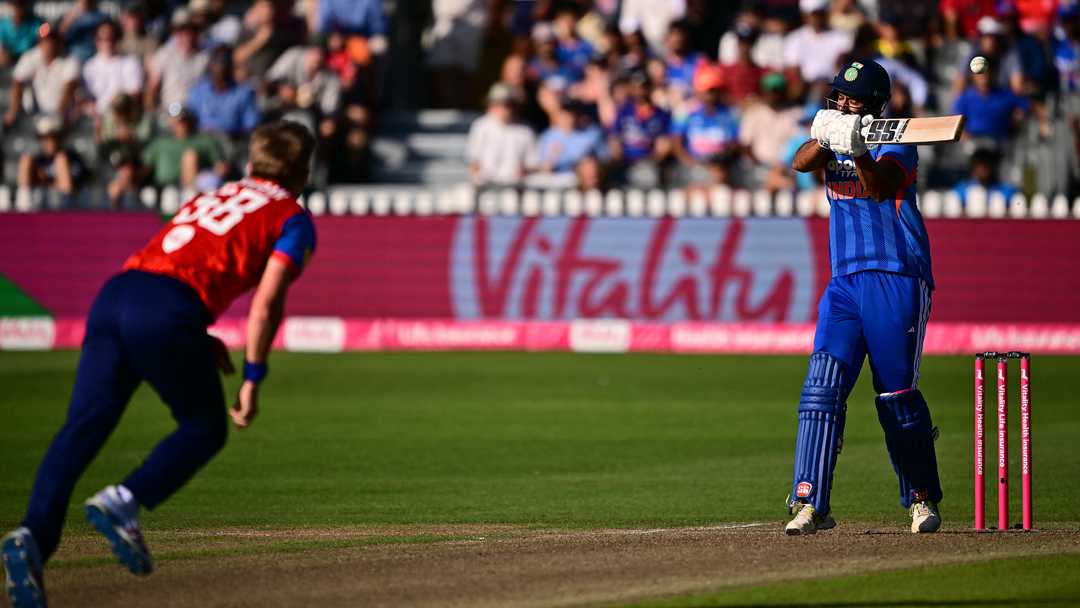
Data Shorts: The anatomy of England's bowling masterclass in Bristol
Six games into a new T20I cycle, one pattern has surfaced too often to ignore. On pitches offering extra bounce and longer square boundaries, India's inability to counter hard lengths and access all areas of the ground has repeatedly left them vulnerable. Ahead of Australia 2028, that is becoming a concern.
Jofra Archer and Josh Tongue attacked hard lengths from the outset while mixing in fuller deliveries to deny rhythm. England stationed fielders at both square leg and deep backward square leg, anticipating mistimed cross-batted shots. The ploy worked immediately as India lost Vaibhav Sooryavanshi and Ishan Kishan inside the Powerplay attempting pulls, before Abhishek Sharma perished attempting a similar stroke against Adil Rashid in the seventh over.
Harry Brook's captaincy was equally influential. He ensured there were never more than three consecutive overs of either pace or spin. Will Jacks was introduced when Abhishek and Kishan were together, while Archer and Tongue each bowled an over to Shivam Dube immediately after he arrived.
Jacks finished with four overs for 28 runs, conceding only one boundary, built around constant pace variation from 77 to 99 kph. India offered little variation with their spinners, consistently operating north of 90 kph. Even when England's spinners erred fuller, India managed only 13 runs from 11 deliveries pitched four metres or fuller, with just one boundary.
Aside from Shreyas Iyer, the other seven India batters managed two sixes combined.
India's approach after Abhishek's dismissal compounded the problem. Shreyas Iyer and Shivam Dube added 53 from 43 balls but rarely looked to manipulate the field or force the pace. With the older ball gripping, Archer and Tongue repeatedly took pace off into the surface, while Sam Curran mixed in yorkers. England's seamers conceded only 17 runs in their final three overs, allowing just one boundary.
England seamers by speeds
| Pace | Balls | Runs | Wkts | ER |
|---|---|---|---|---|
| 140+ kph | 28 | 40 | 2 | 8.57 |
| 128-140 kph | 21 | 19 | 0 | 5.42 |
| < 128 kph | 23 | 19 | 0 | 4.95 |
India failed to clear or pierce the shorter straight boundary even once against England's pace trio. Fifteen hits down the ground yielded just nine runs, while England struck four boundaries, including two sixes, in the same region.
Wagon wheel vs pace: India and England batters
| Fielding zone | Ind | Eng |
|---|---|---|
| Fine leg | 10 | 26 |
| Backward square leg | 6 | 3 |
| Forward square leg | 18 | 11 |
| Mid on | 4 | 20 |
| Mid off | 7 | 6 |
| Extra cover | 18 | 12 |
| Backward point | 2 | 15 |
| Third man | 13 | 10 |
India finished on 159, well below Bristol's average first-innings score of 206. England's chase was merely the finishing touch. The match had been won through 20 overs of disciplined execution where hard lengths, pace variation, proactive fields and smart matchups came together to produce England's most complete bowling performance of the series.
Related Posts
 Ghana vs Sierra Leone: 4th Match Prediction & Preview | Quadrangular T20I Series in Nigeria
India A Women vs Australia A Women, 3rd unofficial ODI, Australia A Women tour of India 2026
Afghanistan vs Nepal, 4th Match, Group A, Asian Games 2026
Ghana vs Sierra Leone: 4th Match Prediction & Preview | Quadrangular T20I Series in Nigeria
India A Women vs Australia A Women, 3rd unofficial ODI, Australia A Women tour of India 2026
Afghanistan vs Nepal, 4th Match, Group A, Asian Games 2026