


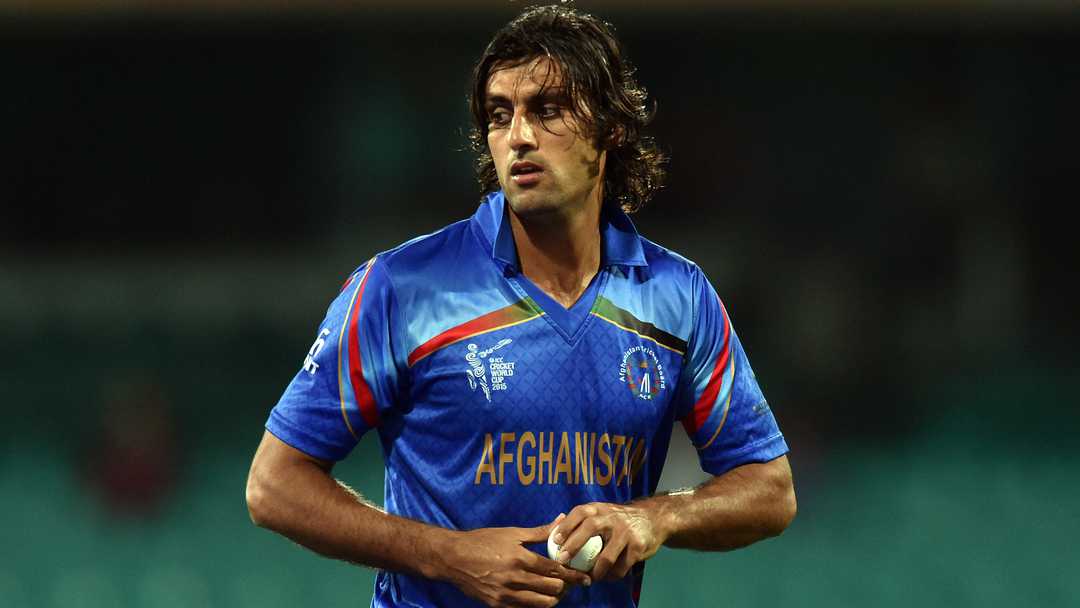
The life and times of Shapoor Zadran: A national hero gone far too soon
During his near six-month convalescence in Indian hospitals, Shapoor Zadran was confined to a zero-infection room and kept under sedation for much of the day. But he had one abiding condition for doctors: that they ensure he stayed awake between 7pm and 11pm, the daily evening IPL window.
Naturally, cricket meant everything to one of Afghanistan cricket's original heroes, who passed away this week, following a prolonged battle with cancer. On Thursday (July 9), he was buried with full state honours in Kabul.
Whenever Punjab Kings were in action, Zadran would almost unfailingly point out that the Shreyas Iyer-led side would be better off with Azmatullah Omarzai in the XI. "Why are Punjab Kings and Ricky Ponting not playing Azmat?" he would often lament. His friends vividly recall him saying, "He is so much better than Marcus Stoinis, you know." Even in the midst of his terminal illness, Zadran knew Omarzai was among the world's leading all-rounders, currently ranked No.6 in the ICC rankings.
When Omarzai himself visited him at a Noida hospital, Zadran did not forget to raise the matter. The 26-year-old apparently laughed it off. He also reassured his senior mate that once he had fully recovered, they would play together again.
Omarzai himself was coping with a personal tragedy, having lost his mother just a short while earlier. Yet, despite fighting for his own life, Zadran mourned Omarzai's loss.
"It was deeply moving. He was on the verge of death himself, yet he wasn't thinking about himself at all. He always thought of young Afghan cricketers. He never once believed he was going to die – not even 0.1 per cent. He always spoke about life, about returning to Kabul," recalls Amin Khatir, a close associate and a constant presence during Zadran's hospital days in Greater Noida and then Gurugram.
Cricketers and teammates were family to him. Raees Ahmadzai, Daulat Ahmadzai, Mohammad Nabi, Nawroz Mangal and Hamid Hassan were among the former teammates he would often want to speak to. The family would arrange video calls. Those conversations always lifted his spirits, but he would frequently end up asking the same question: when could he return to Kabul.
Rashid Khan, who was playing in the IPL at the time, visited him once in the hospital and even consulted the doctors about his condition. Zadran told him he did not miss a single Rashid game. Nabi flew in from Dubai, while AM Ghazanfar also paid him a visit. Most national players stayed in touch on WhatsApp, as they could not obtain Indian visas.
"Shapoor Zadran was a very decent man. But as a fast bowler, he always believed that one had to have aggression. And that's what he carried onto the field. He had a very long run-up and long hair. He used to say that once he stepped onto the ground, he was a different man," comments Ahmad Farhad, an Afghan cricket expert and commentator.
"He absolutely was a role model for the youngsters. Daulat Zadran, Hamid Hassan and Shapoor Zadran were the players everyone looked up to. Before the era of Rashid Khan, it was the era of these three fast bowlers."
The Wasim Akram of Afghanistan: A fighter to the core
Asghar Afghan, the former Afghanistan captain, was his closest friend. Other friends claim that whenever Asghar's name came up in conversations, Zadran's face would light up. During the last six months, Asghar would often be required to travel to Dubai and, after five or six days, Zadran would begin asking about him. On one occasion, Asghar dropped everything and returned to India.
"We go a long way back, from 2004 till 2021. We played together and stayed together in Kabul for almost 18 years. Our friendship was real," Asghar says. "He was a very funny person. Our seniors – Karim Sadiq and Nabi – used to tease him and he would tease them back. He would enliven the atmosphere. His conversations were always funny.
"He was a fighter. He would endure pain but never complain. For him, the country always came first. The physios would advise him not to play, but he would defy those instructions. I remember one occasion in Bangladesh. He was advised not to play because of his condition, but he still took the field and helped us win the game. That's the kind of fighter he was. The country always came first."
Zadran was a left-arm pacer, often referred to as the Wasim Akram of Afghanistan. He bowled with lively pace and represented Afghanistan in 44 ODIs and 36 T20Is in an international career that spanned 11 years, from 2009 to 2020. Together, Zadran and Asghar played 36 ODIs and 26 T20Is for Afghanistan.
Ironically, Zadran's most memorable cricketing moment came with the bat. In the 2015 World Cup against Scotland in Dunedin, New Zealand, batting at No. 11, he shared a vital unbeaten 21-run last-wicket stand with Hamid Hassan and struck the winning boundary in the final over to seal Afghanistan's first-ever World Cup victory. He had also claimed four wickets in the Scotland innings. Zadran was also the first Afghanistan player to feature in an overseas league, in Bangladesh. It was a massive moment for a country still taking baby steps in world cricket.
Zadran was hospitalised in February. He flew from Kabul to India with his wife. Asghar, who was already in India, received them in Delhi and took him directly to Yatharth Super Speciality Hospital in Greater Noida. During the final month of his treatment, he was admitted to Fortis Hospital in Gurugram. Diagnosed with Hemophagocytic Lymphohistiocytosis (HLH), his health deteriorated further after he contracted dengue. Cancer had completely destroyed his immune system.
In the last six months, his white blood cell count was often around 1,000-2,000, whereas a normal count is generally between 4,000 and 11,000. His platelet count would sometimes drop to as low as 10,000-20,000, while a healthy person's platelet count is usually between 150,000 and 450,000. His immune system had virtually collapsed.
"The doctors would often wonder how he was still surviving. Yet he never slipped into a coma. He hid his pain and fought for his life. In fact, he had even started training again in India," Asghar remembers.
The treatment overseas naturally required substantial financial backing and, fortunately for Zadran, funding never became a constraint. An Afghan billionaire, Mirwais Azizi, who lives in the UAE, flew to Delhi from Dubai after learning about Zadran's condition. He agreed to bear the entire cost of the treatment.
He told the hospital management: "Whatever the expenses on Shapoor Zadran's treatment, I will pay." He left his contact details with the hospital management and said he would transfer the money directly from Dubai.
"That was a major relief," both Asghar and Khatir said. They do not know what the final hospital bill came to, but Azizi's support was a godsend. The doctors had made it clear that the illness was extremely serious. The cancer was in its final stage, but Zadran received every possible treatment available – "the kind of care he would have received in New York or London."
Blood was required frequently, and appeals would often be made on Instagram and Facebook. The family remains surprised by the response. There are not many Afghans in the area, but the response from the Indians was immediate and overwhelming.
People would come to the hospital and simply say they wanted to donate A+ blood for the cricketer. It would instantly be understood that they had come for Zadran. "We were told some of the donors were Indian soldiers. It was truly heartening to see so many Indians come forward to help Shapoor," Khatir remembers.
Zadran (38) is survived by his wife, young son Mohammad Zadran, parents, three brothers and five sisters. His wife remained by his side throughout his hospitalisation in India. One of the brothers, Ghamai Zadran, who lives in Canada, flew to India and stayed with him for the entire six months. He was the eldest among the nine siblings.
His son, Mohammad, is a right-arm fast bowler in the making. Those tracking the 16-year-old's progress say that he is already capable of bowling close to 130 kmph. "Inshallah, he can play for Afghanistan," says Khatir. "If he works as hard as his father did, why not?"
Zadran himself would never give up the fight. He was a born fighter. He would take his son to different cricket academies in Kabul, including the one run by Nabi in the Afghan capital.
Even in the hospital, he would get restless and would often tell his friend: "Yaar Khatir, I want to go back to Kabul." His family and companions would conceal the seriousness of his condition, telling him that everything was fine and that his test results were normal. He would then counter by asking why he was not being taken home. "Just a few more days," they would have to lie to him again.
Zadran would often remember Kabul. He would talk about his mother back home. His son was delayed in joining him in India because of visa issues, which were resolved after the Afghanistan Cricket Board intervened. His son's arrival seemed to calm him and he remained unusually quiet for a few days, but not for long.
The doctors had warned the family that he could appear normal for days, but the cancer could suddenly strike at any time. He was on ventilator during the final week of his life. At the time of his death, his wife, son Mohammad Zadran, brother Ghamai Zadran, nephew Abu Bakar and close friend Aftab Alam were by his side.
A send-off worthy of a hero
Zadran passed away on Tuesday (July 7) and his body was flown to Kabul the next day. According to friends, eyewitness accounts and social media posts, the cricket community, including Rashid, Nabi, Asghan and many other members of the national team, were at Kabul International Airport when Zadran's body arrived at around 4 pm. Senior government officials were also present. There was hardly a dry eye.
The body was taken to his home in Kabul, about 10 kilometres from the airport, with thousands lining up on the roadside to pay their respects. As per tradition, verses from the Holy Quran were recited and prayers were offered. His body remained at his home throughout the night.
Khatir says that Zadran's mother, who had initially been unaware of his passing, was inconsolable when she learnt the news. Many of Kabul's prominent personalities came to pay their respects. The Shpageeza Cricket League, currently underway in the Khost province, was postponed by two days as a mark of respect.
The funeral was held at 10 am on Thursday. The Afghanistan Board organised a large condolence gathering attended by government officials, cricketers, and fans from different parts of the country. Government officials also paid tributes. Zadran's father was among those who spoke. He appealed to the Afghanistan Board to rename the Kabul cricket ground after his son. "He was a hero," the distraught father said. "This is my request."
It is said that about one lakh people turned up for his funeral. Zadran was laid to rest near Maranjan Hill, an elevated site in Kabul where former Afghan kings, including Nadir Shah and Zahir Shah, were buried. That the government of Afghanistan chose such a hallowed place was a testament to the stature Zadran enjoyed in the country. As Khatir would remember, Zadran always longed to return to Kabul and his wish has finally – and inevitably – been fulfilled.
Related Posts
 Ghana vs Sierra Leone: 4th Match Prediction & Preview | Quadrangular T20I Series in Nigeria
India A Women vs Australia A Women, 3rd unofficial ODI, Australia A Women tour of India 2026
Afghanistan vs Nepal, 4th Match, Group A, Asian Games 2026
Ghana vs Sierra Leone: 4th Match Prediction & Preview | Quadrangular T20I Series in Nigeria
India A Women vs Australia A Women, 3rd unofficial ODI, Australia A Women tour of India 2026
Afghanistan vs Nepal, 4th Match, Group A, Asian Games 2026