


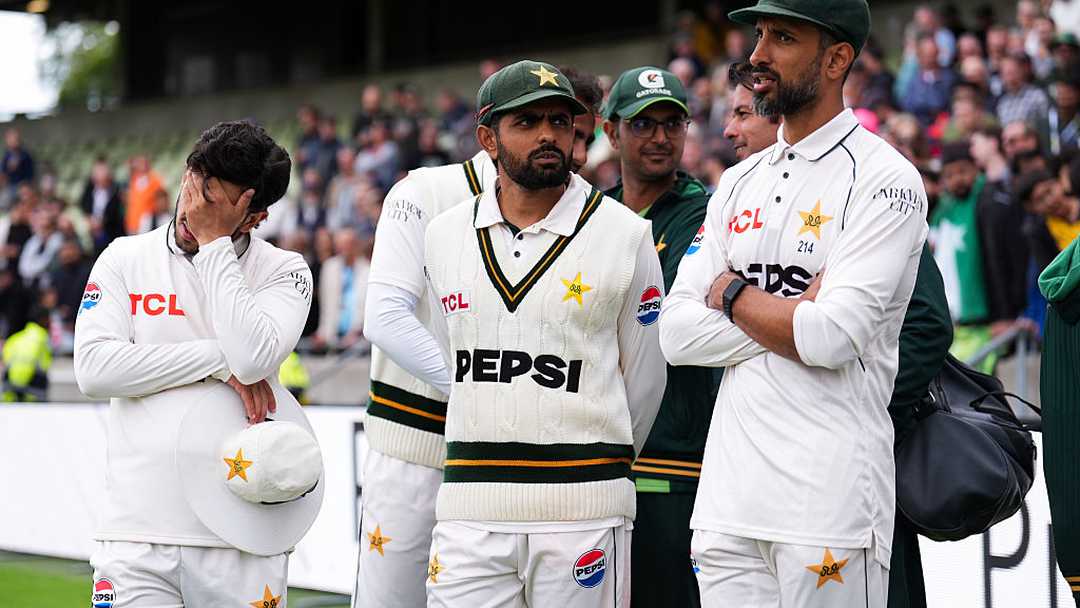
Pakistan’s Test Cricket Crisis: When Winning Became the Exception
Pakistan’s current crisis extends beyond a single bad series; it represents a systemic failure in Test cricket. The latest episode saw Pakistan lose all three Tests on their 2026 England tour by margins of an innings and 103 runs, 194 runs, and eight wickets. This 3-0 sweep marks England’s second whitewash of Pakistan (following 2022/23) and Pakistan’s 11th series loss by a 0-3 margin. It is their sixth whitewash in 12 multi-Test series over the last four years and their ninth 0-3 loss in a three-Test series in the 21st century—the most by any team, ahead of Sri Lanka (five).
Following the defeat at Lord’s, the Pakistan Cricket Board (PCB) sacked head coach Sarfaraz Ahmed, reshuffled the coaching staff, and sent seven players home. These moves have intensified scrutiny, with former Test coach Jason Gillespie criticizing the board’s frequent U-turns. The data highlights a team capable of individual brilliance but unable to convert it into sustained success, particularly in Tests and major tournaments.
Constant Chopping and Changing
Selection inconsistency has plagued Pakistan since the start of the second WTC cycle in August 2021. In 37 Tests during this period, Pakistan fielded an unchanged XI only three times: against Bangladesh in Dhaka (2021), Sri Lanka in Colombo (2023), and England in Rawalpindi (2024). They won all three of those matches and sealed the series.
The constant rotation has resulted in 43 players being used in 37 Tests since the start of the WTC 2021-23 cycle. After the initial 11 players, 32 more were introduced across the next 36 matches, equating to 0.89 new players per Test. Among WTC teams, only South Africa has a higher turnover, largely due to fielding a second-string side in New Zealand in 2023-24 for the SA20 league.
Players used by each team in Tests since the start of 2nd WTC cycle:
| Team | Tests | Players | Players per Test |
|---|---|---|---|
| England | 64 | 49 | 0.60 |
| South Africa | 34 | 47 | 1.09 |
| Pakistan | 37 | 43 | 0.89 |
| India | 50 | 42 | 0.63 |
| West Indies | 40 | 40 | 0.74 |
| Sri Lanka | 34 | 37 | 0.79 |
| Bangladesh | 37 | 34 | 0.64 |
| New Zealand | 38 | 33 | 0.60 |
| Australia | 50 | 29 | 0.37 |
Since August 2021, no specialist bowler has played more than 18 of Pakistan’s 37 Tests, with Noman Ali leading the way. Among pacers, Shaheen Afridi played just 17 Tests. Among batters, no player has featured in all 37 matches; Babar Azam played 33, Rizwan 32, and Salman Agha 28. Pakistan have fielded 23 debutants in Tests since the start of the second WTC, second only to South Africa (26) and England (24). Thirteen of these debutants were specialist bowlers. This lack of continuity has denied the side the stability needed to build consistency.
Pakistan’s Coaching Carousel
Instability extends to coaching and captaincy. Shan Masood’s 3-12 record was followed by Babar Azam’s reinstatement. Pakistan have made 11 coaching changes across formats in five years, including seven different Test coaches in the last three years since May 2023.
Pakistan Test coaches from May 2023 onward:
| Test Coach | Period | Role |
|---|---|---|
| Grant Bradburn | May 2023 – November 2023 | Permanent |
| Mohammad Hafeez | November 2023 – April 2024 | Permanent |
| Jason Gillespie | April 2024 – December 2024 | Permanent |
| Aaqib Javed | December 2024 – May 2025 | Interim |
| Azhar Mahmood | June 2025 – December 2025 | Permanent |
| Sarfaraz Ahmed | April 2026 – August 2026 | Permanent |
| Mike Hesson | September 2026 – Present | Interim |
Coaching uncertainty began in September 2021 when Misbah-ul-Haq and Waqar Younis resigned, followed quickly by Saqlain Mushtaq, Grant Bradburn, Mickey Arthur, and Mohammad Hafeez. In 2024, the PCB split roles, appointing Jason Gillespie for Tests and Gary Kirsten for white-ball cricket, but both departed within months. Aqib Javed took interim charge before Mike Hesson became permanent white-ball coach in May 2025.
Former captain Sarfaraz Ahmed was appointed red-ball head coach ahead of the 2026 Bangladesh Tests. His stint lasted only a few months, ending after defeats at Leeds and Lord’s against England. The PCB sacked Sarfaraz and bowling coach Umar Gul, sent seven players home, and handed Test duties to white-ball coach Mike Hesson. Such instability is detrimental to Test cricket, where coaches need time to build systems. The constant changes suggest a reactive approach rather than long-term planning.
Declining Performance Metrics
Pakistan’s red-ball cricket is flashing serious warning signs. They finished seventh in the 2021-23 WTC cycle with a 38.1% points percentage (four wins in 14 Tests) and ninth in 2023-25 at 27.98% (five wins in 14 Tests). They now sit bottom in the ongoing cycle with just two wins in nine Tests and a 14.81% points percentage.
Pakistan has the second-worst win-loss ratio (0.5) in Tests among WTC teams since the start of the second WTC cycle (2021-23), with only the West Indies (0.4) faring worse. Their overall Test win-loss ratio (0.987) has dipped below 1.0 for the first time since 1987, with 153 wins against 155 losses in 474 matches.
Win-loss ratio for WTC teams since August 2021:
| Team | Mat | Won | Lost | Draw | W/L Ratio |
|---|---|---|---|---|---|
| Australia | 50 | 33 | 10 | 7 | 3.3 |
| South Africa | 34 | 22 | 10 | 2 | 2.2 |
| India | 50 | 25 | 18 | 7 | 1.388 |
| New Zealand | 38 | 19 | 15 | 4 | 1.266 |
| England | 64 | 31 | 27 | 6 | 1.148 |
| Sri Lanka | 34 | 14 | 16 | 4 | 0.875 |
| Bangladesh | 37 | 13 | 22 | 2 | 0.59 |
| Pakistan | 37 | 11 | 22 | 4 | 0.5 |
| West Indies | 40 | 10 | 23 | 7 | 0.434 |
The home Test comparison highlights the decline. South Africa, Australia, and England dominate home records with W/L ratios of 5.5, 5.0, and 2.2, respectively. India is strong at 2.0 (14 wins, 7 losses). New Zealand and Sri Lanka have 10 wins each (W/L: 1.43). Pakistan have managed just four wins and nine defeats in 17 home Tests, giving them a poor 0.444 win-loss ratio—the worst among WTC teams and only better than Zimbabwe (0.285). Their tally is below Bangladesh (0.727) and the West Indies (0.875).
Their away record offers little respite. Since August 2021, Pakistan have won just seven and lost 13 of 20 away Tests—the third-most defeats among WTC teams, behind England (17) and the West Indies (15). Their 0.538 win-loss ratio ranks fifth, well behind Australia (2.4), South Africa (1.25), New Zealand (1.125), and India (1.1).
**Home and Away win-loss ratio since WTC
Related Posts
 Attack first, attack hard – Abhishek Sharma resumes normal service
 Shafali and Mandhana power India to another Asia Cup title
 Abhishek powers India to breezy win after Omarzai’s valiant recovery act