


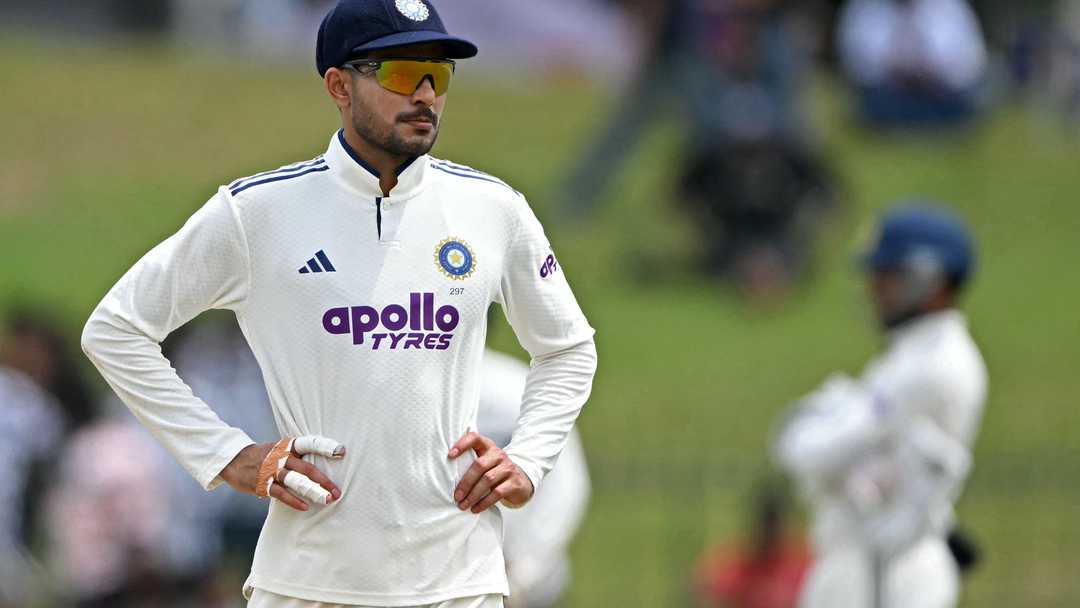
When LBW and bowled are not in play, it becomes easier to bat – Gill
India's troubles in the Colombo Test, where they spent 243.4 overs in the field, had become cyclical, with one leading to and compounding the next. Sonal Dinusha proved to be a thorn in their flesh, as Sairaj Bahutule had described him at the end of Day 4, but the conditions at the Sinhalese Sports Club also played villain for Shubman Gill's side.
The data should tell you the spinners should've been delighted at the SSC: the average degree of turn just kept getting bigger as the Test progressed and balls turned sharp consistently. And India came armed with three spinners. But turn alone wasn't enough.
"We felt that on Day 3, 4 and 5, the mode of dismissals – LBW and bowled – were completely out of the game, because the ball that was turning, was turning very slow and with bounce," Gill said after the drawn fixture. "So only one mode of dismissal was left if the batters were defending, which is catch at silly point, short leg or slip."
"As the day went, the wicket got even slower. It was not that the ball was not spinning. But on the ball that was spinning, the wickets were not in play at all. So as a batter, if you know that LBW and bowled – two modes of dismissals are not in play for the bowlers, then it becomes a little easier to bat," he added.
But India were on the field chasing shadows for that long because of their own doing. When, on Day 4, Saransh Jain picked up the first two wickets of his Test career, Sri Lanka had folded 14 runs short of avoiding the follow-on. India looked at the potential overheads and went for the jugular. After being in the field 89.4 overs, they decided to extend their stay. But Gill owned his decision and refuted the claim that it backfired.
"I think we fielded for about 250 overs [243.4]. They bowled around 130 overs [138]. There are 450 overs in a match, so the 70 overs [68.2] that were lost in the middle were because of the rain. And we were also thinking whether Day 4 and Day 5 would even be possible.
"We wanted to take that chance. Whether we bat 1-1.5 sessions on Day 4, make 200 runs and give them a target of around 400 or give them a follow-on, and then whatever their lead goes to – 100 or more – we chase that quickly. We had these two options. Everyone expected it to rain, so you can think about this decision in hindsight. But you have to take the best decision possible in whatever situation you are. So I don't think it backfired."
"And like I said, we felt that when you play in India or any turning track where there is a lot of spin, usually all three modes of dismissal are in the game – caught behind, LBW, bowled. There are a lot of LBW and bowled. But we felt that wasn't there in the game at all, so we had to change our plans. So I don't think it backfired. The decision that we felt was best at that time, we took that," he explained.
It was just the sixth time India conceded a 200-plus lead after asking the opposition to follow on.
In dealing with the dismissal disadvantage, India had to change their plans on the fly as Sonal Dinusha settled in for the long haul again. India attacked the morning session with multiple fielders around the bat to force breakthroughs, but as Dinusha and Keshara Nuwantha built their stand, Gill had to back off a little. Technically, Sri Lanka began the day on 16/6, but they got comfortable very quickly. The pair added 100 runs in the session, forcing India to recalibrate. Balancing the need to bowl Sri Lanka out with the need to prevent quick runs, especially with the threat of rain looming, became nearly impossible. Gill eventually had to move his field out to deny the batters easy release shots, and in the process, eased off the attack.
After dismissing Nuwantha in the first over after Lunch, India had one clear strategy: get the tailender on strike and dismiss him. There were only two left. But India ran into trouble here too. First, Dinusha did his best to shield his tailender partner; second, when the strike did turn over, the tailenders didn't look to attack. Prabath Jayasuriya batted out 28 balls for his two, while Lahiru Kumara dug in for 90 deliveries and made 12. India's spinners got the ball to turn sharply away, but they just couldn't find the edge. The other dismissals, as Gill spelled out clearly, were out of play.
"We saw that he [Dinusha] scored a lot of runs square of the wicket with sweeps and reverse sweeps. And we had to put a fielder there. And every time when they batted, it was a very similar situation. When a tailender or a lower-order batter is batting with him… we were looking to rotate him [Dinusha] and try to get the other batter out. And when the other batter wasn't trying to hit at all, we had to change plans.
"And he [Dinusha] played really well, his defense was solid, he played some really good sweep shots. And in this match, I don't think there was even a half-chance that he went to a fielder," Gill said. Dinusha scored 173 runs from sweep shots without getting dismissed in the two-Test series – no batter has scored more in a single Test series since 2007. India's only other avenue to prise out the diminutive batter was through the short ball, but there too India had a problem.
"We thought we can get him with pace but there wasn't enough of it on the wicket. Someone like Prasidh was consistently bowling 135-140kmph and bowling bouncers but he was able to defend. So we could see there wasn't enough pace in the wicket to challenge him again and again," Gill explained.
In the end, Dinusha batted out 264 balls in the second innings to lead Sri Lanka's charge towards a hard-fought draw. Gill admitted it was disappointing not to win after amassing a big first-innings total, but also gave Sri Lanka and Dinusha their flowers.
"I wouldn't say it stung like a loss. But obviously if you score 500 runs in the first innings… after that when Day 2 ended, we had them at 8/2. Then we only had to take 18 wickets in three days. In any other situation, you will feel that you will win such a match. So from the situation we were in, the way they got a draw is credit to them. It's obviously disappointing because we hoped for a win, but we have to also give them credit where it is due," Gill said.
"Apart from today, if we look at the last 8-9 days of cricket, I think we were on top everyday. And when you're playing Test cricket at someone else's home, it's not that easy. They're also here to play, it's their home conditions, a lot of people take that for granted," he felt.
As for India's World Test Championship final chances, the result does complicate matters. They next play two Tests in New Zealand in October, followed by a five-Test home Border-Gavaskar Trophy against Australia early next year. It will take a lot for them to climb from fifth position, with a current PCT of 51.52%, into the top two, but Gill remains optimistic.
"I still think we've got a pretty good chance to qualify for the WTC. If we play the New Zealand series well. And then hopefully, by the time Australia series come, we just have to win the series [to reach the final]. If we're in a situation where we just have to win the series I think we'll be in a good position to qualify," Gill said.
Related Posts
 Sonal Dinusha: The making of a methodical Sri Lankan gem
 Abbas, Ali help Pakistan take honours on opening day