


Delhi Capitals and a very manoeuvrable bowling attack
"I think I went a bit overboard with tactics for the 19th over."
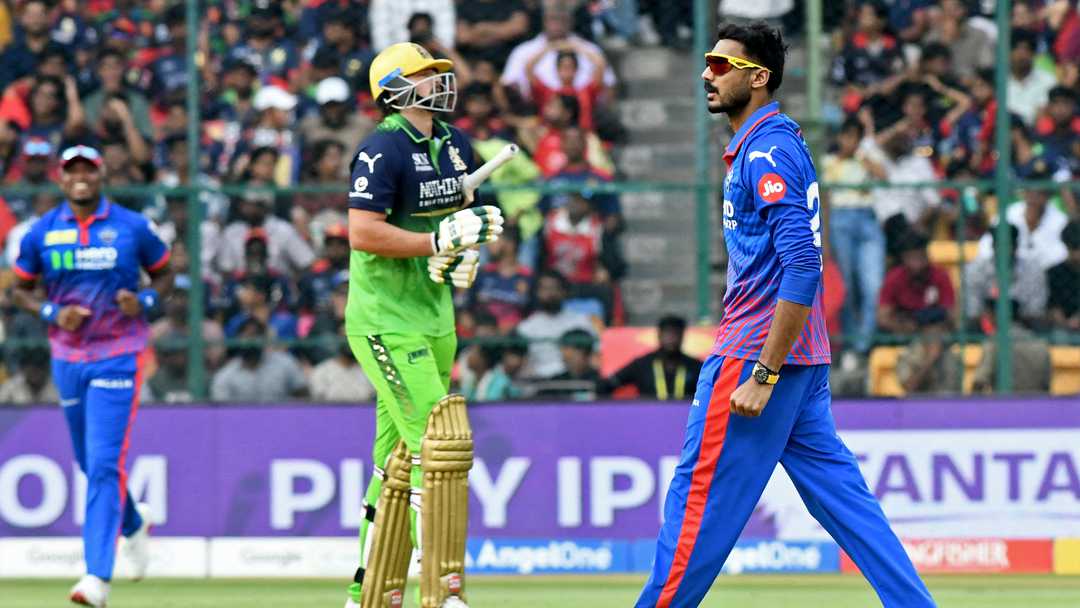
Axar Patel said that after last season's win in Bengaluru, retrospectively analyzing his decision to bowl the 19th over that had cost him 17 runs. A year on at the same Chinnaswamy Stadium, the Delhi Capitals skipper bowled the 16th over himself, handed his spin partner Kuldeep Yadav the 17th, and again tactically outmaneuvered RCB for the second season running.
It was the same venue, same opponent, same result, and yet Delhi's methods were very different. That, more than anything, is the point. Winning the toss helped. A wicket with grip and hold, less typical of this ground, helped too. But strip those circumstances away and what remains is something more durable: the room Axar has to outthink opponents with the ball, and a bowling attack built precisely to give him that room.
Last year, Axar threw three overs of spin at RCB in the Powerplay, brilliantly pulling the brakes on Phil Salt and Virat Kohli's flying start. The theory was clean: RCB's right-dominated line-up, a surface with hold, away spin. This year, there wasn't a single ball of spin in the first six overs. On another day, that invites scrutiny. Today, it doesn't. Because the point isn't which option Axar chose, it's that he had many to choose from.
The best way to understand that Capitals attack is to start with the player who isn't here yet. Mitchell Starc's absence has cleared the path for the excellent Lungi Ngidi – a multiphase bowler who can dismiss Virat Kohli with his first ball in the Powerplay, hit hard lengths through the middle, and produce an assortment of dipping slower balls and heavy balls at the death. T. Natarajan threads through the middle and hones in on toes at the death. Kuldeep, the wrist spinner, can be deployed through the middle. Axar, the left-arm finger spinner, works in the Powerplay and beyond. All of which frees up Mukesh Kumar and Auqib Nabi to exploit whatever swing is available up front.
The same fixture, a year apart, makes for a revealing comparison. Where he bowled the second over last year, Axar held himself back until the ninth this time. DC's Director of Cricket Venugopal Rao offered the explanation afterwards that the left-handed Devdutt Padikkal and a recent dip in form caused the hesitation.
Almost instantly, Axar found drift away from Padikkal, who charged out and was beaten in the flight, only saved by a faint edge that evaded the keeper. Two balls later, Axar dragged the length back and had his man anyway. Padikkal couldn't generate pace off a surface that wasn't offering any and holed out.
In a season that has been largely narrated through batting feats – big totals, big sixes – Delhi's bowling is a quietly emphatic counter-argument.
Ideally, the DC captain could have rolled through four straight overs from there. However, walking in was Rajat Patidar, batting in the kind of touch few have found in this early part of the season. In a pre-season conversation, Patidar had spoken about his love of facing pace – his strike-rate against the quicks was actually better than against spin coming into this game. But almost as a matter of principle, he destroys spin. Axar simply wasn't going to give him any, even at the risk of pushing those spin overs dangerously close to the death.
And so, Patidar didn't face a ball of spin. Instead, Ngidi and Mukesh Kumar came back for spells, now bowling into the pitch or wide outside off, forcing the hitters to reach. One such wide delivery from Mukesh missed Patidar's broad bat face as he swung, and found only the edge on its way to the keeper. At 131 for 4 after 13 overs, RCB were still in touching distance of 200, but the lower order now faced a very different kind of examination.
Axar returned for the 14th over and gave away just seven. Which meant when Axar came back for his third – the 16th over – Tim David actually refused a single, preferring to stay on strike as he had a better read of the pitch. Axar's answer was to slow the next ball up and bowl wide of David's immense reach. David swung anyway, sliced it to short man, and walked off.
Suddenly Romario Shepherd was facing Kuldeep Yadav in the 17th over – a finisher who keeps depositing pace-on deliveries onto the Chinnaswamy Stadium roof now having to contend with a left-arm wrist spinner, bowling with fine leg up, asking him to do something altogether different. Where he'd normally clear his front foot and swing hard through the line against the quicks, Shepherd turned to a sweep shot for a boundary. A full ball trapped him, and RCB were six down for 151, running out of batters equipped to push the score past par levels.
The close was routine – Ngidi and Natarajan, with their variations and yorkers against RCB batters without the tools to negotiate them. RCB managed just 29 in the final five overs.
T20 tactics are sometimes happenstance. Cause and effect. If Patidar doesn't nick one there, he gets to face spin soon enough. If David doesn't fall at that time, he takes on pace and adds 20 extra runs in the death. But what makes this Delhi attack genuinely special is its elasticity. Axar and Natarajan combined for only five overs and 2 for 34 between them. On another night, Axar opens the bowling and Natarajan bowls three at the death.
That is exactly what RCB didn't have, for all the quality of their attack. When their best bowlers had to be front-loaded because the target was small, they were left with Shepherd bowling the 20th. The death is not Shepherd's most potent phase.
In a season that has been largely narrated through batting feats, Delhi's bowling is a quietly emphatic counter-argument. It is both effective and maneuverable. And in the hands of a captain who laughs at his own tactical overreach one year and corrects it the next, that might just be the most exciting thing to keep track of in this tournament.
Related Posts
 Washout eliminates Japan; Nepal, Afghanistan qualify from Group A
 Rizwan’s curious case: Midnight summons, confiscated phone, and a probe shrouded in questions
 Inside South Africa’s fast bowling hamdemic