


Lack of Head-starts raises deeper questions for SRH
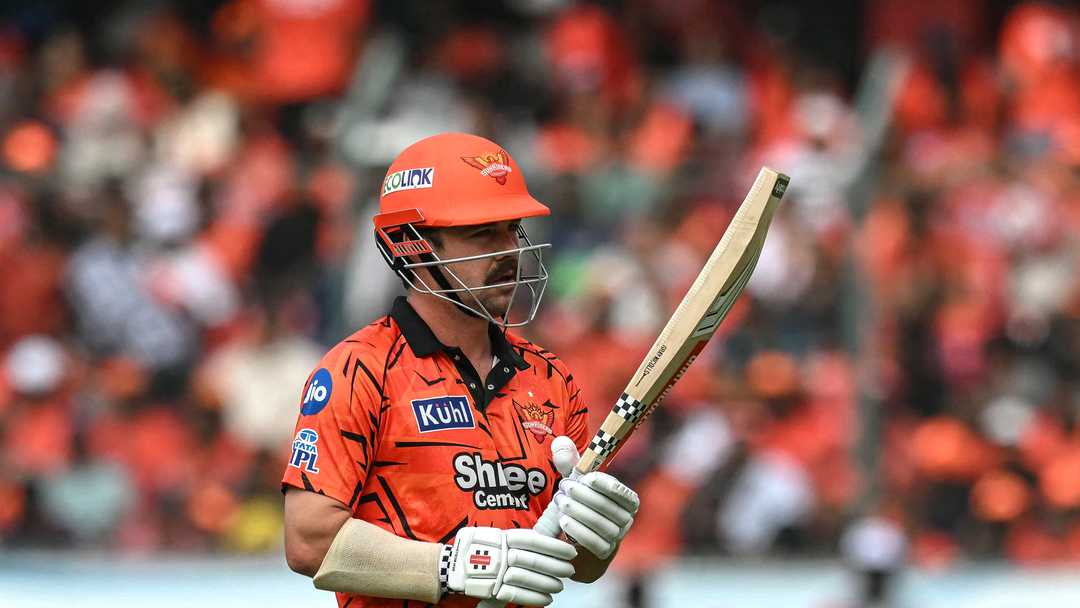
Travis Head was on strike, the batters' happy hours were still on, and he had the license to get greedy for more. With 75 runs on the board, both openers still in the middle, and two balls remaining to wrap up the Powerplay, it was the kind of start Sunrisers Hyderabad like to manufacture.
This compulsive need for quick control makes opposition teams twitchy. Stephen Fleming admitted as much on the eve of the game. In response, CSK included Matthew Short, hoping his part-time offspin would check SRH's left-handed trio.
The match-up tactic seemed to work initially—only 12 runs came off Short's first two overs. That reading would have been better had he not bowled one into Abhishek Sharma's slot, who tonked it over long on for six.
Largely, the plan was working for CSK. So, at the start of the fifth over, they gave the offie another go. Head pulled one through mid wicket for a single. Needing a surge from a 9.5 run-rate, Abhishek upped the risk. He made room and repeatedly hit against the turn, securing 24 runs off the next five balls, each crossing the boundary. The assault threw CSK off their plans and Short out of the attack.
Within 15 balls, Abhishek had another half-century, SRH had a powerful start, and CSK looked listless. With two balls left in the Powerplay, Head had license to maximize. In a bid to hit Mukesh Choudhary over the infield, he mistimed a full-toss. Ruturaj Gaikwad provided a moment of magic—a fine, low diving catch running from mid on—to end the partnership and seize back momentum.
During Abhishek's carnage, Head's rustiness became a side note. Against Short, he managed only four runs off eight balls. His innings ended on 23 off 20, even as boundaries rained for SRH.
It was still one of his meatier knocks over the last year and a half—only the 15th time in 32 innings he has crossed 20 runs in T20s since the start of 2025.
There has been a marked drop in Head's returns since 2024, the season his early attack with Abhishek set new T20 benchmarks. Since then, his numbers have dropped across all parameters. From 2024 to now, his boundary percentage fell from 31.43 to 26.73, his dot-ball percentage rose from 37.3 to 44.3, and his strike rate reduced from 182.07 to 150.26.
These figures alone aren't alarming. But coupled with a falling average—slipped from 41.20 to 23.41—bigger concerns for SRH emerge. In 2024, Head had 14 fifty-plus scores in T20s. This year, he has passed that mark only once.
But that's not SRH's only concern. It's the start of many worries. A team that banks on batting muscle to win, they are averaging only 202 per game this season. Concerns run deeper into inconsistencies, led by the top order's inability to fire in unison.
Head's lack of contribution and dropping scoring rates have passed the burden to the rest. Coincidentally, in sustaining early attack, SRH often see Head's dismissal followed or preceded by another quick wicket. This pattern—seen in five of six games this season—repeated against CSK when Ishan Kishan holed out right after Head fell.
These quick strikes seize momentum from a strong start and force SRH to steady—something they can ill-afford—or risk going bust, as they did repeatedly last season.
This successive fall of wickets is why Heinrich Klaasen, SRH's No. 4, has measured his gameplans. Klaasen has been among the slowest starters this IPL, striking at 106.66 in his first 10 deliveries—a period where opponents seize momentum.
Explaining his slow starts, Klaasen said, "I've been in situations where we lost four wickets in one or two overs. I can't just tee off. If we lose a wicket there, five are down. It's not on purpose. I still need to get the job done. On a slow wicket here, we were three down after the powerplay. That's why my strike rate is low."
Exaggeration aside, Klaasen holds the Orange Cap but at a strike rate of 144—the slowest among batters with at least 170 runs. Among the top 35 scorers this season, only Tristan Stubbs has been slower.
Klaasen defended his approach: "I've been in difficult situations and have to take responsibility. You can't just tee off. We get paid to do that job. I don't care about strike rates. I've been putting my team in good positions and doing my job."
As CSK fought with the ball and chipped away with wickets—forcing SRH to use Liam Livingstone as Impact Substitute instead of bolstering bowling—Klaasen's 39-ball 59 was instrumental in SRH posting 194 for 9, their highest ever against CSK.
But that might have counted for little if Ayush Mhatre's innings hadn't been impacted by cramps. Against CSK, SRH just found a way through with a 10-run win, courtesy of disciplined bowling and reverse swing late on. But they seem still searching for a version of themselves that holds shape across 20 overs, not just in bursts. Until their most feared weapons fully bare teeth, their strong starts will carry vulnerability and a question mark over where they might end—and perhaps, over time, lose the audacity to threaten oppositions.
Related Posts
 Washout eliminates Japan; Nepal, Afghanistan qualify from Group A
 Rizwan’s curious case: Midnight summons, confiscated phone, and a probe shrouded in questions
 Inside South Africa’s fast bowling hamdemic